


Four more SC judges will not clear case backlog: RS member to govt
TMC MP and senior SC advocate Menaka Guruswamy reminds govt that real issue is govt’s refusal to appoint judges who do not 'toe its line'
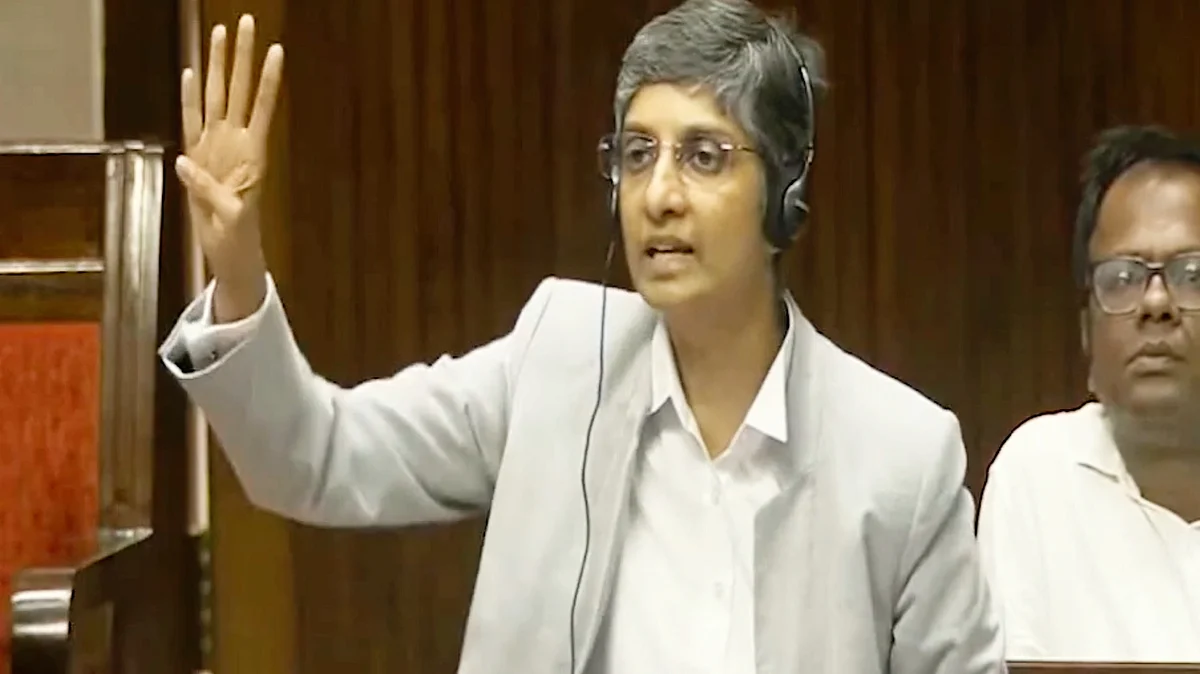


Speaking on the Supreme Court (Number of Judges) Amendment Bill, 2026, which increases the sanctioned strength of the Supreme Court from 33 to 37 judges (excluding the Chief Justice of India), Trinamool Congress (TMC) Rajya Sabha member Menaka Guruswamy on Wednesday, 5 August reminded the government that the stated objective of reducing the backlog of cases would not be achieved merely by adding four more judges.
The TMC MP was speaking on the Bill, which had been passed by the Lok Sabha earlier without any discussion. Guruswamy pointed out that nearly 30 per cent of judges' posts in the high courts continue to remain vacant.
The real issue, she argued, is the government's reluctance to appoint judges who may not toe its line or subscribe to its ideology. Accusing the government of failing to appoint judges from religious minorities, the Scheduled Castes, the Scheduled Tribes and women, she said the judiciary suffers from a fundamental lack of diversity. Arguing that it is not representative of Indian society, she cited statistics to claim that fewer than 20 per cent of judges are women or belong to the Scheduled Castes or Tribes.
If that is the case, how would four additional Supreme Court judges help clear the backlog?
The government promulgated an ordinance in May, days after the Budget session of Parliament ended, to facilitate the appointment of four additional Supreme Court judges. The collegium recommended names in the last week of May, and five appointments were made on 1 June.
The appointees were Justice Sheel Nagu, Chief Justice of the Punjab and Haryana High Court (parent high court: Madhya Pradesh); Justice Shree Chandrashekhar, Chief Justice of Bombay High Court (parent high court: Jharkhand); Justice Sanjeev Sachdeva, Chief Justice of Madhya Pradesh High Court (parent high court: Delhi); Justice Arun Palli, Chief Justice of Jammu and Kashmir and Ladakh High Court (parent high court: Punjab and Haryana); and senior advocate V. Mohana, who was elevated directly from the Bar.
Why, then, was it necessary to promulgate an ordinance to enable these appointments — an ordinance that the present Bill now seeks to replace?
In the words of Guruswamy herself: "The date of appointment of a judge of the Supreme Court determines seniority and, eventually, who becomes the Chief Justice of India and for how long. The government could have introduced the Bill during the Budget session, but instead waited for the session to end before promulgating the ordinance. Were they deliberately waiting for the session to end? Or are we to believe that the government was so poor at planning that it could not introduce such a Bill during the Budget session? Or had the pendency of cases become so alarming that it could not wait until the Monsoon session in July?"
She also questioned why Parliament was bypassed. Was the move intended to ensure that particular judges were appointed to the Supreme Court in time to hear certain pending cases?
She further raised questions about the increase in the court's sanctioned strength itself. How did the government arrive at the figure of four additional judges? Why 37 and not 36, 38 or 39? What was the rationale, and what criteria were used to arrive at that number?
The Supreme Court began functioning in 1950 with eight judges, including the Chief Justice of India. Parliament has periodically increased its strength in line with rising litigation. The sanctioned strength was raised to 11 in 1956, 14 in 1960, 18 in 1978, 26 in 1986, 31 in 2009, 34 in 2019, and now 38, including the Chief Justice of India, following the 2026 amendment.
The backlog of cases across all courts in India has crossed 5.5 crore, with the overwhelming majority pending in subordinate courts. The India Justice Report 2025 noted that India has just 15.9 judges per million people, far below the Law Commission's 1987 recommendation of 50 judges per million. It also found that in 22 of the 25 states surveyed, cases pending for more than three years accounted for at least 25 per cent of all pending cases in subordinate courts.
If reducing pendency is the objective, strengthening the high courts and filling vacancies across the judiciary would appear to be the more pressing priorities. Why, then, is the government so focused on adding four more judges to the Supreme Court?
Join our official telegram channel (@nationalherald) and stay updated with the latest headlines