


From wall wars to web wars: Bengal’s campaign playbook gets a makeover
Bengal’s wall writing tradition dates back to the early years after 1952 general election, when campaign resources were limited
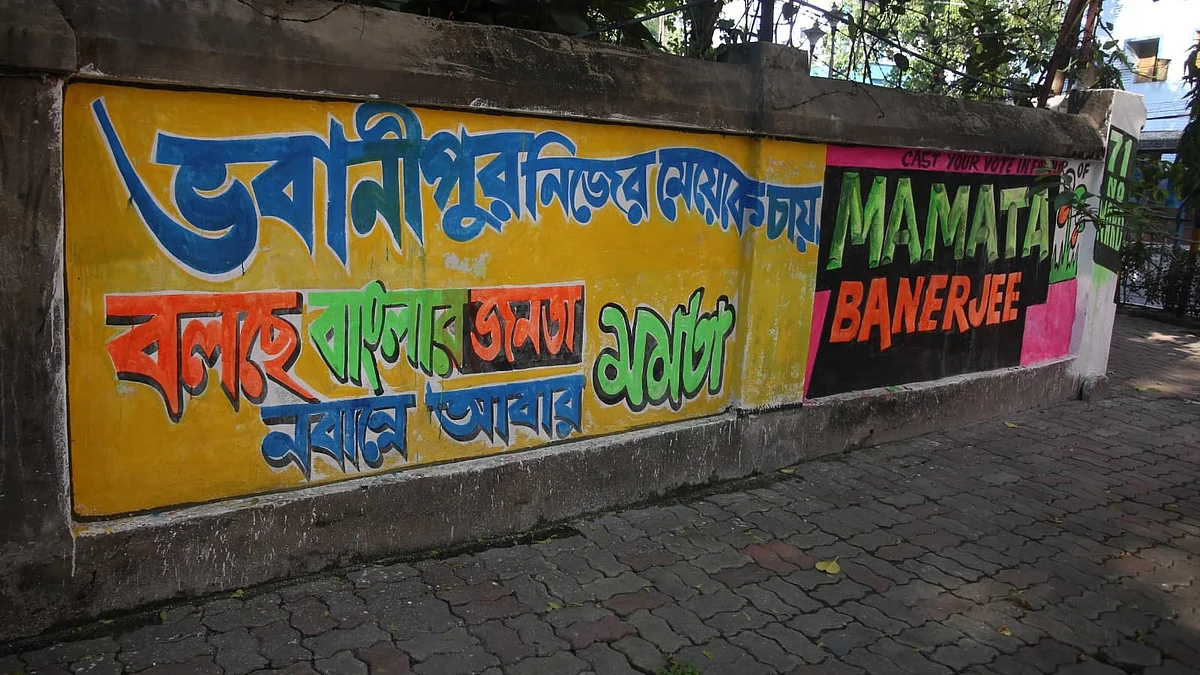


In West Bengal, election campaigning has never been limited to speeches and rallies. For decades, the walls of towns and villages have served as canvases for political messaging — bearing slogans, rhymes, cartoons and sharp one-liners. Today, however, this familiar culture is undergoing a visible shift. Wall writing is increasingly competing with flex banners, hoardings and social media campaigns, even as it continues to hold strong emotional value for many.
That transition is evident as the 2026 Assembly elections approach. From Katwa to Madhyamgram, and from Chandrakona to rural pockets across districts, political activity is intensifying. Soon after candidates were announced, grassroots workers fanned out, carrying the election buzz into both city lanes and village roads.
There was a time when election season in Bengal meant walls layered with paint, posters plastered at every corner and loudspeakers blaring slogans round the clock. While that culture hasn’t disappeared, it has evolved. In the digital age, parties are investing heavily in platforms such as Facebook, Instagram and YouTube — using memes and short videos to reach younger voters who spend much of their time online.
Yet, for many, walls still matter. Jayita Kundu, a member of the Left, said, “Walls are not just surfaces for writing; they are part of a neighbourhood’s political identity. A painted slogan can spark debate, laughter or even anger. It remains one of the most direct and visible forms of communication.”
This continuing relevance is reflected in recent clashes over campaign space. In Madhyamgram, allegations of “wall theft” have triggered a political controversy. Workers of the Bharatiya Janata Party (BJP) reportedly whitewashed three walls near Jessore Road in Michael Nagar to campaign for Barasat candidate Sankar Chatterjee. The BJP later alleged that supporters of the All India Trinamool Congress (TMC) painted over two of those walls to promote their candidate Sabyasachi Dutta.
The BJP termed it an attack on its campaign space and said it would approach the authorities, while the TMC dismissed the allegations, insisting that no wall is used without the owner’s consent and accusing the BJP of creating unnecessary drama.
Such disputes underline how seriously parties still view physical space. To an outsider, a wall may seem ordinary — but for party workers, it represents visibility, control and presence. In a crowded political landscape, even a patch of plaster can turn into contested territory.
A different but equally vivid campaign is unfolding in Chandrakona-II block. In Bhagwantapur-II panchayat, especially around Maheshpur, walls have become an open-air gallery of political expression — featuring rhymes, caricatures and slogans targeting the BJP while backing the TMC. Much of this messaging is tied to the ongoing Special Intensive Revision (SIR) of electoral rolls.
The artwork here blends politics with theatre. Satirical sketches, witty lines and pointed criticism transform public spaces into what resembles a political scrapbook. Welfare schemes such as Lakshmir Bhandar, Kanyashree, Krishak Bandhu and Pathashree-4 are also prominently highlighted.
In Katwa, meanwhile, wall writing appears to be making a strong comeback. Flex banners and hoardings seem less dominant, with local traders noting a dip in demand for printed materials and a rise in orders for paint. For wall artists, this has translated into a busy and lucrative season.
Artist Bappaditya Sen said wall writing allows greater creative flexibility. “A slogan can be tailored to a specific wall, a local issue or even the mood of a neighbourhood. Hoardings are larger, but less personal — and they are more vulnerable to weather, especially the Kalbaishakhi storms,” he noted.
Environmental concerns are also contributing to this shift. Activist Swagata Nandi pointed out that reduced use of flex banners means less plastic waste. “Wall writing is being seen not just as nostalgic, but also as practical and cleaner. Its return feels like a small victory for local art and sustainability,” she said.
The tradition of wall writing in Bengal dates back decades, particularly to the early years after India’s first general election in 1952, when campaign resources were limited. Over time, parties like the Congress, the Left and later the TMC developed distinctive slogan styles, often infused with wit, rhythm and literary flair — reflecting Bengal’s rich cultural heritage.
Today, political communication has expanded into the digital realm. Parties operate dedicated IT cells, produce videos, design memes and respond instantly to opponents. A message that once took hours to paint can now reach thousands within minutes.
Even so, wall writing has not disappeared — it has adapted. It now functions alongside digital outreach as part of a broader campaign strategy. Social media offers speed and reach, while walls provide tangible presence, signalling that a party is active on the ground.
Adding to this mix, parties are also distributing branded merchandise — umbrellas, T-shirts, caps and bags — to reinforce visibility. The TMC has introduced a novel twist with customised Ludo boards, where images of Mamata Banerjee appear on ladders symbolising rise, while Narendra Modi and Amit Shah feature on snakes, representing decline — turning a familiar game into subtle political messaging.
As the election season intensifies, West Bengal’s campaign landscape reflects a blend of tradition and transformation. Social media may be the newest battleground, but the walls — etched with colour, satire and history — continue to speak, carrying forward a legacy deeply rooted in the state’s political culture.
Join our official telegram channel (@nationalherald) and stay updated with the latest headlines