


Maharashtra civic poll campaign ends with spotlight on BMC as BJP faces united Thackeray alliance
Over 3.48 crore voters to decide fate of 15,900 candidates across 29 municipal corporations on 15 January
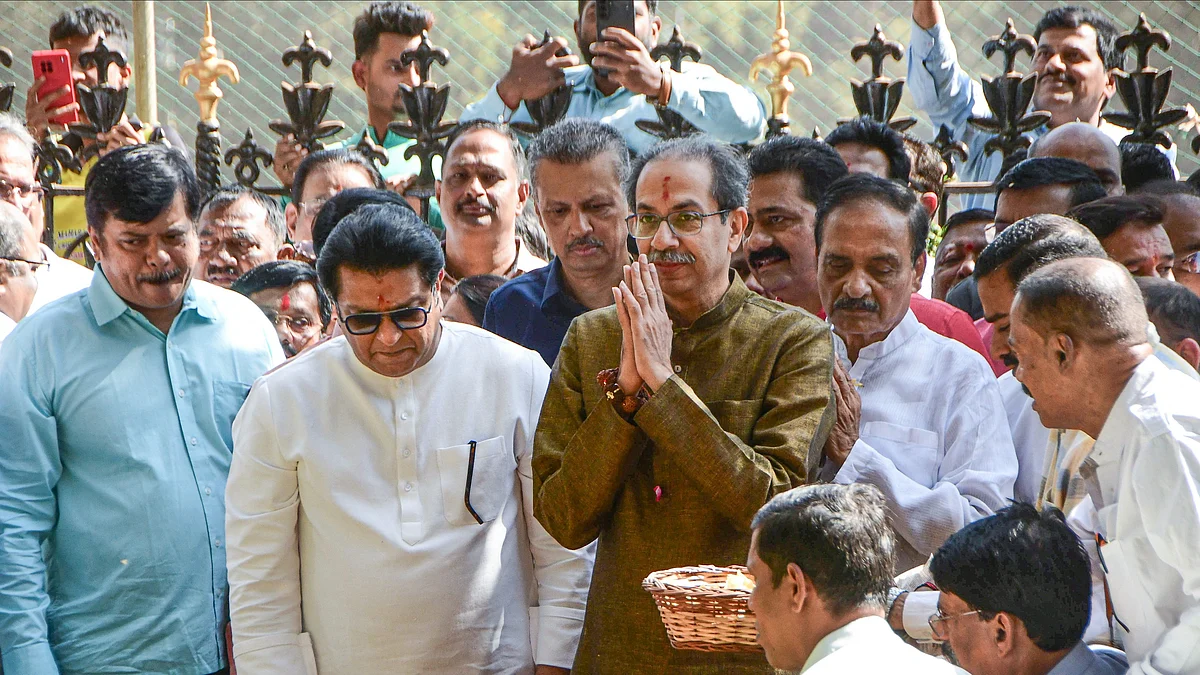


Campaigning for the high-stakes elections to 29 municipal corporations in Maharashtra ended on Tuesday, with political focus firmly on the contest for the Brihanmumbai Municipal Corporation (BMC), where the BJP-led Mahayuti is seeking to wrest control amid a formidable challenge from a united Thackeray front.
Polling for 2,869 seats across 893 wards will be held on 15 January, with voting scheduled from 7.30 am to 5.30 pm. Counting will take place the next day. The outcome will be decided by 3.48 crore eligible voters, choosing from 15,931 candidates, including around 1,700 in Mumbai and 1,166 in Pune.
Battle for Mumbai takes centre stage
The BMC election has assumed added significance as it is the first civic poll for the Shiv Sena since its 2022 split, when Eknath Shinde led a majority of MLAs away from the party, retaining the party name and symbol. The undivided Sena had ruled Mumbai’s civic body for 25 years.
The BJP, which leads the ruling Mahayuti alliance in the state, is making a determined push to capture the country’s richest municipal corporation, banking on a three-pronged campaign led by Chief Minister Devendra Fadnavis, Deputy Chief Minister Eknath Shinde and Deputy Chief Minister Ajit Pawar.
However, the BJP faces a stiff challenge from the reconciliation of estranged cousins Uddhav Thackeray and Raj Thackeray after nearly two decades, a move widely seen as an attempt to consolidate the Marathi vote in Mumbai and key urban centres.
Shifting alliances, fresh equations
The run-up to the polls has seen unusual political realignments. While rival factions of the Nationalist Congress Party (NCP) have joined hands in Pune, Pimpri-Chinchwad and Parbhani, the Congress has opted to chart an independent course in Mumbai.
The party has tied up with Prakash Ambedkar’s Vanchit Bahujan Aghadi (VBA) and the Rashtriya Samaj Paksh in the state capital, while choosing to contest solo in Nagpur. Across the rest of Maharashtra, the Congress has fielded 1,263 candidates.
Observers noted that in parts of the campaign, the Ajit Pawar-led NCP was tactically kept in the background by the Mahayuti in a bid to attract minority voters, underlining the complex social arithmetic shaping these elections.
Key battlegrounds across the state
The civic polls are being held after a gap of more than six years, with the terms of these bodies having ended between 2020 and 2023. Of the 29 corporations going to the polls, nine lie in the Mumbai Metropolitan Region (MMR), making the contest especially crucial in India’s most urbanised belt.
Major battlegrounds include Mumbai, Thane, Navi Mumbai, Kalyan-Dombivli, Vasai-Virar, Mira-Bhayandar, Pune, Pimpri-Chinchwad, Nashik, Nagpur, Solapur, Amravati, Akola, Kolhapur, Sangli-Miraj-Kupwad, Jalgaon, Dhule, Jalna, Chhatrapati Sambhajinagar, Nanded-Waghala, Chandrapur, Parbhani, Latur, Bhiwandi-Nizampur, Panvel, Ulhasnagar and Ichalkaranji.
Star campaigners such as Telangana minister Mohammad Azharuddin, AIMIM chief Asaduddin Owaisi and Tamil Nadu BJP leader K. Annamalai also addressed rallies in different cities.
Populism, identity politics dominate discourse
Populist promises targeting women voters featured prominently in rival manifestos.
The Mahayuti promised a 50 per cent concession for women on BEST bus travel in Mumbai.
The Shiv Sena (UBT)-MNS alliance offered a Rs 1,500 monthly allowance for women domestic workers and a property tax waiver on homes up to 700 sq ft.
The Congress focused its pitch on pollution control, strengthening the BEST fleet and improving Mumbai’s financial health.
The campaign in Mumbai also saw intense political sparring over the mayoral post. The BJP alleged that a victory for the Shiv Sena (UBT) could result in a Muslim mayor, a claim strongly countered by Uddhav Thackeray’s party, which assured voters that Mumbai would have a Marathi mayor.
Chief Minister Fadnavis went a step further, asserting that the city’s mayor would be “Hindu and Marathi”, injecting a sharp identity dimension into the civic contest.
Seat-sharing matrix in Mumbai
In the final tally of candidates for Mumbai:
BJP is contesting 137 seats,
Shiv Sena (Shinde faction) 90 seats,
NCP 94 seats,
Shiv Sena (UBT) 163 seats,
MNS 52 seats,
Congress 143 seats,
VBA 46 seats.
With campaigning over, political parties now await the verdict of voters in what is being seen as a litmus test of Maharashtra’s shifting political equations, and, above all, a decisive battle for control of Mumbai’s civic powerhouse — the BMC.
Join our official telegram channel (@nationalherald) and stay updated with the latest headlines