


Nation pays homage to Jawaharlal Nehru on death anniversary
Mallikarjun Kharge calls the first PM the architect of modern India and praises his role in shaping the nation’s democratic and scientific vision
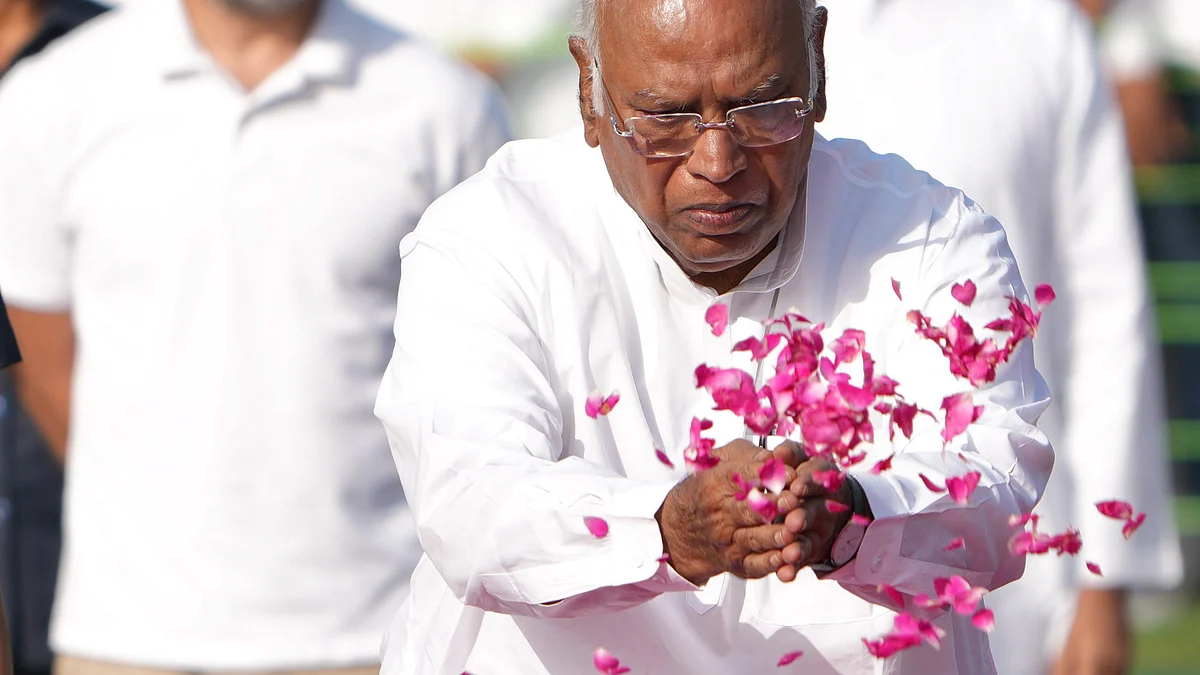


Leaders across the political spectrum on Wednesday paid tribute to India’s first prime minister Jawaharlal Nehru on his death anniversary, remembering his contribution to nation-building, democracy and India’s freedom struggle.
Mallikarjun Kharge led the tributes from the Congress, describing Nehru as “the architect of modern India’s strong foundation” and a leader who shaped the country’s democratic and scientific outlook.
Quoting Nehru’s vision of national unity and equality, Kharge said, “The defense of the nation, the progress of the nation, the unity of the nation—these are our national duty. We may follow different religions, live in different provinces, speak different languages, but no wall should arise between us because of that.”
The Congress chief further said Nehru’s visionary leadership laid the foundation for industrial development, scientific thinking and economic self-reliance in independent India. “The vision of 21st century India remains incomplete without the invaluable contributions of Pandit Nehru ji,” Kharge said.
Leader of Opposition in the Lok Sabha and Congress MP Rahul Gandhi paid floral tributes to Nehru, his great-grandfather, at Shanti Van on the occasion of his death anniversary.
The Goa Pradesh Congress Committee also remembered Nehru as the “architect of modern India”, praising his role in laying the foundation of a democratic and progressive nation.
In a post on X, the party said Nehru’s visionary leadership strengthened India’s scientific, industrial and global standing, while helping establish institutions that continue to shape the country. It added that his vision and leadership still inspire generations.
Congress leader Jairam Ramesh said Jawaharlal Nehru’s relevance continues to grow as “the truth of the damage this Modi regime has done to our polity, society and economy becomes increasingly stark and evident with every passing day.”
Remembering India’s first Prime Minister on his death anniversary, Ramesh said Nehru continues to be “studied and analysed, as well as both criticised and applauded,” adding that such debate is natural for historical figures who leave a lasting impact on the nation and history.
Prime Minister Narendra Modi also paid homage to Nehru, posting a brief message on social media platform X. “Paying homage to former Prime Minister Pandit Jawaharlal Nehru on his death anniversary,” Modi wrote.
Born on 14 November 1889 in Allahabad, Nehru was educated in England at Harrow and later at Cambridge University, where he studied Natural Sciences before qualifying as a barrister from the Inner Temple in London. He returned to India in 1912 and soon emerged as a central figure in the freedom movement.
Deeply influenced by Mahatma Gandhi after meeting him in 1916, Nehru took part in major national movements including the Non-Cooperation Movement, Salt Satyagraha and Quit India Movement. He was jailed nine times during the struggle for independence.
Nehru became Congress president at the historic Lahore Session in 1929, where the party adopted complete independence as its ultimate objective. Over the following decades, he played a key role in mobilising the freedom struggle and later became independent India’s first prime minister in 1947.
Known for championing parliamentary democracy, secularism and scientific temper, Nehru also helped establish major educational and industrial institutions that shaped post-Independence India. Because of his affection for children, his birth anniversary on 14 November is observed every year as Children’s Day in India.
Nehru passed away on 27 May 1964, after suffering a heart attack, marking the end of a defining chapter in India’s political history.
With agency inputs
Join our official telegram channel (@nationalherald) and stay updated with the latest headlines