


The Panthic voter: from Nankana Sahib to Instagram
Harjeshwar Pal Singh decodes a group of voters who become a critical factor in any Punjab election
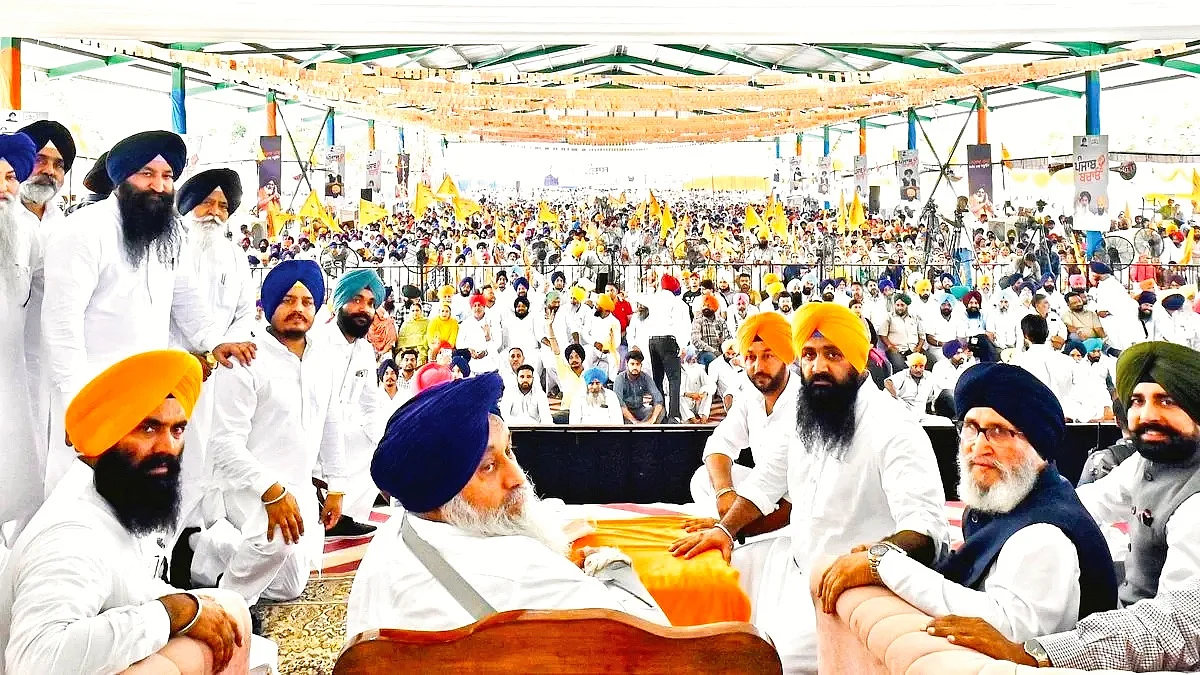


A year ago this month, a little-known independent called Mandeep Singh polled nearly 20,000 votes in the Tarn Taran Assembly by-poll. He neither won nor came second, but he pushed the Congress to fourth place in the heart of Majha. What he had was the backing of a jailed MP, Amritpal Singh, and the ashirwad of those written off by Punjab’s pundits at least three times in 30 years: the Panthic voter.
Panth means ‘the path’. In Sikh tradition, it came to mean the collective body of the Guru’s followers. After Guru Gobind Singh, authority passed to the Guru Granth and the Guru Panth, so the community itself became sovereign. With miri-piri, the twin swords of spiritual and temporal power, religion and politics were never kept in separate compartments. The early Akalis said it plainly: they are one and the same.
The Panthic voter, then, is a Sikh who votes mainly through the lens of the Panth: its shrines, its institutions like the Akal Takht and the SGPC, its honour and its grievances. He is not necessarily a Khalistani or even an amritdhari; many are clean-shaven youngsters. What sets him apart is that qaum comes before party.
Panthic politics was born in the gurdwara reform movement of 1920-25, when the Sikhs fought to take historic shrines back from corrupt, loyalist mahants. The SGPC was formed in November 1920 and the Shiromani Akali Dal on 14 December the same year. About 130 Sikhs were killed at Nankana Sahib in 1921.
When the Chabbian da Morcha (the struggle for the keys of the Golden Temple) succeeded, Mahatama Gandhi wired Baba Kharak Singh: ‘First decisive battle for India’s freedom won’. The Gurdwaras Act of 1925 handed the shrines to an elected SGPC.
For seven decades, the Panthic voter was the backbone of regional Akali politics. He courted arrest during the Punjabi Suba movement (1966), the Emergency (1975), and the Dharam Yudh Morcha (1982). After Operation Bluestar and 1984, he turned to the radicals: in 1989, a jailed Simranjit Singh Mann won Tarn Taran by more than four lakh votes. Then came the retreat.
The radicals boycotted the 1992 polls, and less than a quarter of the electorate turned out to vote. In 1996, at Moga, Parkash Singh Badal moved the Akali Dal from ‘Panth’ to ‘Punjab, Punjabi, Punjabiyat’.
In 1997, he sealed an alliance with the BJP. For two decades, the Panthic voter was a captive vote bank, taken for granted by a party that ran on the family, the halqa (constituency) system and the language of development.
Between 2015 and 2024, those ties foundered. The beadbi at Bargari, the firing at Behbal Kalan and pardoning the Dera chief broke the Badals’ moral contract with the Panth. Agrarian distress, drugs, joblessness and the ensuing rush to Canada produced a restless generation, while social media provided a platform beyond the reach of any Badal.
The Kisan Andolan gave it confidence and, in Deep Sidhu, a new icon. When the AAP’s promise of badlav faded, the neo-Panthics found their own vehicles: Mann in Sangrur (2022), Amritpal Singh and Sarabjeet Singh Khalsa (2024). Amritpal won the Khadoor Sahib Lok Sabha seat from Dibrugarh jail by nearly two lakh votes.
****
Yet the Panthic space today is more fractured than at any time since 1920. In December 2024, the Akal Takht declared Sukhbir Badal tankhaiya. In January 2025, Amritpal’s Akali Dal (Waris Punjab De) was launched at the Maghi Mela in Muktsar. In August 2025, the rebels elected former Jathedar Giani Harpreet Singh to head the now floundering SAD (Punar Surjit), the first Dalit to lead any Akali faction.
With Mann’s SAD (Amritsar) still in the field, that makes four Akali Dals for one Panth. At Tarn Taran, the Badal Akali Dal and the Panthic candidate together polled about 50,000 votes, comfortably more than the AAP winner. Because they were divided, both lost.
So who is the Panthic voter of today? Recent field surveys in rural Malwa provide a rare close-up. Roughly one voter in six shows some Panthic attachment; about one in ten is committed to Amritpal or Mann.
Nearly two-thirds of committed Panthic voters are Jatt Sikhs — with a cross-caste fringe — one Jatt Sikh in four leans Panthic. Ramgarhias come next, with Dalit Sikhs comprising about a fifth of the core. Hindus are almost entirely absent, and that is the movement’s glass ceiling.
The Panthic voter is young, male and, surprisingly, better educated than most. Among young Jatt Sikh men, nearly one in three is a committed Panthic voter. Support increases with education: graduates are more than twice as likely to vote Panthic as those who never went beyond middle school, the reverse of AAP’s welfare base.
Students are the most Panthic group; labourers the least. Today’s Panthic voter is a 12th-pass, smartphone-carrying Jatt Sikh from a farming family; angry about drugs and jobs, scornful of handouts, suspicious of Delhi, devoted to a jailed leader, and ready to ‘give the new party one chance’.
Alongside the sons stand their mothers. Many middle-aged Jatt Sikh women back Amritpal for one reason: “naujawani bachaunda” (he saves our youth). Theirs is a vote against the chitta in their sons’ veins, not a vote for Khalistan.
Drugs unite Punjab’s voters. What distinguishes the Panthic voter is a broader sense of decay and injustice. He talks far more often about unemployment, corruption, beadbi and the release of the Bandi Singhs. It is Panth plus Punjab, with Sikh identity serving as the language of social anxiety.
He is proud, not poor. While many rural voters still give Bhagwant Mann’s government a thumbs-up, the Panthic voter gives it a firm thumbs-down. Barely one in five credits the women’s cash transfer. One respondent asked: “Nang thodi aa lok, 1,500 naal rajj jange (are these people beggars, to be satisfied with Rs 1,500)?”
This politics is about anakh (self-respect) and resentment of Delhi’s dakhal-andazi (interference) as much as it is about scripture.
The Panthic voter’s loyalty is not set in stone. Only about two in five of those who voted for Amritpal or Sarabjeet in 2024 plan to stay with the new party. At the same time, about a quarter of today’s committed Panthic voters are former AAP voters — one in seven did not vote in 2024. The Panthic vote is less a fortress than a busy railway platform, with passengers getting on and off at every station.
It is a one-leader movement with no use for national leaders. Unlike the Badal loyalist, who votes for the party symbol, the Panthic voter weighs the candidate first.
More than three-quarters of the core name Amritpal as their favourite, while Mann, the old standard-bearer, has all but vanished. Nearly nine in ten name no national leader at all; Modi barely registers.
The reel has replaced the village sath. Four in five get their political news from Facebook, Instagram or YouTube. Support grows pind by pind (village). In some villages, two out of three voters are Panthic. Once the gurdwara committee or the youth club turns, the entire pind often follows.
Events also matter. After the killing of anti-drug activist Parvinder Jhota in October, many sympathisers in the area hardened into committed Panthic voters almost overnight.
In the rural Malwa belt, the Panthic and Badal votes together make up between one-third to two-fifths of the electorate. That is enough to decide who rules Punjab, but only if it votes as one.
History is clear: the Panth has been most powerful when it marched as one jatha (band), and most irrelevant when its leaders fought over the siropa (robe of honour).
Harjeshwar Pal Singh teaches history in SGGS College, Chandigarh. More of his writing here
Join our official telegram channel (@nationalherald) and stay updated with the latest headlines