


Defections, FIRs rule the roost
Punjab’s political circles are abuzz with the zealousness of ‘investigating’ Opposition leaders
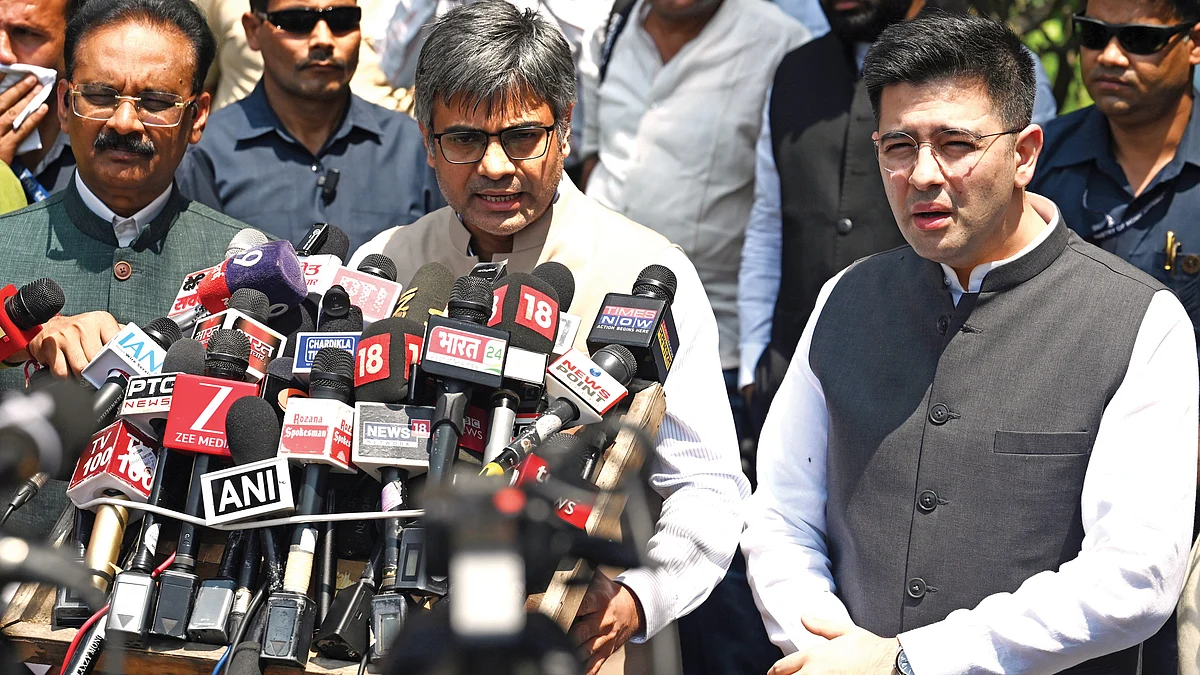


Less than a week after Sandeep Pathak — a Rajya Sabha MP from Punjab — defected from the Aam Aadmi Party to join the BJP, a Punjab Police team arrived at his official residence in Delhi. Pathak, however, had reportedly been tipped off. By the time the officers arrived, he had slipped through a rear exit and been whisked away by a waiting car. A video clip of his hasty departure has since been widely circulated, capturing what many see as a spiralling culture of political retribution.
In the days that followed, it emerged that two FIRs were registered against Pathak in separate districts of Punjab, invoking stringent legal provisions under which securing bail is difficult. Delhi Police personnel were deployed outside his residence. The message from Punjab was unmistakable: if he showed up, he would be arrested.
Pathak is not an isolated case. Rajinder Gupta — another of the seven AAP MPs who defected — has also run into legal trouble, albeit of a different nature. Gupta is chairman emeritus of the Trident Group, a prominent industrialist with business interests spanning textiles and manufacturing.
In 2022, the Bharatiya Kisan Union (Ugrahan) had protested against alleged water pollution from the group’s Dhaula unit in Barnala district. At the time, the state government appeared indifferent, and the issue faded from public discourse.
Gupta’s defection seems to have galvanised the administration into action. The Punjab State Pollution Control Board has now initiated proceedings against him, and reopened the pollution case with renewed vigour. The timing has raised eyebrows, with critics arguing that selective enforcement of regulatory laws has become a convenient tool to ‘discipline’ dissenting political actors.
The use of state machinery to target political opponents is hardly unprecedented in Punjab. Yet, what distinguishes the current scenario is the scale and intensity with which these tactics are being used. The Punjab Vigilance Bureau, tasked with probing corruption, is increasingly perceived as an extension of executive authority, working zealously to investigate Opposition leaders.
Parallelly, Central agencies have also stepped up their presence in Punjab. The Enforcement Directorate is currently probing at least 16 political leaders in Punjab, with several arrests already made — many of them from Opposition parties, including the Congress and AAP. The pattern has fuelled allegations that the fear of investigation is being used to engineer political realignments.
A report in the Indian Express (3 May 2026) reinforces this perception. Quoting party insiders, it reveals that several MPs had told Arvind Kejriwal during a parliamentary session that they were under immense pressure to join the BJP. Some reported raids on their premises; others claimed they had been warned of action by Central agencies. The implication is clear: in today’s political climate, allegiance is not merely an ideological choice — it is also an existential threat.
Perhaps the most intriguing illustration of these dynamics is former chief minister Capt. Amarinder Singh. While he was with the Congress, the ED had initiated proceedings against him over alleged foreign assets. After he joined the BJP, it was widely assumed that the matter had been quietly shelved.
However, in a surprising move, a summons was issued earlier this year seeking his appearance before the ED’s Jalandhar office. Although Singh did not comply, the officer responsible for issuing the summons was subsequently transferred — an episode that only deepened the murkiness surrounding such investigations.
Caught in the crossfire are several senior Congress leaders, many of whom appear to be bearing the brunt of these actions. Charanjit Singh Channi, Sukhpal Singh Khaira, Bharat Bhushan Ashu and Shyam Sundar Arora have all been subjected to investigations by either the ED or state vigilance authorities — or both. With the exception of Channi, several have also been arrested.
The actions have not been limited to legal proceedings. In a particularly controversial move, the state government ordered the demolition of a portion of Khaira’s ancestral home using bulldozers, a spectacle that embodies the punitive use of administrative power. Such actions raise fundamental questions about the rule of law being replaced by a ‘vendetta raj’.
As Punjab approaches another electoral cycle, the stakes can only rise. Political defections, legal battles and public accusations are likely to intensify, further entrenching mistrust. After a recent meeting with President Droupadi Murmu, Raghav Chadha — the ‘leader’ of the pack of seven defectors — warned that while the Punjab government controls the police force of one state, the BJP commands 21 across the country. This comment encapsulates the reality of contemporary Indian politics.
Punjab, once defined primarily by its agrarian economy and cultural vibrancy, now finds itself at the epicentre of a different kind of contest — where law enforcement agencies, regulatory bodies and investigative institutions are instruments in a larger political chess game.
In this context, vendetta politics is not merely about settling scores. It reflects the systemic erosion of institutional neutrality, where the boundaries between right and retribution grow increasingly indistinct. For the electorate, the consequences are significant.
When governance is overshadowed by political warfare, it is the people who pay.
Join our official telegram channel (@nationalherald) and stay updated with the latest headlines