


Why Tamil Nadu says ‘no’ to NEET
When coaching becomes essential to crack an exam, the exam becomes a reflection of economic privilege, writes K.A. Shaji
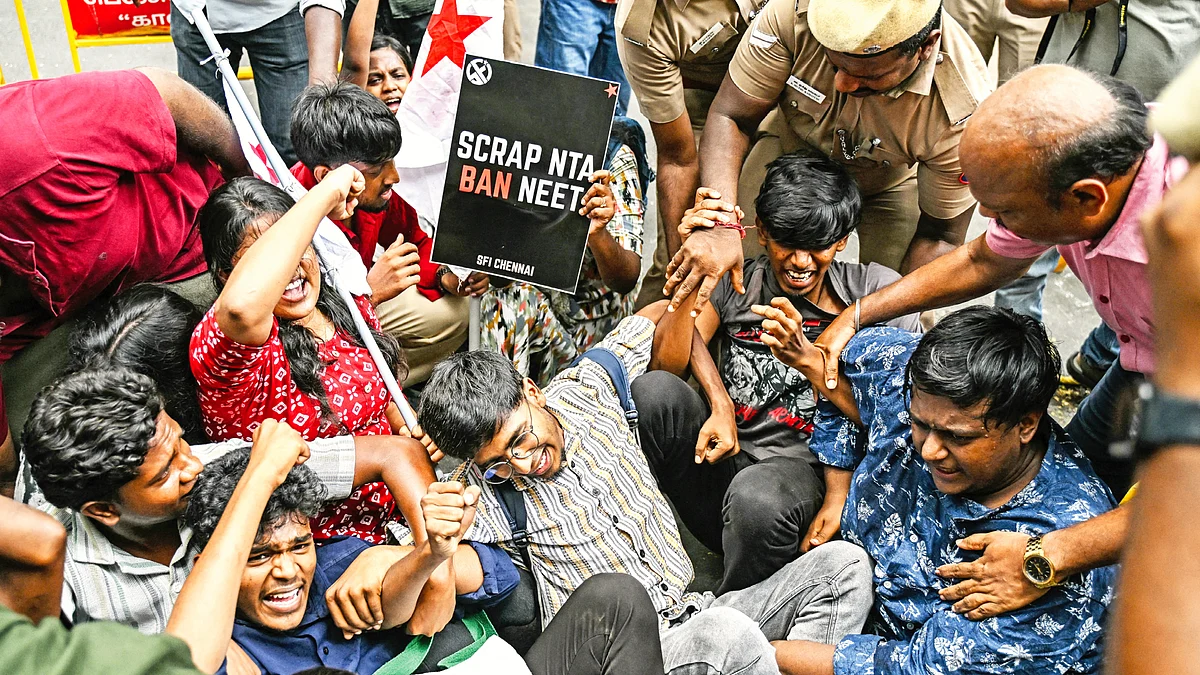


Tamil Nadu is no stranger to bitter political battles. Governments change, alliances shift, parties refuse to share a stage even during all-party meetings on crucial national issues. Yet one issue unites them all (bar the BJP, of course).
Whether it’s the Dravida Munnetra Kazhagam (DMK), the All India Anna Dravida Munnetra Kazhagam (AIADMK), the Congress, the Left parties, the Pattali Makkal Katchi (PMK), the Viduthalai Chiruthaigal Katchi (VCK), the Marumalarchi Dravida Munnetra Kazhagam (MDMK) or a host of smaller regional parties, they all agree on one thing: abolish the National Eligibility cum Entrance Test (NEET). Such unanimity is almost unheard of.
This consensus holds even after actor-turned-politician C. Joseph Vijay broke the decades-old alternation of power between the DMK and AIADMK to become chief minister. The Tamilaga Vettri Kazhagam (TVK) has not only opposed the examination but also demanded its abolition.
Why does Tamil Nadu, unlike every other state, continue to reject a national entrance examination that the Union government describes as transparent, merit-based and essential for maintaining uniform standards in medical education? The answer lies not in recent politics but in a century-old social revolution.
C. Lakshmanan, scholar and a former faculty member at Madras Institute of Development Studies (MIDS) elaborates: “Long before NEET entered the national vocabulary, the Justice Party, founded in 1916, challenged the near-monopoly of higher education and government employment enjoyed by a handful of privileged communities.
"Later, Periyar E.V. Ramasamy’s Self-Respect Movement expanded that struggle into a larger campaign against caste hierarchy and inherited social privilege. Education became one of its most powerful instruments. Professional colleges, particularly medical colleges, were viewed as gateways through which historically marginalised communities could secure dignity, employment and social mobility.”
He adds, “When Independent India adopted reservation as a constitutional mechanism for correcting historical discrimination, Tamil Nadu embraced that vision. Regardless of political ideology, governments expanded reservation, strengthened schooling and treated higher education as a public good rather than a market commodity.
"Thousands of students from farming families, fishing villages, Dalit settlements, backward communities and economically disadvantaged households entered medical colleges. Many were first-generation graduates, and many returned to serve in government hospitals, primary health centres and remote villages. Their stories reinforced the belief that while talent was widely distributed, opportunity was not.”
That conviction influenced one of the state’s most significant decisions. In 2006, Tamil Nadu abolished entrance examinations for professional courses. Admissions to medical colleges were based entirely on Class XII board examination marks. The government argued that sustained academic performance over two years was a better indicator of a student’s capability than a single three-hour exam. For more than a decade, the system functioned with broad political support.
“The introduction of NEET fundamentally altered that model,” points out Sumathi Padmanabhan, educationist and assistant professor at a Coimbatore college. “Supporters argued that a national examination would eliminate arbitrariness in admissions, curb capitation fees charged by private medical colleges and ensure that every aspiring doctor met the same academic benchmark.
"Tamil Nadu argued that NEET ignored the enormity of inequality. Students studying under different curricula, with different educational resources, were suddenly expected to compete in a single national examination. Urban CBSE students often had easier access to study material and specialised coaching, while State Board students from government schools did not.”
That disadvantage became increasingly visible with the explosion of the coaching industry in cities like Kota, Chennai, Hyderabad and Delhi. Families routinely spend lakhs on coaching, accommodation and study material. Affluent families see it as an investment in their children’s future. Poorer households see it as yet another barrier between aspiration and opportunity.
Also Read: The revolt of the Cockroaches
The state’s anti-NEET argument moved beyond emotional appeals to a data-driven critique of how this exam reshaped medical admissions.
At the centre of that exercise was the Justice A.K. Rajan Committee, constituted in 2021 to study the impact of NEET. After analysing admission trends and more than 86,000 responses from students, parents, teachers and the public, the committee concluded that the exam had significantly altered the social profile of students entering medical colleges.
After NEET became mandatory, the proportion of students from rural areas declined. Admissions from Tamil-medium schools and the State Board fell sharply, while the share of students from CBSE schools increased. Government-school students, who had once found a pathway into medical colleges through consistent academic performance, almost disappeared from admission lists until the state introduced a 7.5 per cent horizontal reservation in 2020.
A common exam appears fair on paper, but students grow up in unequal educational landscapes. The starting line for a child studying in a government school in a remote village, often without adequate laboratories, experienced teachers or access to coaching, is different from a student from an elite urban school with digital learning tools and deep pockets.
Subjecting both to the same exam risks legitimising existing inequalities under the language of merit. But what exactly is merit? Is it the ability to answer multiple-choice questions in a three-hour exam, or is it years of disciplined learning and academic consistency?
Tamil Nadu has consistently favoured the latter. Many medical educators have also questioned the assumption that a competitive entrance examination can accurately predict who will become a good doctor. The medical profession demands empathy, patience, communication skills, ethical judgment and an ability to work under pressure.
All of which are difficult, if not impossible, to measure through an exam like NEET. Beyond statistics and policy debates lies an issue that has profoundly influenced public opinion in Tamil Nadu: the emotional toll of NEET.
Over the years, the state has widely reported suicides by students who feared they would fail or were devastated by their results. Mental health professionals have repeatedly warned against the psychological consequences of placing an adolescent’s future almost entirely on the outcome of one test. While exams are an inevitable part of education, the present system has created an atmosphere of anxiety that disproportionately affects first-generation learners and students from vulnerable backgrounds.
“Tamil Nadu also sees NEET as an example of centralisation,” says Madurai-based human rights defender Henri Tiphagne. “Education is in the Concurrent List of the Constitution. While national standards have their place, individual states should retain the flexibility to design admission systems suited to their educational realities and social objectives. One exam imposed on completely different school systems undermines the federal spirit of the Constitution.”
Supporters continue to defend NEET with examples of success stories from economically weaker sections. These arguments have not altered the state’s position.
As Tiphagne says, “Tamil Nadu does not reject excellence; it questions the assumption that excellence can be measured independent of social context. In a society where educational opportunities remain deeply unequal, we believe that true merit must account for the circumstances in which students learn and compete.”
Join our official telegram channel (@nationalherald) and stay updated with the latest headlines