


Badminton: New 15-pointer games may make it shorter, but at what cost?
H.S. Prannoy feels it may often deprive the paying public; Dronacharya Vimal Kumar had flagged his reservations to BWF


The historic rule change of Badminton World Federation (BWF), which adopted a new 3 x 15 scoring system to make the sport ‘shorter and faster,’ has it doubters among some of the biggest Indian names in the fraternity. The resolution adopted by BWF in it’s AGM in Denmark in late April marks the end of the long standing 3 x 21 points, a format which has defined the sport for nearly two decades, once the new rule takes over from 4 January next year.
Under the new system, matches will be played as best-of-three games to 15 points instead of 21, with the BWF arguing that the shorter format will improve scheduling, create more high-pressure moments and help player welfare. BWF President Khunying Patama Leeswadtrakul called the decision an ‘important milestone’ for the future of badminton and said the sport needed to evolve for the next generation. “We are building a sport that speaks to the next generation, while continuing to invest in the long-term future of our players,” Leeswadtrakul had said.
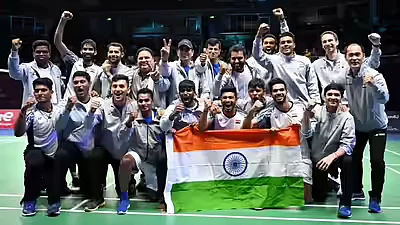
The game-changing move, with an eye towards making the sport more broadcast-friendly as well, as it’s doubters though. ‘’I am not a big fan of it and would rather play the 21 points, may be the younger players like Lakshya (Sen) or Ayush (Shetty) can answer this better,’’ remarked H.S. Prannoy, the seniormost singles player in India’s Thomas Cup team.
‘’It’s an interesting move alright but I am not sure it will be value for money for paying fans,’’ the 33-year-old Prannoy said in response to a National Herald query during a virtual media interaction with a select group of journalists. ‘’It’s going to be very tricky when conditions are really windy, like it often happens in Indonesia or Malaysia where a match with 21 points can finish even in 25 minutes even if it’s between a world No.2 and 4 – so imagine what would happen in 15-point scenario,’’ remarked Prannoy, a 2022 Asian Games bronze medallist.
When the world governing body invited recommendations from the international badminton community on proposed rules changes and global calendar reforms in early January, Vimal Kumar – a Dronacharya awardee and former national coach had expressed reservations. ‘’While I fully support BWF’s long term vision for the sport, I strongly believe that altering the existing scoring system risks diluting the core essence of badminton—its physical toughness, tactical depth, and mental resilience,’’ he said.
‘’My suggestion was in favour of retaining the 21-point format for men’s singles and women’s singles, especially at Tour 1000 and 750 events. If experimentation is required, they could have restricted the 15-point format to Tour 500 and lower-tier events or to non-singles disciplines,’’ said the former Olympian and Co Founder and Director of the Centre for Badminton Excellence from Bengaluru.
Raising an element of concern was Saina Nehwal, a former world No.1 women’s player and the country’s first-ever Olympic medallist in the sport. “If changes are introduced, they should ensure that the quality of rallies and the competitive balance of the sport are not affected. At the end of the day, the focus should remain on fair competition and the spirit of the game,” Saina had said earlier.
If changes are introduced, they should ensure that the quality of rallies and the competitive balance of the sport are not affected. At the end of the day, the focus should remain on fair competition and the spirit of the gameSaina Nehwal
Someone like Chirag Shetty, the doubles ace, however feels that 15-pointers could be the ideal way forward to take the sport forward. ‘’It was about six to seven years back when the BWF had mooted a 11-pointer, best-of-five games where before you realized, you were 2-0 down. The 15-pointers should still be manageable and somewhat similar to the existing 3 x 21 games.
‘’However, there is no doubt that the accent will be more on speed and power and the amount of rallies will be shorter. Players will want to start from the word go and hence matches will become faster and shorter. Come January, let’s see how it goes,’’ Shetty added.
Key rule changes from January, 2027
Scoring structure: Best-of-three games, with each game played to 15 points (down from 21).
Deciding game: The third game, if required, ends when a side reaches 15 points.
Game gap: A maximum cap of 21 points applies; if a game reaches 20–all, the next point wins.
Intervals: A 60-second mid-game interval occurs when the leading score reaches eight points, instead of the previous 11.
Change of ends: Players change ends in the deciding third game when a side first reaches eight points.
Serve: The side winning a game serves first in the next game.
Join our official telegram channel (@nationalherald) and stay updated with the latest headlines