


Can star-studded India defend both titles in the gruelling Chess Olympiad?
A strong performance in Samarkand may boost D. Gukesh’s confidence levels ahead of the world title game
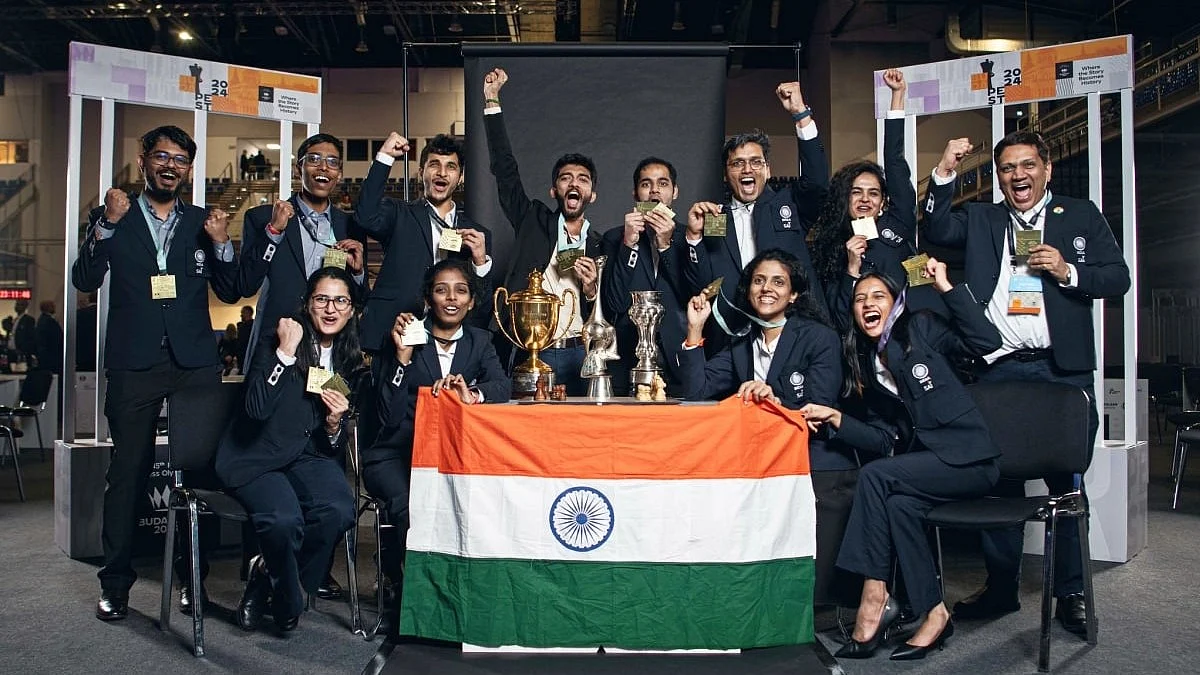


A look at the Indian line-up for the Open section, which gets down to title defence along with the women’s team at the FIDE Chess Olympiad from Wednesday (16 September), makes one gape at the sheer depth of talent at their disposal. There are two men in the top 10: No. 8 R. Praggnanandhaa and No. 9 Arjun Erigaisi, while reigning world champion D. Gukesh is No. 32 in the world rankings. But given that it’s a game of small margins at that level, their chances of retaining the title are anybody’s guess.
Nihal Sarin, world No. 24, is the fourth member of the squad, while Vidit Gujrathi, a much-respected opponent on the circuit and currently No. 34, is the reserve.
The women’s team is also a Who’s Who, comprising three Grandmasters—Koneru Humpy, Vaishali Rameshbabu and FIDE World Cup champion Divya Deshmukh—along with International Masters Vantika Agrawal and Savitha Shri B (reserve).
Open team has retained the core of the 2024 gold-medal-winning outfit in Gukesh, Pragg, Erigaisi and Gujrathi, while Pentala Harikrishna was the remaining member of India’s maiden gold-medal-winning team in Budapest. It was quite a thriller, as India clinched the title in the final round after second-placed China dropped points on two boards against the USA, while the Indians got the better of Slovenia.
Meanwhile, a critical win against Uzbekistan in the final round, along with a 2-2 draw between the other two contenders, the USA and Kazakhstan, helped the women seal the title. The ‘double’ in Budapest ushered in a memorable year-end for India, as its best performance in the Olympiad before that was a bronze in the Open section, in 2014 (Norway) and 2022 (Chennai). What’s more, Gukesh went on to become the youngest world champion in classical chess in December.
The clock has now come full circle, with the Indians carrying great expectations. Come November, Gukesh will take on the prodigious Javokhir Sindarov, the Uzbek who ran through his opponents in a one-sided Candidates tournament earlier this year to become the challenger for the world title. A strong performance in Samarkand may help a somewhat off-colour Gukesh regain his confidence ahead of the title match.
Asked to reflect on the Indian teams’ chances, captain GM Srinath Narayanan said in a recent interview: “Defending an Olympiad title is always a tough challenge, but this Indian team has a lot going for it. There is continuity in the squad, and the players are more experienced. India has brilliant depth across the boards.”
The 11-round team format at the Olympiad offers a test of consistency as much as strength. Experts say every team faces situations when it is expected to win, when it must defend and, inevitably, a few matches where everything is at stake. The challenge is to keep all four players performing together day after day. Much like in relay teams or rowing crews, one exceptional performer cannot compensate indefinitely for weaknesses elsewhere.
Captains must constantly judge in their pre-match strategy when to push for victory and when a solid result is the best practical choice. In an event this long and competitive, maintaining the right balance throughout the two weeks can be as important as playing the strongest chess. There is no single road to the podium: each team will create its own tournament as the rounds unfold.
There will be 208 teams in the Open section and 191 in the women’s section in the upcoming edition, which will run from September 16 to 27 at the Silk Road International Exhibition Centre in Samarkand. While Team India will garner a lot of eyeballs as defending champions, the United States, China and Germany are among the many established chess powers seeking gold. It’s also an occasion to watch out for Uzbekistan, a developing chess nation and the host this time, which was the surprise winner in 2022 and has an emerging superstar in Sindarov.
Join our official telegram channel (@nationalherald) and stay updated with the latest headlines