


India seal historic Asian Games double gold in hockey with 5-1 win over Malaysia
India had already celebrated one hockey fairytale. On Saturday, they completed another
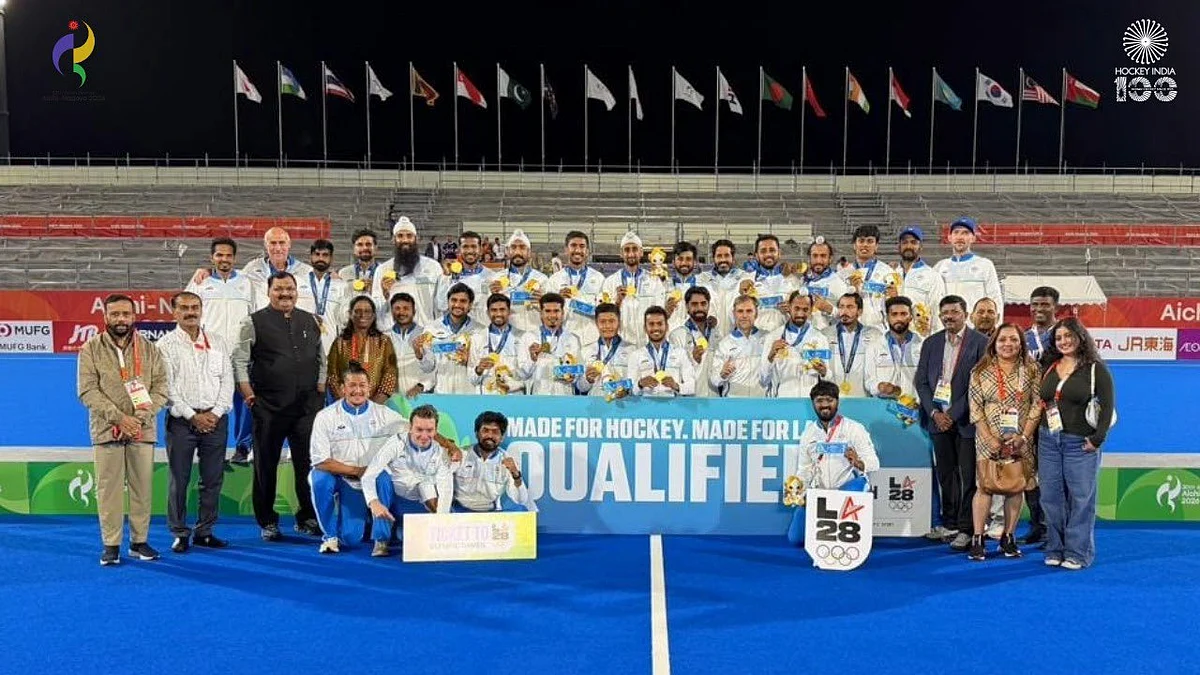


The Indian men's team beat Malaysia 5-1 in the Asian Games final to retain their hockey gold, adding another chapter to a memorable week for Indian hockey. A day after the women's team ended a 44-year wait for Asian Games gold, the men followed them to the top of the podium, creating a golden double that India had never achieved before at the Games.
It was a victory that carried significance well beyond the final score. India not only defended the title they won in Hangzhou in 2022, but did so for the first time in the men's team's Asian Games history. The gold was also India's fifth in men's hockey at the continental showpiece, following triumphs in 1966, 1998, 2014 and 2022.
India set the tone
India entered the final as defending champions and immediately looked like a team determined to make the occasion count. They pushed forward from the opening whistle, spending long periods in the Malaysian half and putting pressure on the defence.
The breakthrough came in the 11th minute, and it was a goal that captured India's confidence. After winning a penalty corner, India opted for a variation that involved just three Indian players moving into the Malaysian half. Harmanpreet Singh then found a narrow route through a maze of Malaysian defenders and fired the ball home.
It was a clever piece of execution and a statement of intent from India.
Malaysia responded three minutes later through Shelly Silverius, who found the net with a field goal to make it 1-1. But the equaliser did little to disturb India's rhythm. The defending champions continued to move the ball with purpose and kept looking for gaps.
In the 23rd minute, another penalty corner presented the opportunity and Jugraj Singh made it count. India were back in front, and the momentum was once again with the defending champions.
India pull away
Malaysia remained competitive, but India continued to control the contest as the final moved into the second half. The Indian midfield kept finding ways forward, while the Malaysian defence was increasingly forced to retreat.
The third goal arrived in the 42nd minute. Vice-captain Hardik Singh converted a penalty stroke to give India a 3-1 lead and put Malaysia under serious pressure.
The game began to open up as Malaysia searched for a way back, but that created more space for India. In the 54th minute, Shilanand Lakra completed a flowing attacking move to make it 4-1.
By now, the gold medal was firmly within India's grasp.
A captain's final flourish
There was still time for one more moment of confidence.
India won another penalty corner in the 57th minute and, with the result already heavily tilted in their favour, produced another variation. Just three Indian players were involved in the attacking routine inside the Malaysian half.
Harmanpreet Singh found the ball and somehow threaded it through a maze of Malaysian players defending the corner before sending it into the net.
It was his second goal of the night and India's fifth, but the manner of the finish said as much as the scoreline. India were playing with the freedom and belief of a team that knew the gold was theirs.
The final whistle soon followed.
India had done it again.https://x.com/kharge/status/2106361080360702418
A golden double
The significance of the victory stretched far beyond the men's team.
Just 24 hours earlier, the Indian women had ended a 44-year wait for Asian Games hockey gold, stunning reigning champions China 1-0 in their final.
That victory had already given Indian hockey a landmark moment. The men's triumph turned it into something even bigger.
For the first time, India's men's and women's hockey teams had both won gold at the same Asian Games. Two teams, two finals and two gold medals had combined to create a moment that had never previously been achieved by Indian hockey.
The men's title also extended India's long-standing status as a heavyweight in Asian hockey. Winning on the continent is nothing new for India, whose history at the Asian Games stretches back decades. But this achievement was about more than maintaining that position.
It was about what comes next.
From Asia to the world
The Asian Games gold has secured India's direct qualification for the 2028 Los Angeles Olympics, giving the men's team a clear runway towards the next Olympic cycle.
India's dominance in Asia is well established. The bigger challenge now is to translate that consistency into sustained success against the world's best.
The Olympics remain the ultimate stage for Indian hockey, a competition where the country has a storied history and where expectations remain high. The next two years will therefore be about more than defending a continental title. They will be about building a team capable of turning Asian dominance into genuine global contention.
The golden double in Nagoya provides an ideal platform.
Malaysia took the silver medal, while Pakistan claimed bronze after defeating South Korea 5-3 earlier in the day. For India, however, the focus was firmly on the celebrations after another memorable night.
Harmanpreet led the way with two goals, while Jugraj, Hardik and Lakra added one each. But the numbers only tell part of the story.
A day after the women ended their long wait, the men defended their crown. India's two hockey teams stood together at the top of the Asian Games podium, creating a golden double that will stand as one of the defining moments of their campaign.
The Asian Games heavyweight had done what it has done so often before: win gold.
Now comes the harder task: to take that confidence, consistency and belief from Asia to the world stage.
Join our official telegram channel (@nationalherald) and stay updated with the latest headlines