


How Bhuvi re-invented himself to lead purple cap race for RCB
Exponent of seam and swing had first won the honour a decade back for Sunrisers Hyderabad
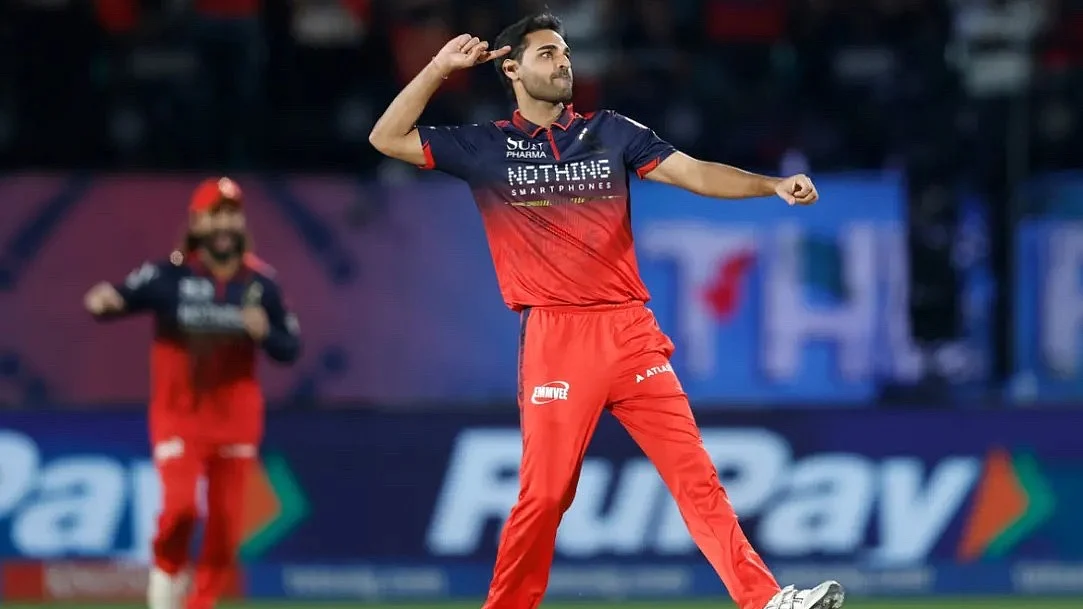


When Bhuvneshwar Kumar first won the purple cap in IPL 2016 for being the highest wicket taker, a certain Shubman Gill was yet to turn an adult, while Vaibhav Suryavanshi was a five-year-old. The 36-year-old master of seam and swing, who last donned India colours back in 2022 and was being considered a washout by most, has really re-invented himself in the current season, so much so that he is well poised for another tilt at said cap.
Last night in Dharamsala, Bhuvi — as the self-effacing allrounder is popular as — breached the usually compact defence of Gujarat Titans skipper Gill and added another one in the qualifier 1 as defending champions Royal Challengers Bengaluru stormed into their first back-to-back final. At 26 wickets with an economy rate of 8.07, the canny Bhuvi is very much at the top of the race, with the final to come on Sunday, 31 May.
Chasing him in second spot is South African Kagiso Rabada, who is also sitting on the same number of wickets for Gujarat Titans but with a marginally poorer economy of 9.18. The Titans, who were walloped in qualifier 1, will have another crack at a final berth against the winner of the eliminator — which means Rabada can look at another two matches if things go their way.
A purple cap after a gap of nine years (Bhuvi won it back-to-back in 2016-17 for Sunrisers Hyderabad) would be an extraordinary feat for any pace bowler, but the sense of satisfaction would be no less for the Meerut-born cricketer even if he ends second in the race.
Back in the day, Bhuvi and Rashid Khan were key to the Sunrisers’ successful template of defending small targets in an eight-team competition for several seasons. The going has only got tougher since then for a senior pro like Bhuvi, with more matches, introduction of ‘impact players’ — with the current season proving to be a bowler’s nightmare with an overall run-rate of 9.85 until last week, the highest in IPL history.
The question is: how did Bhuvi manage to do it in such an unfavourable ecosystem for bowlers, having to shoulder the tag of being the leader of the pace bowling unit in the absence of Josh Hazlewood in the initial stages? Bhuvi’s arsenal was a time-tested one which relied on control over length and a mix of swing and seam, not to speak of ice in his veins during the death overs.
Trying to decode his senior pace bowler’s craft, RCB’s talismanic Virat Kohli said in his viral podcast recently: "When you have technical abilities in place, you can always adjust. And especially when you are going through a tough phase, it is easier for the guys who have a technical foundation to a way to score runs or get wickets.
What is Bhuvi doing? He is not bowling banana in-swing, banana out swingers.
‘’He (Bhuvi) is bowling at a length that is telling the guys: I am good enough to hit this length everytime. It is the most length to hit and I am just gonna keep hitting this length. Are you good enough to take me on or not?’’
A total of six three-wicket hauls in RCB’s first 11 games, not to speak of the epochal feat of being the first pace bowler to claim 200 IPL wickets, was possibly just reward for Bhuvi’s craft and resilience.
It has been nothing short of a dream season for the earnest speedster — who works on a self-starter and is not vocal at all on any comeback ambitions on the international stage. This, of course, didn’t stop him from becoming only the third bowler, the first Indian, to claim 25-plus wickets for multiple IPL teams, the other two being Dwayne Bravo and Rabada.
Nice guys, as his saga tells you, need not always finish last.
Join our official telegram channel (@nationalherald) and stay updated with the latest headlines