Art and Culture
Try the famous rewdi of ________
Or ask what’s the home of the mouth-watering galawati kabab, Rahim ki nihari, Mubeen ke pasande, Idrees ki biryani, Tundey kabab…
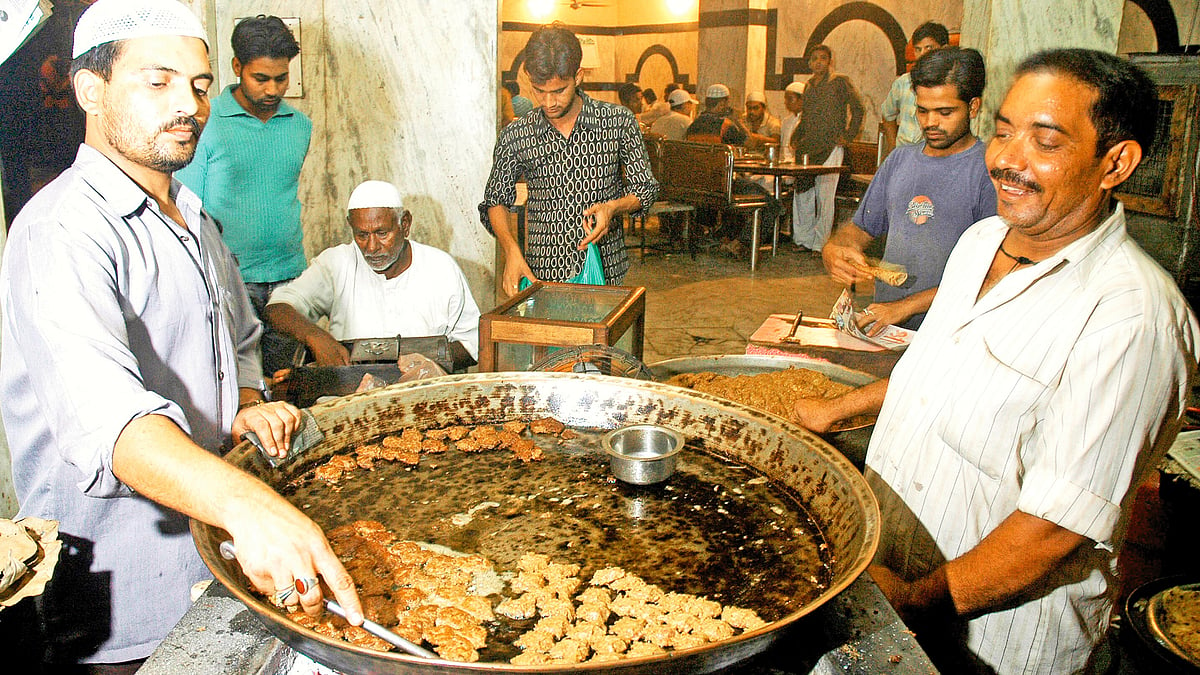
Every time I stepped outside the city and told someone where I was from, the reaction was almost scripted. Either they would immediately start talking about kababs, nihari, biryani… or they would laugh at my insistence on saying ‘hum’ and my talaffuz. Nobody has ever heard ‘Lucknow’ and responded with, “Ah yes, rewdi.” Nobody.
The smell that rises after maghrib (Arabic for sunset) from countless tandoors and grills across old Lucknow is practically one of the three reasons I moved back. People gather around hole-in-the-wall hotels to eat Rahim ki nihari, Mubeen ke pasande, Idrees ki biryani, Tundey kabab… Standing shoulder to shoulder, sometimes waiting for a plate of kababs so soft they melt in your mouth, just like your slightly liberal political opinion might in front of your right-wing papa.
I grew up proudly telling people that Lucknow boasts of over forty varieties of kababs and that Awadhi cuisine is what truly puts us on the map. Galawati kabab so delicate they were supposedly invented for a toothless nawab. Dhaagey ke kabab tied carefully with thread so the meat would not disintegrate before cooking. Shami kabab and the endless debate about how crisp they should be. Nargisi kabab, boti kabab, pasande, koftey, Kakori kabab, majlisi kabab... Even lauki ke kabab.
And this is just kababs. I have not even started on nihari-kulcha breakfasts after winter fog, paya simmering overnight, bheja fry at weddings, yakhni pulao, or even home-cooked adraki gosht, methi machhli ka saalan or even gosht ka achaar.
I am listing all this because one Uttar Pradesh government list would have us think that all of UP survives on vegetarian snacks. I truly hope this list does not reach my Lucknawi friends Tullika or Madhvi or Shabnam apa, who would launch a protest almost instinctively when they find out that only rewdi, mango produce and chaat made it to the Lucknow district cuisine.
Now listen, I have absolutely nothing against rewdi. What problem could I possibly have with those little gur-and-til discs sold every winter in every gali and every train stopping at LJN? I love them. I am also deeply loyal to ‘mango produce’. I’ll physically defend the honour of Lucknawi chausa mangoes, if need be. So, this is not just about me taking the absence of kababs on that list personally.
Or maybe it is.
Because the curious case of the missing kababs from UP’s grand ‘One District One Cuisine’ list is absurd (and dangerous). According to ministers, district-level committees were formed across all 75 districts. District magistrates chaired them. Teachers, professors and local experts were consulted. Surveys were conducted. Files moved. Meetings happened. Chai was consumed.
Can you imagine this? A full-blown committee of experts sat together to decide what the historic Lucknow district should boast of culturally and arrived at the revolutionary conclusion that the city globally associated with Awadhi meat cuisine should pretend kababs don’t exist. Or can be packaged and sold and benefit communities.
This government is asking us to believe that only vegetarian items can serve MSME interests. Seriously? In the whole of Lucknow district? Which has mastered the art of packaging even malai makkhan, a dessert so delicate it practically evaporates if exposed to sunlight for three minutes. Somehow, that made the list.
Now, I’m a huge fan of malai makkhan. But one cannot ignore the saffron tint of practically any new policy. And by saffron, I do not mean the zafran lovingly sprinkled over our biryani. I mean the saffron draped over legislative and policy processes.
The state insists the omission of meat is ‘not intentional’. Which is as far from the truth as malai makkhan is from boti kabab. The uncooked truth is this state-driven cultural and palate cleansing is a way to impose a savarna upper-caste vegetarian worldview on us all.
They are using food to shape identity, memory, nationalism and power. The state decides whose cuisine becomes ‘heritage’, whose food gets subsidies and branding support, and whose food is made to disappear from official memory.
This is not even about some exoticised Nawabi nostalgia. Lucknow’s food culture survives in small businesses tucked inside narrow lanes, in qasai mohallas, in winter nihari breakfasts, in bhuni kaleji stalls, in Kayastha kitchens cooking khade masale ka gosht, in Eid daawats where shami kababs disappear before the second roti arrives, and in paya simmering overnight for workers heading out before sunrise.
****
What’s being erased in this sanskari project is the food of meat-eating communities and economies built around them. Out with Muslim food traditions! Out with Dalit food traditions! And their kitchens, roadside stalls, butchers, women preserving recipes through generations, and the labouring castes whose cuisines emerged from resilience and survival. None of this should sully our ‘One District One Cuisine’ list.
And how they love their unitary fantasies! One District One Cuisine, One Nation One Election, One Nation One Tax, One Nation One Ration Card, One Nation One Grid… One language. One culture. One Supreme Leader. One (political) Party. Obliterate all and everything that does not fit their notion of a Hindu rashtra cooked in the Nagpur kitchen.
Remember this cuisine list is tied directly to state benefits, subsidies, packaging support, branding and promotion. So the question arises: whose food entrepreneurs will benefit? Whose labour will get visibility? Whose cuisines will the state deem worthy of investment?
It’s almost comical to think that UP has been one of India’s largest exporters of buffalo meat. UP is perfectly comfortable exporting buffalo meat all over the world, generating crores through slaughterhouses and meat-processing infrastructure. A fully packaged buffalo can board an international cargo ship, but the kabab cannot enter a tourism brochure.
We are casually informed that the ODOC list is ‘flexible’, that additions can later be approved by the chief minister. Will he approve my kababs? I won’t hold my breath.
But this isn’t about my beloved kababs. I’m angry because this is part of a much larger political project of omission and erasure — of food, language, culture, names, love stories, entire histories!
I’m sure this woman from Lucknow district is not the only person enraged about this list. So, friends from other districts, do speak up! I refuse to believe Azamgarh is happy to be represented by tehri — and I say this as someone who considers tehri deeply emotional comfort food.
Rampur, my friend, are you okay with this list? And Moradabad? Bareilly? Meerut? Will you just sit quietly while your food histories are vegetarianised under your noses?
For the nonce, if someone asks what in Lucknow they must absolutely try, I guess I’ll have to offer: “Ye lijiye, rewdi naush farmaiye”.
And now, if you’ll excuse me, I need to get a plate of kababs to calm my nerves.
Join our official telegram channel (@nationalherald) and stay updated with the latest headlines