Business
India–New Zealand free trade pact sealed, but faces political pushback in Wellington
While New Delhi and PM Christopher Luxon hail the pact as a landmark, New Zealand foreign minister Winston Peters calls it a “bad deal”
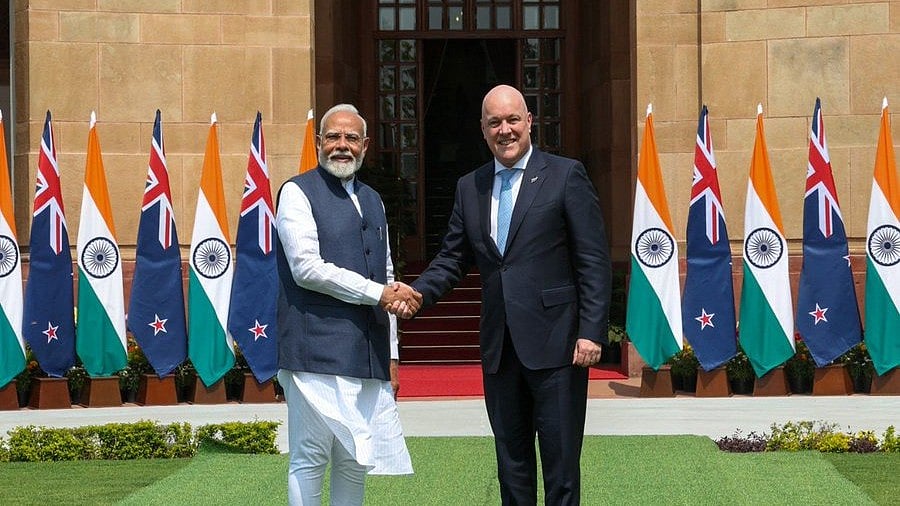
India and New Zealand have concluded negotiations on a comprehensive free trade agreement (FTA), a move welcomed by New Delhi as one of its fastest trade deals with a developed economy but criticised in Wellington as a rushed and unbalanced pact.
The conclusion of the negotiations was announced after a telephone conversation between Indian Prime Minister Narendra Modi and New Zealand Prime Minister Christopher Luxon, according to the Ministry of Commerce and Industry.
Negotiations for the agreement were launched in March 2025 and wrapped up after five rounds of talks conducted through a combination of in-person and virtual meetings. The ministry said the FTA grants zero-duty market access for all Indian exports to New Zealand, while India has agreed to tariff liberalisation covering around 95 per cent of bilateral trade.
The agreement spans trade in goods and services, investment, customs procedures, regulatory cooperation and the movement of professionals. New Zealand has offered market access commitments across sectors including information technology, professional services, tourism, financial services and education. It also includes mobility provisions for Indian students and professionals, such as post-study work opportunities and temporary employment visas.
According to the official statement, New Zealand has also indicated it will facilitate investments worth $20 billion in India over the next 15 years. Commerce Minister Piyush Goyal said the pact was focused on people-centric growth. “This Free Trade Agreement is about building trade around people and creating opportunities for farmers, entrepreneurs, students and professionals,” he said.
Commerce Secretary Rajesh Agrawal described it as a new-generation agreement, covering tariffs, agricultural productivity, investment and talent mobility. The FTA also provides for cooperation in agriculture, including productivity partnerships and proposed centres of excellence for apples, kiwifruit and honey, while excluding certain sensitive sectors from tariff commitments.
However, the agreement has triggered a sharp political backlash in New Zealand. Shortly after the announcement, Foreign Minister Winston Peters said the deal was a “bad deal” and confirmed that his party, New Zealand First, was “regrettably opposed” to the FTA.
“We consider the India–New Zealand free trade agreement to be neither free nor fair,” Peters said in a statement, arguing that it gives too much away on immigration while failing to secure meaningful gains for New Zealanders, particularly in the dairy sector.
New Zealand First said it had urged its coalition partner not to rush the negotiations and to use the full parliamentary term to secure a better outcome. Those warnings, it said, were ignored in favour of what it described as a quick, low-quality agreement. Peters confirmed that his party exercised an “agree to disagree” provision within the coalition and would vote against the enabling legislation when it is introduced in Parliament.
A key point of contention is dairy. Peters said the FTA would be New Zealand’s first trade deal to exclude major dairy products such as milk, cheese and butter, even though these exports were worth about $24 billion in the year to November 2025, accounting for roughly 30 per cent of the country’s total goods exports.
“This is not a good deal for New Zealand farmers and is impossible to defend to our rural communities,” he said.
The party has also criticised concessions related to labour mobility, arguing that New Zealand has offered far greater per capita access to its labour market than Australia or the UK did in their FTAs with India. New Zealand First warned that creating a new employment visa for Indian citizens could increase migration pressures at a time when parts of the domestic labour market are under strain.
Concerns have also been raised that provisions on work rights for Indian students could limit the flexibility of future governments to adjust immigration and labour policies in response to changing economic conditions.
Despite its opposition, New Zealand First stressed that its stance on the trade agreement does not diminish its commitment to strengthening ties with India. Peters said the party remains deeply invested in advancing the bilateral relationship and noted its long-standing engagement with India’s External Affairs Minister S Jaishankar.
The contrasting reactions underline a widening gap in how the agreement is viewed on either side of the relationship: as a strategic and economic breakthrough for India, but as a politically contentious and economically uneven deal within New Zealand.
With agency inputs
Join our official telegram channel (@nationalherald) and stay updated with the latest headlines