Environment
A message for Himachal: Back off!
Avay Shukla makes an urgent case to stop the desecration of ‘Dev Bhoomi’
Only a fool learns from his own mistakes, said Otto von Bismarck, the wise man learns from the mistakes of others. It is now time for policymakers in Himachal (who have so far refused to learn from either their own mistakes or those of Uttarakhand and Kerala/Wayanad) to imbibe some lessons from the horrendous tragedy in Nepal. The primary lesson is simple: the Himalayas have had enough. Back off!
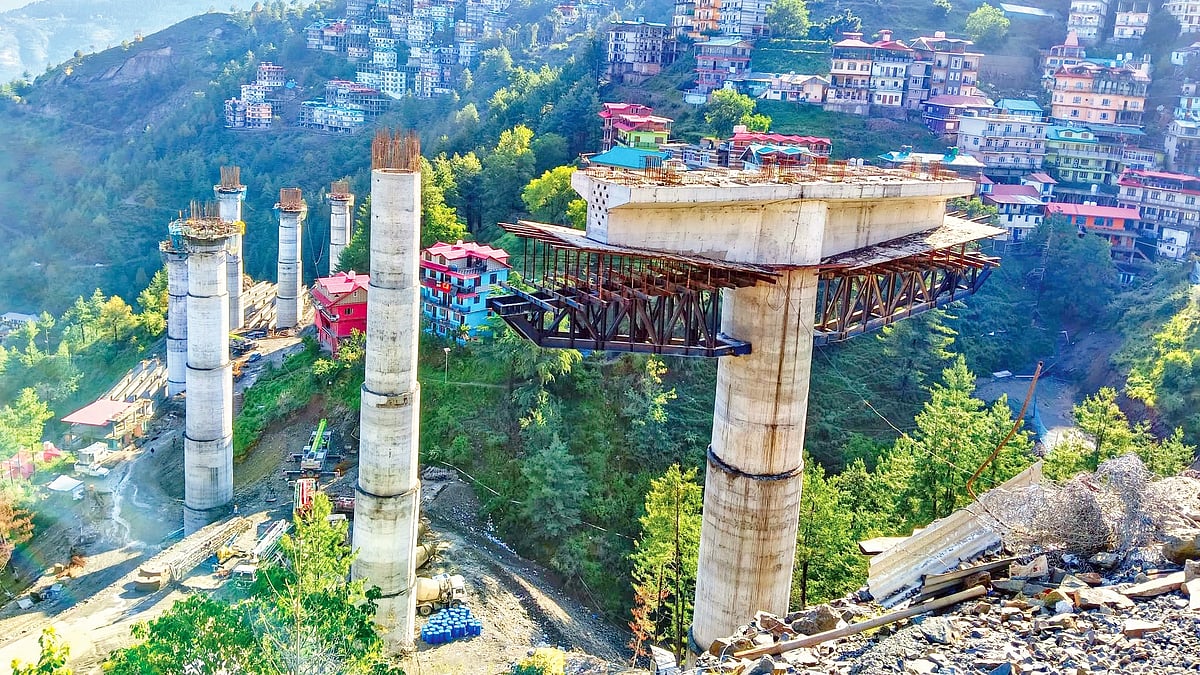
‘Development’ has gone berserk in Himachal: 12,000 hectares of precious forest land diverted in the last twenty years for various projects, 174 hydel projects sanctioned/commissioned, 5 million trees felled, construction rules relaxed to permit 10-storey buildings, the Shimla Development Plan 2041 approved to deregulate the city’s precious green belts and allow construction even in heritage and core areas, an epidemic of unnecessary four-lane highways crisscrossing the state, scores of tunnels under the fragile mountains, plans to increase tourist footfall from the present 20 million per annum to an unsustainable 50 million.
The natural features that held the fragile mountain strata together — trees, glaciers, snowfields, river drainage — are being decimated and destroyed by these activities. No number of warnings or reports from environmentalists and scientists that the mountains simply cannot sustain this level of anthropogenic activities have made the governments (past and present) see sense.
The Himalayas are now pushing back, with increasing intensity. Not-so-natural disasters in just three years (2022-24) have caused direct financial losses of Rs 13,500 crore to the state and claimed 800 lives; indirect losses to business and livelihoods are much higher. In 2026, the losses have already amounted to Rs 1,400 crore and 200+ dead.
The Himalayas are warming at twice the average global rate. This warming effect is being amplified by local ‘heat islands’ caused by emissions from heavy machinery and labour camps, carbon deposits on ice fields, pollutants from the ever-increasing number of vehicles intruding into high altitude fragile ecosystems, removal of green cover...
The permafrost which holds together the fractured mountain soil is melting. Dumping of muck in the watercourses is reducing their capacity to carry excess water, resulting in regular ‘flash floods’. Too many red lines have been crossed.
The warnings have been many: Kedarnath in 2013, Chamoli in 2021, Sikkim in 2023, Dharali in 2025, and now Nepal. Among the most dangerous impending threats to Himachal is the growing number and size of the glacial lakes in the state, primarily responsible for the disasters above.
In 1990, the state had 107 glacial lakes of noticeable size with a total area of 5.54 sq. km. Now there are 669 lakes over 11.20 sq. km. Some have reached dangerous proportions, like Ghepan in Lahaul which has grown six times to almost 100 hectares.
All the major rivers spring from the glaciers above these lakes and the hydel projects on these rivers are extremely vulnerable to GLOFs (glacial lake outburst floods). The very hydrology of these rivers is changing. Any damage to these projects would also endanger the lakhs of people living in towns and villages below them, as Nepal has so tragically shown.
Himachal is also naturally susceptible to other risks: the state comes under seismic category VI, the highest; it has 20,000 landslide-prone hotspots; and EWEs (extreme weather events) caused by climate change have gone up by 40 per cent in the last few years.
The time for studies and seminars is over. What is needed urgently is decisive action and a drastic change in the model of development the state has been following all these years. The government needs to consider these measures urgently:
Impose a moratorium on all new hydel projects, and stay those which have been sanctioned but not yet started construction. Scrap the dozens of projects approved/planned for the high-altitude Chenab and Chandrabhaga basin in Lahaul-Spiti, and in Kinnaur and Pangi areas (which the local people have already been protesting against for many years).
Exhume the 2010 report on the environmental impact of hydel projects by the then additional chief secretary (forests) which the high court had accepted, only for the then government to oppose it and successive ones to mothball it. Consider its major recommendations: ban hydel projects in high-altitude, alpine, glaciated, forest catchment areas; maintain a minimum distance of 5 km between projects; ensure minimum perennial flow of rivers; develop EIAs (environmental impact assessments), EMPs (environmental management plans) and CAT (catchment area treatment) plans for the entire river basin — not just individual projects — before sanctioning any project on any river. Review all projects in the light of these recommendations, and if they do not conform to them, or pose a threat, decommission them.
Vigorously oppose the Centre’s proposal for an 8.7 km tunnel below the Pir Panjal range to bring the waters of the Chandrabhaga in Lahaul to the Beas in Kullu. This project would rip out the heart of the Himachal Himalayas and be a disaster of unprecedented proportions. It would destabilise the geology of three districts; generate tens of millions of tonnes of muck which can only clog the rivers, waterways and drainage of these areas; disturb the underground aquifers and affect hundreds of water supply schemes. The additional water added to the Beas would amplify the river’s destructive potential, which already causes havoc in Kullu every year. New Delhi’s diplomatic failures (which triggered this project) should not morph into misery for the state.
Reconsider the mindless focus on increasing tourist numbers to 50 million per year. The state’s environment cannot support such numbers. The infrastructure needed — roads, buildings, water supply, sewage and garbage disposal — would result in huge damage to the natural environment and cultural identity of the state. Learn from the Bhutan model: limit numbers, improve quality.
Impose a ban on tourist/real estate/commercial constructions in rural areas, especially on the peripheries of major towns. Himachal’s cities have been ruined by such constructions, mainly by outsiders who are now despoiling the rural areas, cutting hills, felling trees, congesting rural roads, straining local water availability, polluting the forests and water sources with sewage and garbage, creating noise and light pollution The areas adjoining Kasauli, Solan, Shimla, Manali, Palampur and Dharamsala bear abundant testimony to this ravaging of the environment. Himachal’s rural areas should not be allowed to go the way of its towns.
Immediately discontinue and put a halt to the four-laning epidemic, which only benefits politicians, contractors and bureaucrats. They are not needed, they fracture the geology of the areas they pass through, destabilise the slopes, destroy properties, deprive people of livelihoods, encourage even more polluting vehicles to contaminate our pristine ambience. Both the Parwanoo-Shimla and Kiratpur-Manali highways are ongoing (and very expensive) disasters that prove this. Both remain ‘under construction’ after a decade.
The time to act is now. The Himalayas have tolerated our arrogance for centuries, but their patience is now wearing thin. Their warnings are getting more frequent, and more powerful each year. We call Himachal ‘Dev Bhoomi’ but ravage and pillage it shamelessly for votes and profit. This must change.
Even the Supreme Court warned the state government some months ago to be more sensitive to the environment or the state would ‘disappear from the map’ of India. We are proving right the words of Hubert Reeves, a French astro-physicist and environmentalist: ‘Man is the most insane species. He worships an invisible god and destroys a visible nature. Unaware that this nature he is destroying is the god he is worshipping.’
Respect nature. That is the true worship of God.
More of the writer's works here
Avay Shukla is a retired IAS officer and author of The Last Sky — Countdown for an Endangered Planet and other works. He blogs at avayshukla.blogspot.com
Join our official telegram channel (@nationalherald) and stay updated with the latest headlines