World
AfD’s regional election breakthrough sends shockwaves across Europe
Anti-immigration party’s landslide in Saxony-Anhalt piles pressure on Friedrich Merz’s government and raises concerns over the rise of nationalist politics across Europe
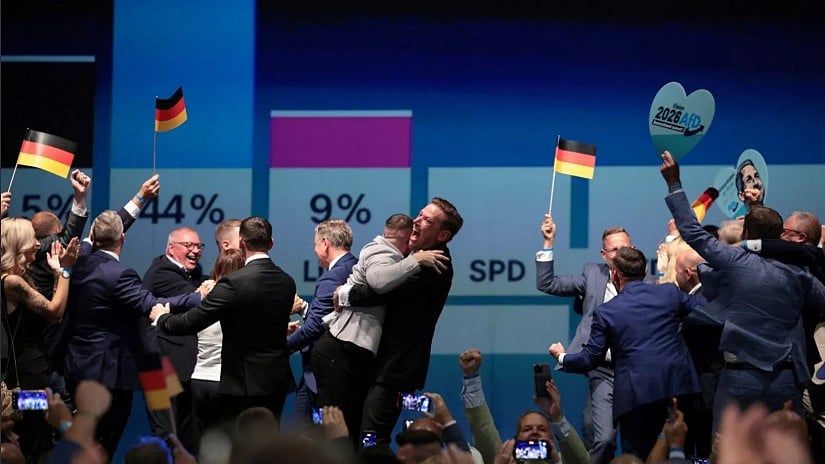
The Alternative for Germany (AfD) has scored a historic victory in regional elections in Saxony-Anhalt, securing a major breakthrough for the hard-right party and triggering political unease in Germany and across the European Union.
Although Saxony-Anhalt is one of Germany’s smaller states and the AfD fell short of an outright majority, the scale of its victory has given the result significance far beyond the state. The party’s performance is expected to increase pressure on Chancellor Friedrich Merz’s already unpopular centrist-conservative government and intensify debate over the future direction of German politics.
The result comes as the AfD is also polling as Germany’s strongest political force nationally. Its growing support has fuelled questions about whether the country’s mainstream parties have failed to address voters’ concerns over immigration, economic insecurity, public services and safety.
The election has also revived difficult questions about Germany’s relationship with its Nazi past. The German authorities have described the AfD as partly anti-democratic, while several regional branches, including its Saxony-Anhalt organisation, have been classified as far-right extremist by authorities.
The party has long enjoyed particularly strong support in eastern Germany, where economic disparities with the western states remain pronounced decades after reunification. Saxony-Anhalt is Germany’s poorest state, and some voters retain a degree of nostalgia for the perceived stability of the former communist era, a sentiment commonly referred to as “Ostalgie”.
The AfD’s rise is also attracting attention outside Germany because of its position on Russia and Ukraine. The party wants Germany to stop military assistance to Ukraine, lift sanctions on Moscow and restore access to cheaper Russian energy. Its position contrasts sharply with Berlin’s current policy and is particularly sensitive given Germany’s role as the largest single national donor to Ukraine.
Russia has openly welcomed the result. Russian businessman and investment official Kirill Dmitriev described the AfD’s performance as “historic”, while portraying the German government as discredited and Merz as humiliated.
US President Donald Trump also highlighted the result on his Truth Social platform. The AfD’s anti-immigration and nationalist messaging has similarities with Trump’s political approach, although European politicians generally avoid prominently associating themselves with the US president because of his unpopularity among many European voters.
The election is being closely watched in Brussels as Europe enters a busy electoral period. France, Italy, Spain and Poland are among the major countries expected to hold elections over the next 12 months, raising concerns that nationalist and populist parties could gain further ground.
Spain’s nationalist Vox leader Santiago Abascal welcomed the AfD victory as a “great hope for Germany and for Europe”. France’s Europe Minister Benjamin Haddad, meanwhile, described the result as a serious moment for Europe and warned about the implications of a far-right victory in a German regional election.
European officials are particularly concerned about the impact of stronger nationalist parties on EU unity. Parties such as the AfD and Italy’s League are generally Eurosceptic, while nationalist forces in several countries favour greater national control over issues including immigration, defence and foreign policy.
The concern comes at a difficult moment for Europe, which is dealing simultaneously with Russia’s war in Ukraine, US trade pressure and growing economic competition from China. European defence officials have also warned that divisions over sanctions on Russia and Nato could weaken the continent’s collective response to Moscow.
Yet the Saxony-Anhalt result also reflects domestic frustrations. Voters across Europe are increasingly concerned about immigration, personal safety, strained healthcare systems and declining economic security. Support for nationalist parties does not necessarily mean that all their voters have embraced extremist ideology, but it demonstrates growing dissatisfaction with established political forces.
For Germany’s mainstream parties, the AfD’s performance therefore represents a warning that cannot easily be dismissed as a regional anomaly. A party that remains untested in government is now attracting enough support for voters to seriously consider giving it a chance to govern.
The message from Saxony-Anhalt, encapsulated in the AfD’s campaign slogan — “Anything is Possible!” — is likely to reverberate well beyond the state as Germany and Europe confront the changing political mood.
Join our official telegram channel (@nationalherald) and stay updated with the latest headlines