World
Delhi Declaration gets BRICS approval after Iran-UAE differences are resolved
Negotiators bridge divisions among Iran, the UAE and Saudi Arabia over language addressing the continuing conflict
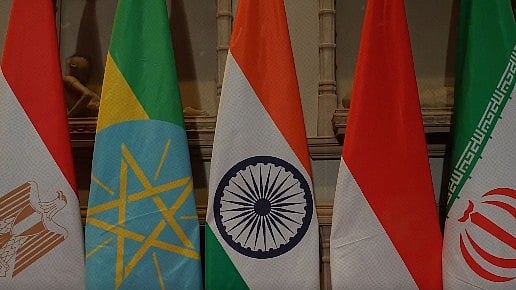
BRICS leaders on Saturday adopted the New Delhi Declaration by consensus after negotiators overcame sharp differences between Iran and the United Arab Emirates over the wording related to the conflict in West Asia.
The adoption of the declaration was made at the conclusion of the first day’s deliberations at the two-day BRICS Summit hosted by India.
The Hindu reported that negotiations continued until shortly before the declaration was adopted, with Iran and the UAE initially holding firm to their respective positions. Since BRICS operates through consensus, opposition from even one member could have prevented the grouping from issuing a joint document.
The principal disagreement concerned references to the military campaign launched by the United States and Israel against Iran and Tehran’s subsequent attacks on installations in the UAE and other West Asian countries, it was reported.
Iran had sought a clear condemnation of the actions taken by the US and Israel. The UAE, meanwhile, had pressed for corresponding criticism of Iran’s strikes. Tehran argued during negotiations that its military response was an act of self-defence and had targeted American military and associated installations.
The dispute had earlier prevented BRICS ministerial meetings from producing joint statements. External Affairs Minister S. Jaishankar issued a Chair’s Summary after the foreign ministers’ meeting in May when members could not agree on a common text.
A series of back-channel negotiations led by India ultimately helped resolve the differences and secure the declaration. The breakthrough echoed India’s diplomatic efforts during its G20 presidency in 2023, when New Delhi forged consensus on a declaration despite divisions over the Russia-Ukraine war. Russia’s close relationship with Tehran was considered important in efforts to break the deadlock, The Hindu reported.
Speaking on the occasion, Prime Minister Narendra Modi said the deliberations showed that institutions created for an earlier era were no longer equipped to manage a rapidly changing world.
“Today’s discussion makes it evident that the changing world cannot be steered by outdated institutions; reforms are essential in representation, responsiveness and rulemaking,” he said in his concluding remarks.
“We also emphasised that the Global South must have equal participation in the development of future technologies and the rules governing them,” the Prime Minister added.
Modi said partnerships and collective action were necessary to close the gap between decisions and their implementation.
“The New Delhi Declaration adopted today provides a clear direction for our shared resolve. It is now our responsibility to translate these resolutions into tangible results,” he said.
Leaders of eight BRICS countries — India, Russia, China, Iran, Egypt, Ethiopia, South Africa and Indonesia — attended the summit proceedings at Bharat Mandapam in New Delhi. The meeting brought the leaders together for the first time since the conflict involving Iran began.
Brazilian President Luiz Inácio Lula da Silva, whose country is heading towards elections, was represented by Foreign Minister Mauro Vieira. UAE President Sheikh Mohamed bin Zayed Al Nahyan, who is visiting Germany, sent Abu Dhabi Crown Prince Sheikh Khaled bin Mohamed bin Zayed Al Nahyan as his representative.
Saudi Arabia, which was invited to join BRICS in 2024 but has yet to formalise its membership, was represented by its foreign minister.
Modi also held a meeting with the Abu Dhabi Crown Prince before the joint session on Saturday.
India also accorded a high-profile welcome to Pezeshkian. The Iranian President was scheduled to meet President Droupadi Murmu, making him the only visiting BRICS leader at the summit to hold such a meeting.
The West Asia conflict has posed a major diplomatic and economic challenge for BRICS. In addition to deepening tensions between Iran and the UAE, the hostilities have disrupted cargo traffic through the Strait of Hormuz and driven up energy prices, affecting several countries in the grouping.
Former multilateral affairs secretary Dammu Ravi said the participation of the leaders amid geopolitical and economic uncertainty reflected their continued confidence in BRICS. He added that the summit offered India an opportunity to focus attention on solutions to the challenges facing the Global South.
With PTI inputs
Join our official telegram channel (@nationalherald) and stay updated with the latest headlines