World
Gaza marks 1,000 days of war amid deepening humanitarian crisis
Gaza Ministry of Health says 1,072 Palestinians have been killed since October ceasefire, raising the death toll to 73,098
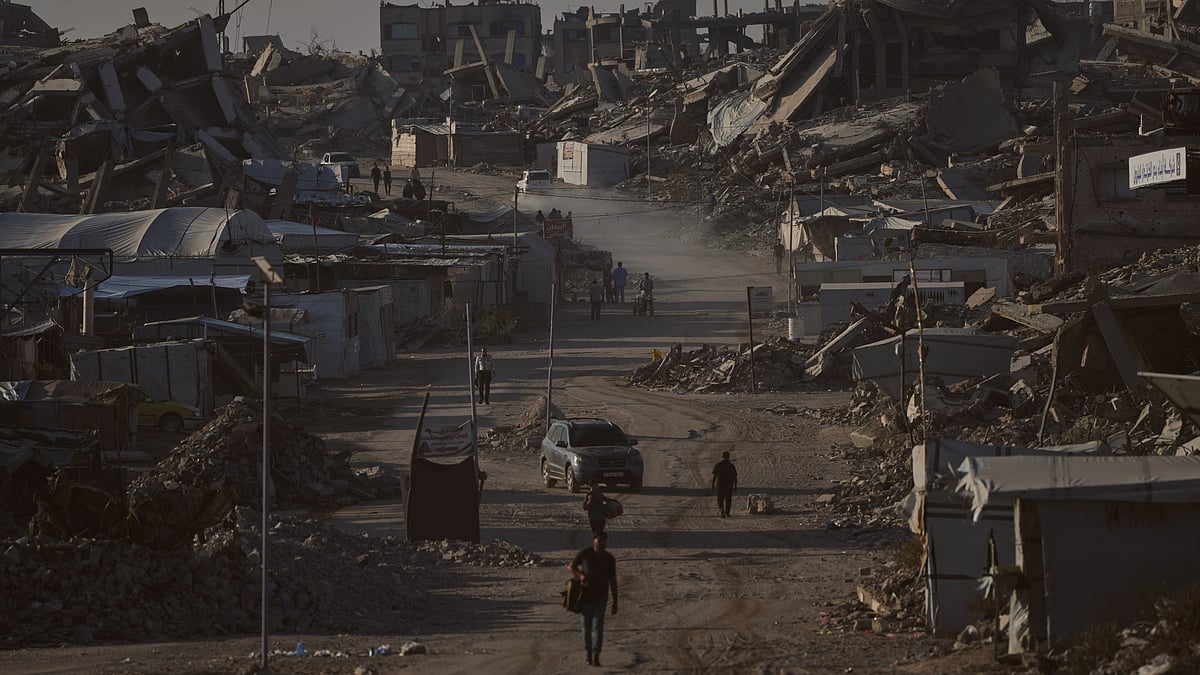
The Gaza Strip crossed another devastating milestone this week, marking 1,000 days since the war began in October 2023, as relentless violence, a worsening humanitarian catastrophe and growing political uncertainty continued to reshape the Palestinian enclave.
According to Gaza's Government Media Office, over 90 per cent of the territory has been destroyed, leaving entire neighbourhoods in ruins and hundreds of thousands of people displaced, the Al Jazeera reported.
The Gaza Ministry of Health said that 1,072 Palestinians have been killed since the October ceasefire, taking the overall death toll since the start of the conflict to 73,098, the Al Jazeera reported.
The violence showed little sign of easing during the sombre anniversary. Israeli drone strikes and shelling continued across the enclave, with local reports saying at least three Palestinians were killed near al-Hilu station on 1 July, followed by at least seven more deaths over the next two days. Among those killed were a child reportedly struck by a quadcopter-dropped explosive at the Shujayea junction and 10-year-old Tareq Sabah, who died near Khan Younis.
Israeli strikes also repeatedly hit tents sheltering displaced families inside the designated al-Mawasi humanitarian zone, an area previously identified as a refuge for civilians fleeing the fighting.
Humanitarian crisis deepens
Gaza's already fragile healthcare system remains under immense strain, with hospitals struggling to function amid shortages of medicines, medical equipment and fuel.
Patients and their families gathered outside al-Shifa Hospital in Gaza City during the week, demanding that Israel ease restrictions on medical evacuations. Gaza health authorities said more than 20,000 critically ill and wounded people remain on waiting lists for evacuation through the heavily restricted Rafah crossing.
The UN Working Group on Arbitrary Detention has called for his immediate release, stating that his continued detention violates international human rights obligations under the Universal Declaration of Human Rights and the International Covenant on Civil and Political Rights.
Political transition begins
Amid the continuing conflict, political developments signalled the possibility of a new administrative structure in Gaza.
Representatives of the US-backed Board of Peace, including former British prime minister Tony Blair, met in Cyprus to discuss plans for the temporary reconstruction of areas designated free of Hamas control.
On Monday, Gaza's Hamas-run administration announced its resignation and said authority would eventually be transferred to a technocratic committee backed by the Board of Peace under a reconstruction framework proposed by US President Donald Trump.
However, the transfer of power has yet to take place.
Ali Shath, head of the National Committee for the Administration of Gaza, said the committee stands ready to assume responsibility once the required political and administrative conditions are met, including the establishment of a unified governing authority and resolution of the question surrounding Hamas's future role.
The Board of Peace also declared that the UN agency for Palestinian refugees (UNRWA) would have "no place in the new Gaza", a position rejected by Palestinian leaders, who argued it undermines the rights of Palestinian refugees.
Settlement expansion accelerates in West Bank
While fighting continues in Gaza, Israel has also intensified settlement activity across the occupied West Bank.
Israeli Prime Minister Benjamin Netanyahu laid the foundation stone for a new Israeli heritage centre at the site of the former Qalandia Airport near occupied East Jerusalem, part of the broader Atarot settlement project.
Earlier in the week, Israel's Security Cabinet approved the establishment of 13 new settlements in the Binyamin bloc stretching towards the Jordan Valley.
Palestinian officials said the project is designed to further isolate East Jerusalem from surrounding Palestinian communities and weaken territorial continuity.
According to data compiled by the Palestinian Forum for Israeli Studies, settlement outpost construction has accelerated sharply in recent years, rising from an annual average of around eight between 2012 and 2022 to 32 in 2023, 62 in 2024 and 86 in 2025.
New settlement outposts were also reported during the week near Jenin and northeast of Jerusalem.
The Israeli government additionally approved a 27-million-shekel (approximately $9 million) programme aimed at expanding tourism infrastructure in West Bank settlements.
Israeli finance minister Bezalel Smotrich described recent administrative measures transferring greater civilian control over archaeological and heritage sites in the occupied territory as "only the beginning of the settlement revolution".
Checkpoints, displacement and settler violence
Humanitarian conditions in the occupied West Bank also continued to deteriorate.
On Sunday, four-month-old Ahmad Marouf Zeid reportedly died after Israeli soldiers prevented his family from reaching an ambulance outside Deir Ammar refugee camp near Ramallah.
According to Palestinian officials, the infant's transfer to hospital was delayed for more than an hour despite his critical condition.
Movement restrictions also intensified, with Israeli forces sealing several towns around Ramallah through military checkpoints, gates and road closures.
Reports from Palestinian media and human rights organisations documented multiple incidents of settler violence during the week, including attacks on villages, assaults on residents, livestock theft and arson targeting Palestinian-owned property.
Israeli forces also carried out demolitions in several locations, including a decades-old sports field near Bethlehem, residential structures and agricultural buildings.
According to the UN Office for the Coordination of Humanitarian Affairs (OCHA), more than 2,300 Palestinians — including over 1,000 children — have been displaced across the West Bank during 2026, while 121 Palestinian communities have experienced complete or partial displacement since 2023, underscoring the continuing humanitarian consequences of the conflict beyond Gaza itself.
Join our official telegram channel (@nationalherald) and stay updated with the latest headlines