World
Putin’s India visit: High optics, hard realities
For Moscow, visit offers opportunity to project normalcy and reaffirm increasingly narrow list of dependable partners
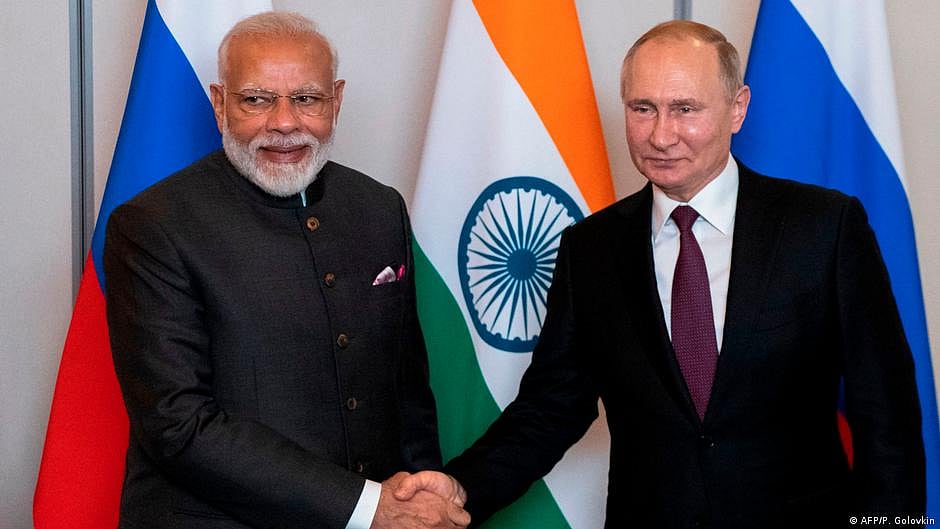
President Vladimir Putin’s two-day visit to New Delhi arrives at a moment of turbulence in India’s foreign policy, when the government is juggling sanctions-laden ties with Russia, a bruised relationship with the United States, and escalating pressures on its defence and energy security. The official language speaks of a “Special and Privileged Strategic Partnership,” but beneath the ceremonial veneer sits a far more complicated ledger.
For Moscow, the visit offers an opportunity to project normalcy and reaffirm an increasingly narrow list of dependable partners. For New Delhi, it is a balancing act—one that demands public warmth towards an old ally while quietly managing the risk of being entangled in the fallout of the US-Russia confrontation.
Russia has placed a familiar set of offers on the table. Discussions on additional S-400 units, the Su-57 fifth-generation fighter, and possibly even elements of the S-500 missile defence system are likely to dominate the headlines. Kremlin spokesperson Dmitry Peskov has already hinted that the S-400 could be a key agenda point, while claiming Russia’s defence industry is “working pretty well”.
The facts, however, tell a less flattering story. India’s pending S-400 deliveries are running behind schedule, with completion now pushed to 2026. Russia’s military-industrial complex—strained by the Ukraine war, supply chain disruptions and a chronic shortage of microchips—has struggled to meet existing commitments. Analysts openly question whether Moscow can deliver on a suite of next-generation systems when it is struggling with legacy orders.
Even within India’s strategic circles, enthusiasm for the Su-57 remains limited. New Delhi quietly walked away from joint development of a fifth-generation fighter years ago, frustrated by technology-transfer gaps and performance concerns. Yet Russia continues to pitch the aircraft as if India’s interest were a foregone conclusion.
In reality, the visit is likely to produce more statements of intent than binding contracts.
India–Russia trade has ballooned since 2022, largely because of discounted Russian crude. But this surge has proven both shallow and unsustainable. The trade imbalance is stark—India exported less than $5 billion to Russia in FY25 while importing more than twelve times that amount.
Private refiners, spooked by the threat of secondary US sanctions, have already begun cutting back Russian oil purchases. The latest American sanctions on Rosneft and Lukoil have exacerbated uncertainty.
Even New Delhi acknowledges the boom has peaked. With Russia’s ability to supply cheap oil now constrained, both sides are scrambling to diversify the trade basket. Moscow wants to sell nuclear technology, small modular reactors, and “technological solutions.” India, meanwhile, is eager to push pharmaceuticals, machinery, agricultural products and chemicals into the Russian market.
But none of this compensates for the scale of energy-driven trade. The structural imbalance will persist and may even worsen as India shifts more of its energy purchases towards the United States to calm tensions.
The visit takes place under the long shadow of US economic coercion. India already faces cumulative tariffs of up to 50 per cent on several categories of exports. Washington has signalled that harsher measures are in the pipeline as part of new legislation aimed at tightening the screws on Russia’s partners.
The proposed Sanctioning Russia Act of 2025 is particularly alarming. It envisions duties of up to 500 per cent on countries “knowingly” purchasing Russian oil or petrochemical products—effectively placing a sword over the heads of energy-dependent nations like India. While the US president will have discretion in invoking these penalties, the uncertainty itself is disruptive.
India has started responding quietly. State-owned companies have signed a substantial LPG deal with the US, and crude imports from America are rising. Russian oil, once the centrepiece of India’s energy strategy, is slowly being edged out—especially by private refiners wary of being locked out of global financial systems.
New Delhi insists this is about “energy security for 1.4 billion Indians,” but Washington’s allegation that India profits by re-exporting Russian crude has taken a toll on public perception. Combined with President Trump’s erratic diplomacy and periodic jabs at India, the political cost of managing the bilateral relationship has gone up significantly for Prime Minister Narendra Modi.
The Indian government’s messaging around Putin’s visit is designed as much for domestic consumption as for diplomatic signalling. By emphasising Russia as a “time-tested partner,” New Delhi seeks to reassure domestic constituencies that it is not capitulating to American pressure.
But the underlying reality is harder to brush aside. Russia’s defence capacity is overstretched; its ability to fund joint projects is constrained; its economy is increasingly isolated; and its leverage over India is now far more transactional than sentimental. India, meanwhile, is broadening its defence procurement to France, Israel and the US. Russia’s share of India’s arms imports has already dropped from over 70 per cent a decade ago to just 36 per cent today.
Putin’s presence in New Delhi allows both sides to claim continuity, but continuity itself is no longer a convincing measure of strength. For Russia, India represents one of the few remaining large markets for oil, arms, and nuclear cooperation. For India, Russia is still a useful partner, but no longer an indispensable one.
The real question is whether New Delhi can continue walking the diplomatic tightrope while facing punitive US sanctions on one side and Russian over-dependence on defence legacy systems on the other.
This visit may produce warm photographs and a string of MoUs, but it will not resolve the fundamental contradictions shaping India’s foreign policy. Those contradictions are deepening—and no amount of ceremonial rhetoric can disguise the hard choices New Delhi will have to make in the months ahead.
With agency inputs
Join our official telegram channel (@nationalherald) and stay updated with the latest headlines