Nation
A river that binds and divides two neighbours
Bangladesh wants changes in the terms of the Ganga Water Treaty. And the time for negotiations is running out
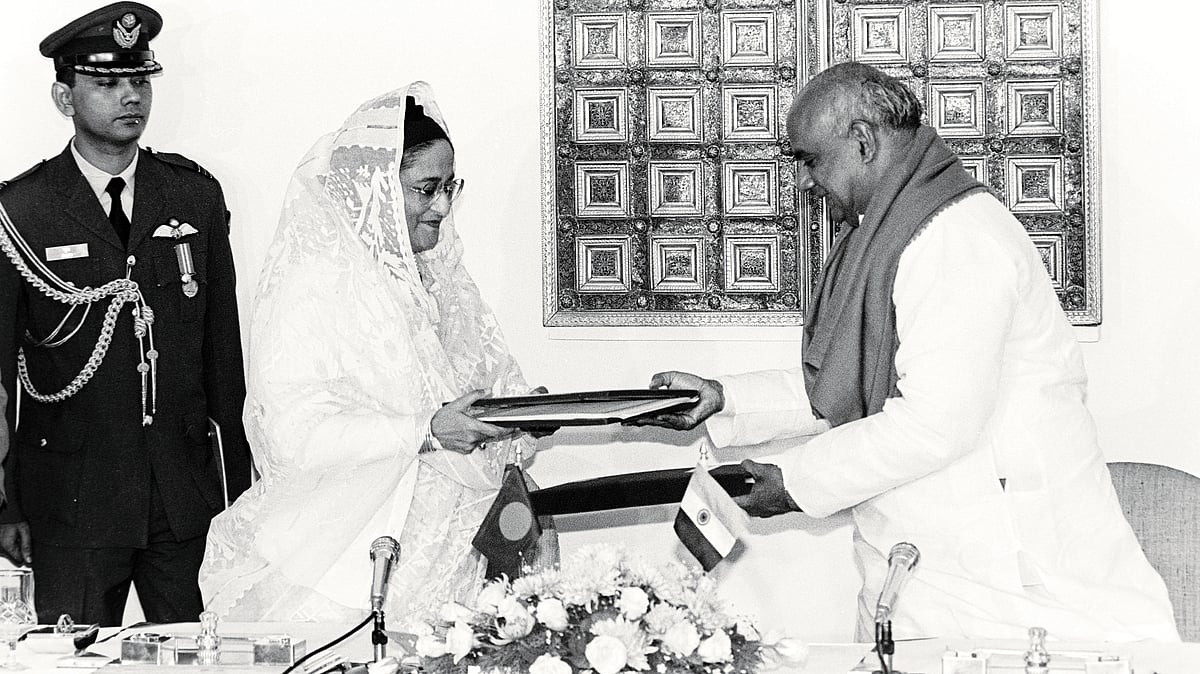
The Ganga Water Treaty between India and Bangladesh, signed in 1996, is up for renewal in December 2026. It was signed in an atmosphere of goodwill and neighbourliness by then Indian Prime Minister H.D. Deve Gowda and his counterpart in Bangladesh, Sheikh Hasina. Now, when the treaty must be re-negotiated, there is mistrust on both sides.
There is a BJP government at the Centre and in the upper riparian states of Uttarakhand, Uttar Pradesh, Bihar and West Bengal — the state where the Ganga forks at the Farakka Barrage, with one stem entering Bangladesh (the Padma) and another bending south towards Kolkata (the Bhagirathi-Hooghly).
The political colour of the upper riparian states matters because the rhetoric and political moves of the ruling BJP have lately been hostile to Bangladesh and Muslims on both sides of the border. Understandably, then, the goodwill of the past has evaporated, which puts the treaty in jeopardy.
Sanjay Jha, Janata Dal (U) MP from Bihar, has urged the Union government to not renew the treaty in its current form, asserting that the treaty has impacted the state negatively. His press note states: ‘Bihar is not seeking a favour. We are only asking for what our own scientific assessment establishes, so that 13 crore people are not left short of water for drinking, irrigation and industrial supply for another 30 years.’
Political parties in West Bengal agree on the need to renew the treaty but are divided on how to go about it. Silting, riverbank erosion and the navigability of Kolkata port are key concerns.
While in power, Mamata Banerjee had strongly opposed the Centre’s bilateral discussions that kept the state out of the loop. The current BJP dispensation in the state has little choice but to support the Centre’s stance on renewing the treaty while emphasising that national security and federal water management are Central mandates.
The Opposition CPI(M) and Congress advocate a tripartite consensus model, featuring extensive parliamentary debate, multi-state consultations (including Bihar) and technical review by environmental scientists.
It is worth recalling that Deve Gowda’s United Front government, which signed the 1996 treaty, was supported from outside by the Congress and the CPI(M), a detail that underlines the treaty’s consensual character.
The CPI(M) was also in power in West Bengal. While then chief minister Jyoti Basu and Pranab Mukherjee of the Congress, both with strong cross-border ties, provided political heft, West Bengal finance minister Asim Dasgupta was the lead Indian negotiator with Bangladesh. Despite the divergence in their politics, Gowda, Basu and Mukherjee were on the same page when it came to water sharing.
****
From a technical perspective, the treaty has delivered what it was designed for — adequate water for both countries. For context, experts rate it way above the Indus Waters Treaty, which was controversial even before the terror attack in Pahalgam and Operation Sindoor thereafter worsened relations between India and Pakistan.
The reason for considering it the most successful mechanism in the history of transboundary water treaties is simple. Speaking to National Herald, river expert and ecological economist Nilanjan Ghosh said: “This treaty was maintained by both sides to a tee. It is a model of how a bilateral treaty (the Rhine or Danube treaties involve multiple players) should be drafted and adhered to.”
The water allocation formula applies to the five-month lean period from 1 January to 31 May, when the flow is measured and divided at 10-day intervals based on real-time data at Farakka Barrage. If the flow is above 75,000 cusecs, India receives a fixed 40,000 cusecs and the remaining flow goes to Bangladesh. For flow between 70,000 and 75,000 cusecs, Bangladesh receives 35,000 cusecs and India gets the balance. Below 70,000 cusecs, available water is split evenly.
If total water availability drops below 50,000 cusecs during a 10-day period, both governments initiate bilateral emergency consultations to adjust releases fairly. During the leanest period (11 March to 10 May), each country is guaranteed a minimum flow of 35,000 cusecs in alternating 10-day cycles to ensure equitable access during peak demand.
The treaty has also mandated a joint committee with representatives from both sides to monitor daily water levels at Farakka (India) and Hardinge Bridge (Bangladesh).
Ghosh pointed out that Bangladesh was receiving at least 20-25 per cent more water in the dry season at its first measuring station at Hardinge Bridge than what was released from Farakka. Both countries are aware of this excess flow in the lean season. Experts have advanced several arguments to explain this. These include recharged aquifers, upstream regulation mechanisms as well as excess flow through the Mahananda channel located upstream of Hardinge Bridge and downstream of Farakka.
****
As a lower riparian state, Bangladesh is keen to renew the treaty with modifications it believes will protect its interests. Bangladesh president Mirza Fakhrul Islam made a pointed request when India’s new high commissioner Dinesh Trivedi called on him on 8 September: settle the water disputes between the two countries, and give Bangladesh its fair share, specifically from the Ganga and Teesta rivers. Trivedi said India was taking “positive measures”.
The Ganga treaty is the only comprehensive water-sharing agreement between Bangladesh and India even though the two countries share 54 transboundary rivers. There is no provision for automatic renewal, and barely three months before it lapses, the two governments have still not announced formal negotiations on what will replace it.
In a report tabled on 30 July, the parliamentary standing committee on external affairs chaired by Congress MP Shashi Tharoor said failure to reach a new arrangement before the treaty expires ‘could erode mutual confidence and further complicate bilateral ties’.
The consequences of letting the treaty simply lapse are significant. India will not be free to take as it pleases. Under international law, Bangladesh will continue to have rights as a downstream state, including the equitable and reasonable use of shared watercourses and the obligation to avoid significant transboundary harm. But those principles are less precise than a treaty that specifies volumes, monitors arrangements and outlines procedures for resolving disagreements.
Also at stake is the agreed arithmetic of water sharing under the treaty. There will no longer be a binding bilateral formula telling the countries how to divide the water available at Farakka during each 10-day period of the dry season. Bangladesh will lose the treaty framework through which flows are jointly monitored and disputes over implementation addressed.
If the sides reconvene, the existing arrangement could either be renewed or the countries may negotiate a revised treaty incorporating stronger guarantees and modern river-management provisions. Bangladesh won’t mind if December 2026 does not bring some kind of new agreement.
Water resource expert Ainun Nishat told National Herald that Dhaka is no longer asking merely “to preserve what it got in 1996”. Its publicly stated negotiating position now includes “a higher water share, a guaranteed mechanism and an agreement better equipped to deal with the changing hydrology of the river […] the difficulty is that India’s negotiating position is moving in the other direction. New Delhi must first account for demands from Bihar and other domestic interests”.
Bangladesh has been spelling out what it wants from the next treaty. India has said where the discussion should take place — the Joint Rivers Commission — but is yet to publicly spell out what it is prepared to offer.
Join our official telegram channel (@nationalherald) and stay updated with the latest headlines