Nation
Accused can't be denied access to documents if part of chargesheet: SC
Top court allows former RAW officer V.K. Singh access to confidential records, citing fair trial rights under Article 21
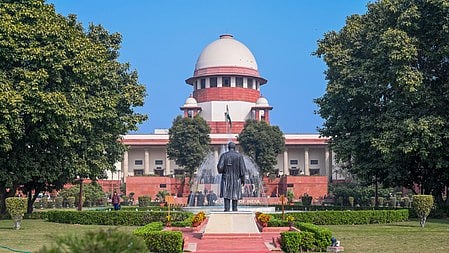
The Supreme Court has ruled that an accused person cannot be denied access to documents that form part of a chargesheet, observing that withholding such material could undermine the right to a fair trial.
The observation was made by a bench of Justices J.K. Maheshwari and A.S. Chandurkar while hearing a plea filed by retired Major-General V.K. Singh, a former officer of the Research and Analysis Wing (RAW), who is facing prosecution in a case registered under the Official Secrets Act, 1923.
In its 18 May order, the bench directed that typed copies of certain documents classified as "highly confidential" be provided to Singh for the purposes of his defence, subject to strict conditions preventing their public disclosure.
The court noted that the Central Bureau of Investigation (CBI) had not disputed the relevance of the documents sought by Singh. The agency's primary objection was that the records contained sensitive material relating to national security and that supplying copies could risk their circulation in the public domain.
Rejecting the argument that confidentiality alone could justify withholding the documents, the bench emphasised that access to material relied upon by the prosecution was a fundamental component of a fair criminal trial.
"It is trite law that an accused cannot be denied access to documents forming part of the chargesheet, including those from the general diary, if such documents were obtained in good faith, are relevant to the prosecution's case, and their disclosure is considered necessary by the public prosecutor for the interests of justice and fair trial," the court said.
"It is so because withholding such documents could seriously prejudice the accused's right to a fair trial," it added.
The order came on Singh's appeal against a September 2024 Delhi High Court ruling that had modified an earlier trial court order directing the prosecution to supply copies of the documents.
Singh had approached the trial court under Section 207 of the Code of Criminal Procedure (CrPC), seeking copies of certain documents that formed part of the chargesheet but had not been furnished to him. Section 207 requires the accused to be supplied with copies of the police report and other relevant documents relied upon by the prosecution.
The Supreme Court observed that since the documents formed part of the chargesheet and were intended to be used during the prosecution, Singh was entitled to receive them.
"In our view, being part of the chargesheet and being used against, the said documents ought to be supplied to the appellant," the bench said.
At the same time, the court sought to strike a balance between the accused's right to a fair trial and concerns relating to national security and sovereignty. To achieve that balance, it asked the law officer representing the CBI to suggest a workable arrangement.
During the hearing, the law officer proposed that typed copies of the documents could be supplied, provided Singh undertook to use them solely for court proceedings and not disclose or circulate them through electronic media, print publications or social media platforms.
Accepting the proposal, the court set aside the high court's order and modified the trial court's earlier directions.
"We direct that the typed copy of the documents as referred in the application filed by the appellant under Section 207 of CrPC... be provided to the accused for the purpose of his defence within two months," the bench said.
The court also directed that the documents must not be made public in any form and ordered Singh to file an undertaking before the trial court within one month affirming compliance with the restriction.
The case dates back to September 2007, when the CBI registered an FIR against Singh following allegations that he had disclosed classified information through his book, "India's External Intelligence – Secrets of Research and Analysis Wing".
A chargesheet was filed in April 2008 under provisions of the Official Secrets Act and the Indian Penal Code. The investigating agency simultaneously requested that classified documents attached to the chargesheet be kept in sealed cover.
Subsequently, Singh moved the trial court seeking access to those documents under Section 207 of the CrPC.
In December 2009, the trial court directed the prosecution to supply the requested documents after obtaining appropriate orders for their de-sealing. However, it imposed conditions requiring that the records remain in the personal custody of Singh's counsel and not be circulated in any manner.
The prosecution challenged that order before the Delhi High Court, which modified the directions and permitted Singh only to inspect the documents in court to enable him to prepare his defence.
The Supreme Court has now restored broader access to the material, while simultaneously imposing safeguards to ensure that sensitive information remains protected from public disclosure.
With PTI inputs
Join our official telegram channel (@nationalherald) and stay updated with the latest headlines