Nation
Aravalli, India’s backbone, is on the verge of breaking
A mining-free Aravalli is the best model of environmental protection and ‘sustainable development’ for India and the world
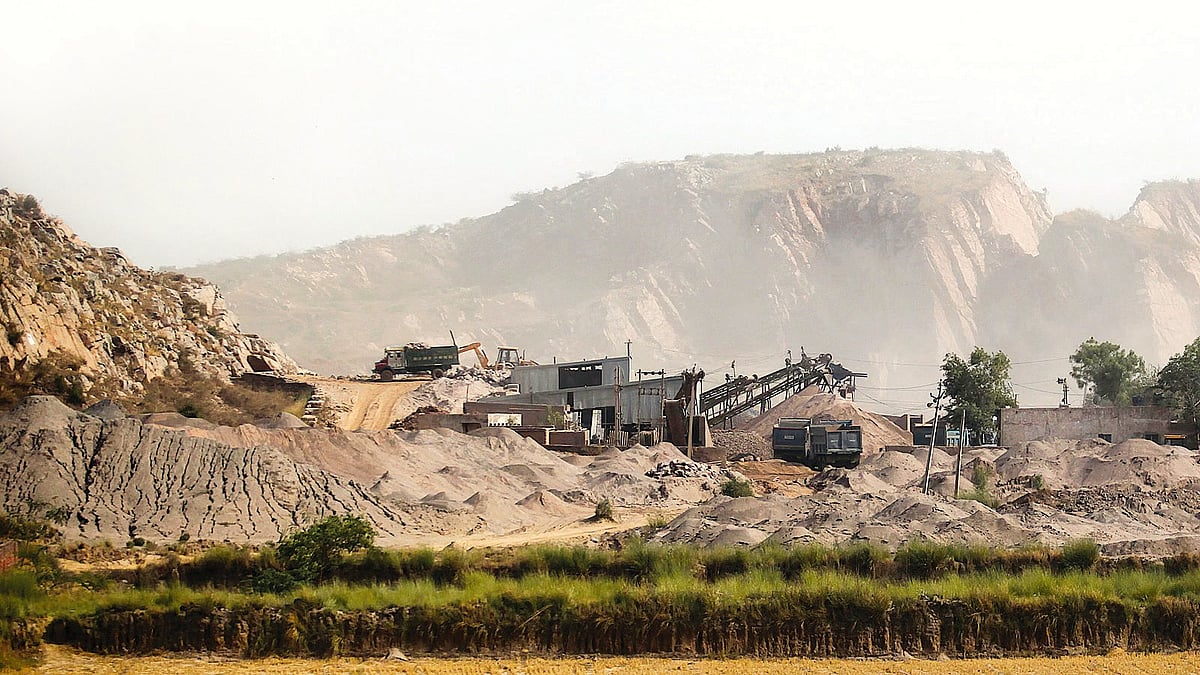
The Aravalli range is India’s only transverse mountain system. Most of India’s mountain chains run in a north-east direction, aligned with the monsoon. The Aravallis, by contrast, stand chest out from south-west to north-east. That very stance allows them to absorb the sand-laden storms blowing in from the west into their dense forests.
This is why the Aravallis are called India’s backbone. They are also the world’s only ancient mountain range where, even today, fresh sand dunes can be seen wedged between primordial rock formations.
After conducting a remote-sensing study, Prof. S.S. Dawariya — then director of the Birla Institute of Scientific Research, Jaipur — submitted his report to the Supreme Court as part of a petition I had filed. By then, mining had already ripped open 22 massive gaps in the Aravallis.
After hearing me and examining the report, then Chief Justice of India M.N. Venkatachaliah had directed the Government of India to protect the Aravallis to shield Delhi from sandstorms. That directive led to the ministry of environment and forests issuing the Aravalli protection notification of 7 May 1992.
Even before that, the Supreme Court had delivered a historic judgment, recognising the Aravallis as a single, integrated mountain system and ordering that it be saved.
At the time, it felt like the Aravallis’ tears had been wiped away, that the judiciary understood the pain. But after reading the Supreme Court’s judgment of 20 November, along with the reports and affidavits, I must say, with profound grief, that no one seems to understand the pain of the Aravallis.
The mountain itself has now been divided into ‘high’ and ‘low’. Only peaks higher than 100 metres will count as Aravallis; anything lower will simply cease to exist as Aravalli. Go ahead, then — erase those small hills we have been fighting to save since the 1980s!
In 1986, to regenerate the Aravallis, we built a large dam in Gopalpur village with the Meo community, to reduce grazing pressure on the hills. As soon as the dam was built, water returned to Gopalpur. Young men who had left the village — helpless, unemployed and sick — started returning the moment they saw water in the wells.
Around then, Jansi Meena from Palpur village came to me and said, “All our wells have dried up because of the mines. Please build a johad [earthen check dams built to store rainwater and recharge ground water] for us too.” We then built johads in Palpur under Jansi Meena’s leadership and in Tilwari under Chhotelal Meena. Chhotelal used to say, “Mining is destroying the mountain — and it’s destroying us too. The johad you’ve built will keep us alive only if mining is stopped completely.”
Tarun Bharat Sangh [an NGO founded by the author in 1975 that works on climate change mitigation and adaptation by promoting water conservation, sustainable agriculture and rural development in the arid and semi-arid regions of India] built johads in both villages, but all the water drained straight into the mines, because the pits were far deeper than the wells. From that point on, the fight to save water became a fight against mining.
When the mines were shut down following strict Supreme Court orders, the wells in both villages filled to the brim again. After that, Jansi Meena’s son Khyaali Ram Meena, along with Mahesh Sharma and Gopi Kumar Malana, launched the ‘Save the Aravallis Yatra’ across the region.
In Palpur, Tilwari, Tilwad, Verwa Dungri, Baldevgarh, Govardhanpur and Malana, sarpanch Panchu Ram led direct satyagrahas that forced mining to stop. Big mine owners like Patni and R.K. Marble also turned up in Malana, but they didn’t have the nerve to operate in the face of a people’s satyagraha.
Those were the days of fearless judges like Justice Venkatachaliah, who understood the pain of the mountains, of the people who lived among them — and delivered justice to the Aravallis.
On 10 October, I visited him at his home in Bengaluru. He remembered the entire Aravalli saga. He said, “We gave clear instructions to the Central and state governments to protect those who protect the mountains from the mining mafia. No action can be taken against Rajendra Singh without the Supreme Court’s permission.” That order had saved the life and dignity of the Aravallis.
Mine owners slapped dozens of false cases against me; the police too harassed me. But back then, there were laws to protect environmental activists — and those laws were enforced. In those days, the mountain and its protectors were safe from mining predators. Today, who knows what has changed, but no one is willing to heed the anguish of the Aravallis. Those who understand it want to save it, but the saviours today have their back to the wall.
The transverse orientation of the Aravallis is the reason why the Aravalli region receives more regular rainfall than the neighbouring Rajasthan desert. The range is criss-crossed with vertical fractures through which rainwater percolates into underground aquifers.
This is why, even today, all four Aravalli states — Rajasthan, Haryana, Delhi and Gujarat — still have sweet, safe drinking water wherever the Aravallis run. This mountain range is the country’s largest groundwater bank. That is why areas like Khadakpur in Delhi, Kala Amb in Haryana and the Gurugram–Fatehabad–Nuh belt were once proposed as protected groundwater zones. In Haryana, wherever there are hills, there is sweet water; the plains are saline.
The same pattern holds even today across all four Aravalli states. If mining resumes in these hills, cloud balance will collapse, weather cycles will turn erratic, floods and droughts will intensify, crop yields will fall, food and drinking water security will be imperilled, and social anxiety will rise. In the name of ‘sustainable development’, mining now threatens to unleash devastation.
If we understand the Aravallis, we can begin to overcome this crisis. The hills, in turn, will heal our pain — by gifting us both food and water security and a clean environment. They will rid our villages of unemployment, disease and forced migration, and lead us to regions free of pollution, environmental degradation and encroachment. But if mining resumes, the encroachment of forests, the pollution of water bodies and the exploitation of young people will return.
Deforestation will accelerate soil erosion, silt will choke farmlands, and the expanse of fertile land will shrink. Fodder for livestock and drinking water for women will become scarce. This has been my experience: when the mines were operating, people became bonded labour and villages began to collapse. When the mines shut, people reclaimed their land and returned to farming. If mining resumes, the same misery will return.
The pain of the Aravallis and the pain of its people are one. The degradation of this mountain range and the crisis of its people and their culture have converged.
To stop this, we must recognise the danger and save the Aravallis from mining. A mining-free Aravalli will be the best model of environmental protection and sustainable development — a gift not just for India but for the entire world.
Water conservationist ‘Jalpurush’ Rajendra Singh won the Ramon Magsaysay award in 2001 and the Stockholm Water Prize in 2015. Translated from an essay in his new book Aravalli Par Naya Sankat
Join our official telegram channel (@nationalherald) and stay updated with the latest headlines