Nation
Delhi-NCR hit by double whammy of biting cold and high air pollution
A persistent cold wave and severe pollution have turned daily life into a struggle across the capital and its outskirts
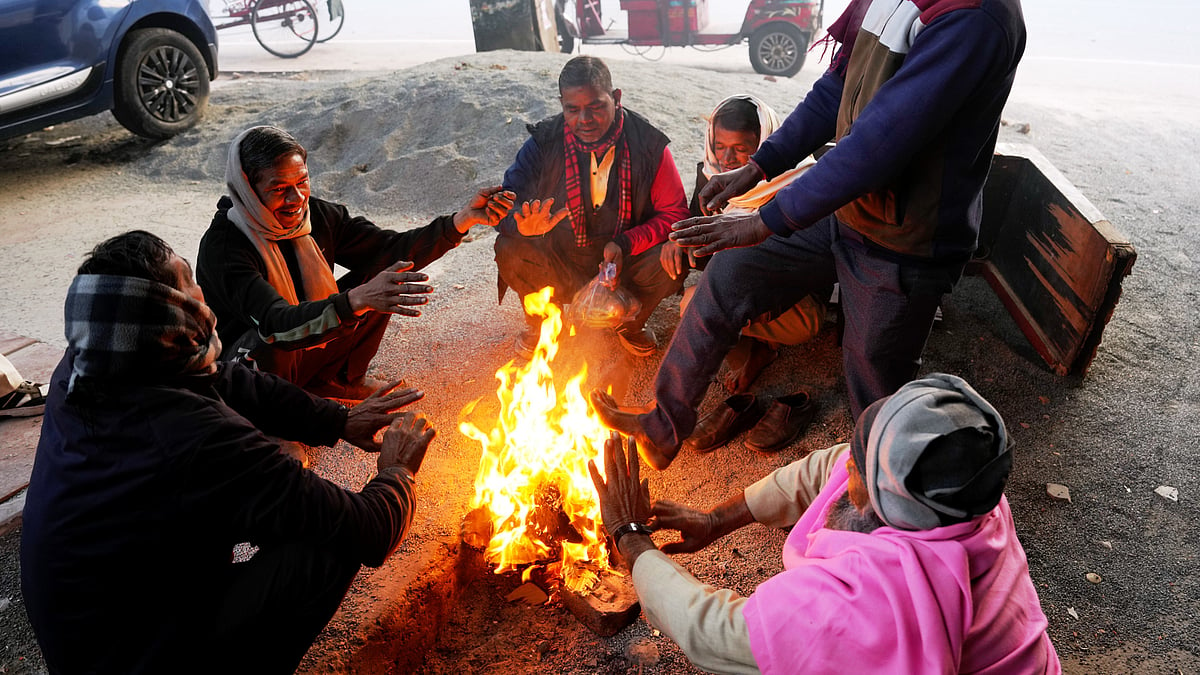
Residents of Delhi-NCR are grappling with a punishing double assault this Tuesday, as biting winter cold tightens its grip even while toxic air continues to blanket the region. A persistent cold wave, coupled with dangerously high pollution levels, has turned daily life into a test of endurance across the national capital and its surrounding cities.
The India Meteorological Department (IMD) has issued orange and yellow alerts, warning that the cold wave will linger through 13 and 14 January. Daytime temperatures are expected to hover near 20 degrees Celsius, while nights could plunge to a bone-chilling 4 degrees Celsius. Compounding the discomfort is suffocating humidity, which surged to 97–98 per cent during the morning hours, amplifying the chill and making the cold feel far harsher than the thermometer suggests.
Cold winds sweeping through the city, combined with the heavy moisture in the air, have intensified the winter bite. While a marginal rise in temperatures is expected from 15 January — with minimum temperatures inching up to around 6 degrees Celsius — relief may be short-lived. The IMD has forecast moderate to dense fog during early mornings and late nights, raising concerns over visibility and disruptions to road, rail and air travel.
At the same time, Delhi’s air remains perilously polluted. Data from monitoring stations run by the Central Pollution Control Board (CPCB) and State Pollution Control Boards show that air quality in several areas has spiralled into the ‘severe’ category, with the Air Quality Index (AQI) breaching the 400 mark at multiple locations. Anand Vihar recorded an alarming AQI of 411, followed by Rohini at 397, Chandni Chowk at 380, Bawana at 378, Wazirpur at 375 and Ashok Vihar at 366.
Other neighbourhoods fared little better. Alipur logged an AQI of 322, R.K. Puram 365, Vivek Vihar 366, Sonia Vihar 334 and Shadipur 309. Even areas considered relatively less polluted, such as Sri Aurobindo Marg, reported an AQI of 274 — still firmly in the ‘poor’ category.
The grim picture extends beyond the capital into neighbouring NCR cities. Noida saw AQI readings of 357 in Sector-1, 339 in Sector-116, 340 in Sector-125 and 307 in Sector-62. In Ghaziabad, Indirapuram recorded 324, while Sanjay Nagar stood at 309, underscoring the regional scale of the crisis.
Against this backdrop, Union minister for environment, forest and climate change Bhupender Yadav on Monday chaired a high-level review meeting to assess the Delhi government’s efforts to combat air pollution across the NCR. Emphasising the need for sustained, long-term solutions rather than temporary measures, the minister urged coordinated action to address the chronic problem.
The meeting, held as part of the Centre’s annual review mechanism, was attended by Delhi chief minister Rekha Gupta, Union minister of state for EFCC Kirti Vardhan Singh, Delhi Environment Minister Manjinder Singh Sirsa, and senior officials from the Ministry of Environment, Forest and Climate Change, the Delhi government and allied agencies.
Health experts have sounded a stark warning, cautioning that prolonged exposure to such hazardous air can sharply raise the risk of respiratory and cardiovascular diseases, especially among children, the elderly and those with pre-existing conditions. Doctors have advised residents to limit outdoor activity, wear protective masks, and take extra precautions against the cold, even as authorities urge strict adherence to pollution-control measures during this critical winter spell.
With IANS inputs
Join our official telegram channel (@nationalherald) and stay updated with the latest headlines