Nation
NCERT academic says SC lacked full context before ban on judiciary chapter
Scholar Michel Danino says 11 March ruling came without hearing authors, had ‘intimidating effect’
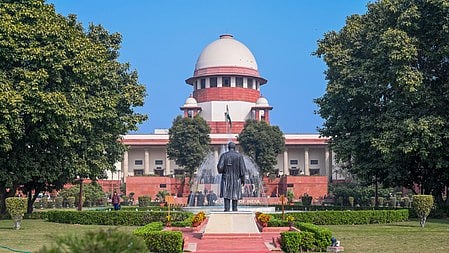
French-born Indian scholar Michel Danino, one of the three NCERT academics earlier barred by the Supreme Court over a controversial textbook chapter on the judiciary, said on Wednesday that the apex court had been “kept in the dark” about the wider context of their work.
He also described the Supreme Court’s initial 11 March order as a “surprise”, saying the academicians were not heard before the ruling was passed.
The Supreme Court last week modified its 11 March order directing the Centre, states and other bodies to disassociate from the three academics following a controversy over an NCERT textbook chapter containing allegedly “offending” references to corruption in the judiciary.
The apex court left it to the Centre, states, Union Territories, public universities and publicly funded institutions to take an independent decision on the matter, without being guided by the observations made in its earlier order.
Danino, Suparna Diwakar and Alok Prasanna Kumar were the three academics linked to the contentious Class 8 textbook chapter.
In an interview with PTI, Danino said the “unprecedented” order had created a “chilling effect” across educational institutions, but maintained that the academics believed the restriction would eventually be lifted once the Supreme Court was informed about the full background, including the framework laid down under the National Education Policy (NEP) 2020 and the National Curriculum Framework for School Education (NCF-SE) 2023.
“The initial reaction about the ban… was a reaction of surprise because first of all, we had not been heard and this was an ex parte order technically,” Danino said. “In view of the severity, the fact that this kind of ban is unprecedented as far as I know in India’s judicial or educational history, it has definitely a chilling effect, intimidating effect with all institutions, so that was certainly surprising.”
Danino argued that the Supreme Court had initially been shown “only a very small part of the picture” and had not been informed about the framework under which the chapter was prepared.
“It (SC) was not aware of the context. It was not aware of the mandate under which we were working — the National Education Policy of 2020 and the National Curriculum Framework for School Education 2023. These two foundational documents define very clearly the mandate of our work,” he said.
Referring to the court’s direction to NCERT to identify those responsible for the “offending chapter” and submit their credentials, Danino alleged that the institution had supplied the names of the three academics without detailing the committees overseeing the process or their qualifications.
“NCERT supplied our three names without giving the mandate under which we were working, without giving the broader context of the two overarching committees that finalised those chapters, and without giving our credentials,” he said. “So basically the Supreme Court bench was kept completely in the dark as to the real context in which we were working.”
Danino said the three academics remained hopeful that the court would reconsider its position once their side was heard. “We were confident that once we explained this context, the Supreme Court would at least modify its order, at the very least the ban under which we were,” he said.
“The ban has been removed and some of the remarks that were passed on us were also removed,” he added, while noting that he had yet to examine the latest order in detail.
Danino, a Padma Shri awardee, chaired the curricular area group responsible for developing NCERT’s social science textbooks. Diwakar and Kumar, who were also part of the drafting committee, had likewise come under scrutiny.
While modifying its earlier ruling, a bench headed by Chief Justice of India Surya Kant, along with Justices Joymalya Bagchi and Vipul M. Pancholi, on 22 May also recalled its observation that the three academics had “deliberately and knowingly misrepresented the facts” to project a negative image of the Indian judiciary to Class 8 students.
With PTI inputs
Join our official telegram channel (@nationalherald) and stay updated with the latest headlines