


‘Kuchupuchu, resign kar do’: How Gen Z rewrote the grammar of Indian protest
From ‘Subway Surfers’ police chases to Taylor Swift paper-leak commentary, India’s youth are dismantling establishment politics with memes, Hinglish, and unapologetic chaos
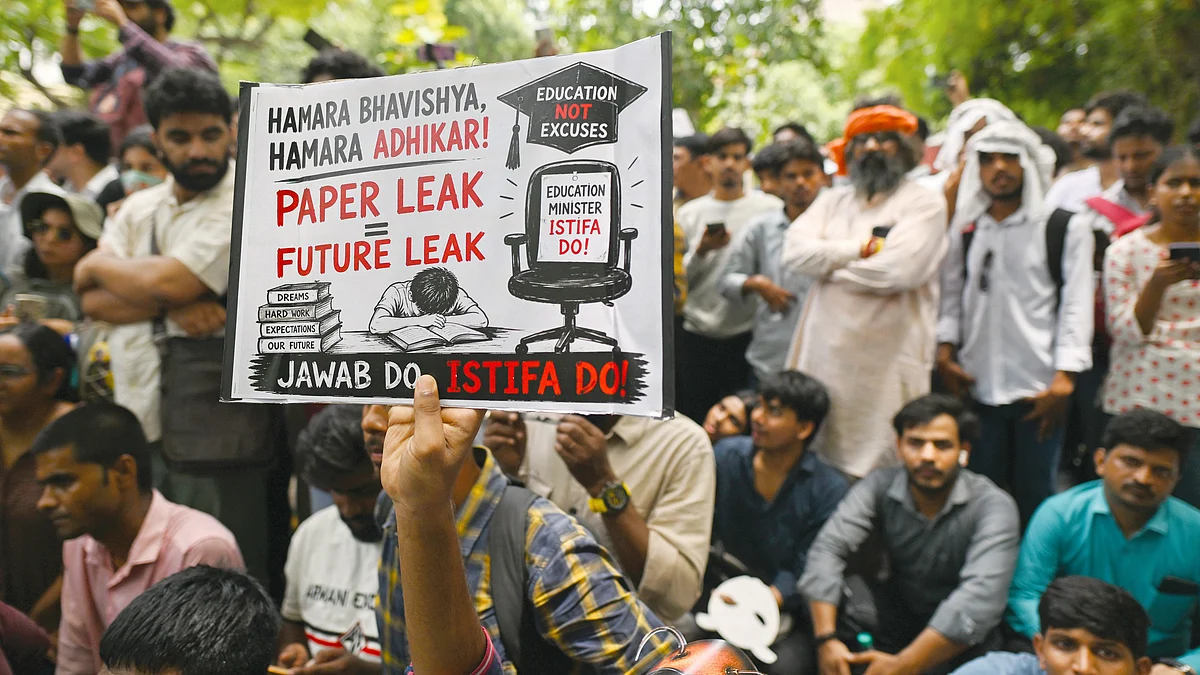


If you strolled past Delhi’s Jantar Mantar, Chandigarh’s Sector 17, or the historic lanes of Pune recently, you might be forgiven for thinking you had stumbled into a high-budget, low-inhibitions internet convention. Spider-Man was there, so was a demonstrator in a full-body cockroach costume, and dozens of students were sporting swimming goggles—not as a quirky monsoon fashion choice, but as tactical gear against police tear gas.
Before facing barricades, protestors were casually filming "Get Ready With Me" (GRWM) reels, treating a high-stakes demonstration against competitive exam paper leaks with the exact same energy as attending a music festival.
For decades, public demonstrations in India relied on a predictable script: solemn speeches delivered through crackling megaphones, heavy-handed ideological manifestos, and slogans steeped in historical reverie. But the current wave of youth-led demonstrations—erupting across Jantar Mantar and spreading across urban India—has jettisoned that traditional handbook. In its place stands a hyper-creative vernacular powered by internet culture, pop-culture mashups, code-switching, and a healthy dose of unparliamentary cheekiness.
The Hindi That Killed the 'Past Tense'
To understand why this linguistic shift has left authority figures completely baffled, one needs to look at the nature of political communication over the last decade. As journalist Ravish Kumar observed in an analysis of the Jantar Mantar demonstrations, the ruling establishment invested heavily in a very specific, carefully curated brand of Hindi. It was a language steeped in nostalgia, dripping with historical glory, and insulated inside a high-minded, moralistic pedestal. It was, for all practical purposes, a language of the "past tense"—designed to evoke ancient pride while deflecting contemporary anxieties.
Gen Z has marched onto the streets with a language that is aggressively "today". Their dialect does not care for museum-grade linguistic purity; it blends Hindi, English, street slang, and viral soundbites into a rapid-fire grammar of resistance. When government ministers expected formal petitions or stern, ideologically loaded denouncements, they were instead greeted by placards reading, “Kuchupuchu... tum resign dedo na,” borrowing a viral toddler audio to reduce high-level political accountability to baby-talk sarcasm.
Predictably, commentators and older generations have rushed to label this abrasive, meme-heavy lingo as a degradation of public discourse—a crisis of values, or evidence of youth incivility. But modern linguistics offers a far less panic-stricken view. Language is not a static artifact preserved behind glass; it is a living organism that evolves alongside technology, social anxiety, and generational experience. Every generation constructs its own vernacular. What traditionalists mistake for "vulgarity" or "corruption" is simply language doing what it has always done: adapting to express the lived reality of its speakers.
Memes, Taylor Swift, and Tactical Anthems
What makes Gen Z’s protest grammar so uniquely potent is its ability to be profoundly serious and wildly unserious at the exact same moment. Where previous generations brought moral outrage, Gen Z brings weaponized absurdity.
Consider the placards dotting Jantar Mantar and city squares nationwide:
* "Yahan paper leak ho raha hai. Wahan Taylor Swift ki shaadi ka photo tak leak nahi hua." (Highlighting administrative incompetence by comparing exam paper leaks to celebrity PR control).
* "IKEA has a better Cabinet." (A minimalist burn on administrative capacity).
* "My ex did not ignore me as much as the government has." (Fusing personal relationship trauma with systemic negligence).
* "Beta, tumse na ho payega," accompanied by a caricature of the education minister alongside Paresh Rawal’s iconic character from Hera Pheri.
This isn't just humor for humour’s sake; it's a calculated subversion of authority. When police attempted to disperse a crowd at Jantar Mantar, students didn't scatter—they suddenly broke into a full-throated rendition of the National Anthem. Police officers, caught in a patriotic catch-22, came to a grinding halt. The protesters promptly uploaded the clip to Instagram with the caption: "Got a breather for 52 seconds. Mother India still protecting us all."
When water cannons were deployed against demonstrators in Patna, instead of retreating in terror, students broke into a synchronized dance routine to the viral track “Paani Wala Dance”. When police chased protesters through central Delhi streets, participants logged their sprint on Strava, posting screenshots with captions like, "Thanks for the cardio, Dilli Police," or overlaying the footage with the Subway Surfers theme song or romantic Bollywood ballads like “Saiyyan Tu Kamaal Ka.”
The Aesthetics of Unapologetic Dissent
For older generations, public speech in democratic movements was expected to be restrained, dignified, and deferential to authority. For a generation raised on the hyper-speed, visual-first feeds of Instagram, Reddit, and X, dignity is overrated—authenticity and virality are what matter.
Gen Z recognizes that in a 24-hour news cycle saturated with slick government PR, traditional outrage gets swallowed up. A catchy, hilarious meme, however, breaks the algorithm. By dressing up in dinosaur costumes, turning tear gas into PUBG jokes (“Koi Dilli Police ko batao AQI badh jayega”), and staging satirical street skits, they ensure their grievances reach millions of screens before the official press release even leaves the printer.
They have turned profanity and code-switching into a unified identity. When a placard reads, "Everyone is gangsta until the cockroaches start flying," or when students use unparliamentary puns to mock systemic administrative failures, they are not corrupting language—they are stripping it of establishment hypocrisy. They are refusing to play by the decorous rules set by a political system that fails to safeguard their futures.
Out of Depth at the Barricades
Governments know how to handle traditional political opposition. They can issue formal counter-statements, deploy security forces, or accuse rival political factions of inciting crowds. But how do you counter a generation that treats tear gas as a background filter for a viral dance reel? How do you spin a narrative against a protest where Spider-Man and Batman are standing alongside quotes from Dr. B.R. Ambedkar?
The propaganda-drenched machinery of traditional state communication operates on fear and solemn authority. Gen Z’s new lingo neutralizes both using relentless satire. You cannot easily gaslight or intimidate a crowd that is laughing directly at you, editing your lathi charge to a pop soundtrack, and tagging the video #DeshBhaktiMaxing.
The crowds at Jantar Mantar have made one thing abundantly clear: the youth haven't lost their political voice; they've simply updated its operating system. Their language may be littered with slang, pop-culture references, and abrasive one-liners, but its underlying message is deadly serious. The old guard can grumble all it wants about the "degradation" of pure language—but while they are still searching for a dictionary, Gen Z has already redefined the entire discourse.
Whether this new grammar of dissent will force institutional change remains an open question. What is no longer in doubt is that the old script for political protest in India has been comprehensively rewritten — in memes, in sarcasm, in sanitary-pad analogies, and in the cheerful, relentless voice of the young. Dharmendra Pradhan’s resignation is just the beginning!
~Hasnain Naqvi is a former member of the history faculty at St. Xavier’s College, Mumbai. More of his writing here
Join our official telegram channel (@nationalherald) and stay updated with the latest headlines