Nation
'Don’t turn our future into a marketplace'
The slideshow of irate protests over a broken public examination system makes a Maharashtra stopover
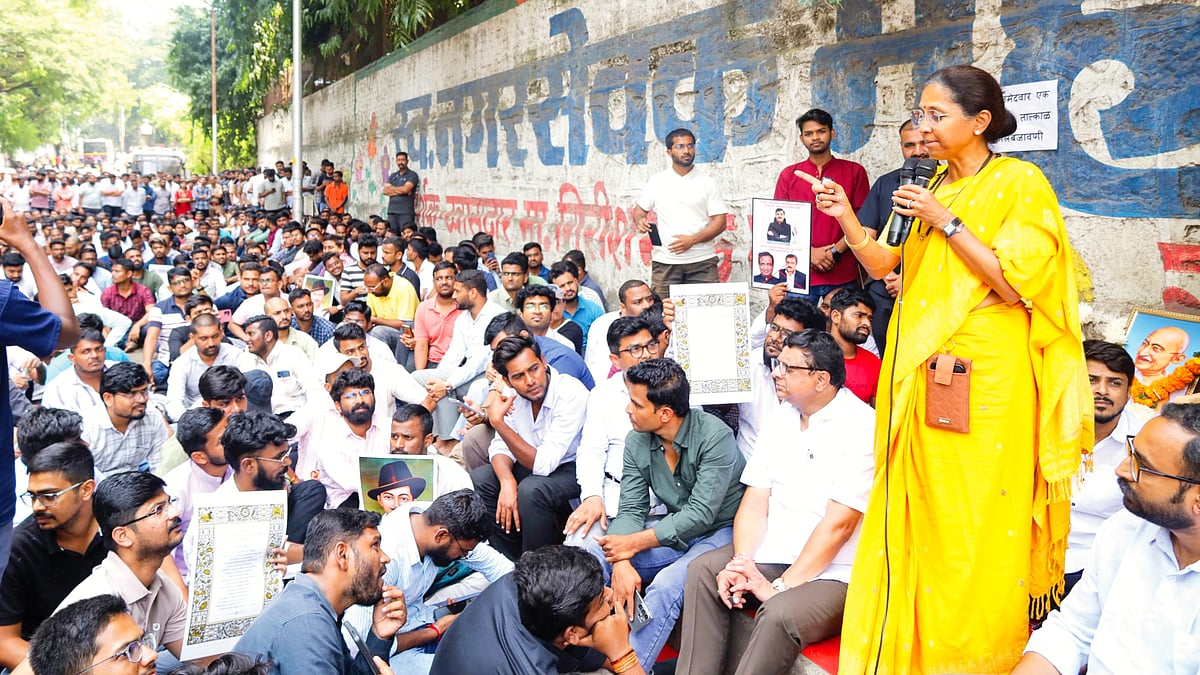
On 2 October, Gandhi Jayanti, while much of India’s attention was focused on Jantar Mantar in Delhi and Shivaji Park in Mumbai, hundreds of public service aspirants came together in Pune to agitate against the Maharashtra Public Service Commission (MPSC).
For the young men and women squatting at Pune’s iconic S.M. Joshi Bridge, named after the socialist leader and freedom fighter, the MPSC’s continuing failures have meant the loss of their best years, money their families can scarcely afford, and the promise that has underpinned India’s social mobility for generations — study hard, compete fairly and you have a chance to make it.
Over the past five years, aspirants have endured question-paper errors, alleged leaks, a cyber breach, repeated postponements, changing examination patterns, disputed vacancies, evaluation controversies and finally a confirmed leak that forced an entire recruitment process to be scrapped.
Three different categories of problems emerged: those established/officially acted upon; alleged irregularities in particular examinations; and systemic administrative problems. Maharashtra has identified 203 pending cases of exam malpractice before 23 designated special courts, the oldest of which dates back to 2002.
The present agitation is split into three streams of demands — one asks that MPSC chairman Vivek Bhimanwar be sacked; the second wants question papers to move from objective to descriptive, with more transparency in evaluation; the third wants the objective question paper system to be reinstated.
The crowds are swelling by the day, and political support from all Opposition parties including the Congress, sections within the BJP-led government and the CJP is pouring in. The state government has instituted a committee to look into the matter; its report is expected in December.
The police, meanwhile, have served notices on 68 protesters at three locations, saying the organisers had not obtained permission. The students, on their part, have threatened to intensify the agitation if their demands are not addressed.
****
Pune’s competitive-exam economy is built largely around young people from mofussil towns and rural districts, under the long shadow of agrarian distress and unemployment.
Far from being affluent students with unlimited financial support, thousands come from drought-prone Marathwada, farmer suicide-torn Vidarbha, the arid belts of western Maharashtra and other smaller towns. Pune is attractive because it is a major education centre and, compared to Delhi, is still relatively affordable.
Vivekanand Maruti Patil is 24. He is a farmer’s son from Radhanagari in Kolhapur district. He began preparing for the MPSC while still in college. “We are from poor farmer families that face many hardships,” he says. “We don’t have Rs 50 lakh to throw around and buy jobs through influence. Don’t turn our future into a marketplace.”
Vivekanand has emerged as one of the most recognisable voices of the movement. His speeches are laced with humour. He is well-read and moves with ease from Plato and Aristotle to Dnyaneshwar and Tukaram, before returning to the hardships of a student.
“When MLAs and MPs were poached and parties were split, we didn’t feel anything,” he said at the boisterous — and packed — protest site. “But when our exam paper was leaked, it felt as though the sky had fallen on us.”
Pune’s exam economics can be crushing. Students rent beds rather than rooms, eat at modest messes and tiffin centres (sometimes cutting down on food intake), sit for hours in crowded abhyasikas (libraries) and calculate the cost of every book, test series and coaching class.
A 2023 report on Pune’s study centres quoted an MPSC aspirant from Kolhapur who said he was paying Rs 6,000 a month for a double-sharing paying guest (PG) in Shivajinagar. Newer accommodation cost Rs 10,500 for triple occupancy.
An older survey found that nearly half of MPSC aspirants had come from rural areas. Their estimated average annual expenditure on preparation was about Rs 1.19 lakh. Coaching fees ranged from a few thousand rupees to over Rs 1 lakh. A current Pune coaching institute lists an MPSC prelims-and-mains programme with test series at around Rs 90,000. These are staggering sums, which are only getting higher.
Every additional year of preparation in Pune means more debt for parents. That is why an examination postponed by several months comes as an economic shock to their families back home.
The cruel contradiction at the heart of India’s government-job exam system is this: the more uncertain the recruitment process, the longer aspirants remain in the preparation-market. Even as aspirants age and lose confidence about making the cut, the industry apparatus thrives.
In Pune, the pressure is visible. Last month, a 28-year-old MPSC aspirant from Dharashiv (formerly Osmanabad) was found dead in his rented accommodation. Police recovered a note mentioning a debt of about Rs 2.5 lakh.
His death cannot simply be attributed to the examination system — the circumstances are far more complicated — but it brought into public view the financial and emotional pressures under which many aspirants live. It is against this backdrop that the present agitation needs to be understood.
MPSC’s recent controversies have accumulated (see timeline above). Under pressure, the government has announced that the examinations will be conducted offline and has transferred MPSC secretary Mahendra Harpalkar.
Earlier, following a meeting with student representatives, the government had promised six measures, including offline examinations, action under Article 317 against officials if warranted, a single-card system reducing repeated document submission and clubbing vacancies over three years. These assurances had temporarily led students to suspend their 2 October protest. Not trusting the government to follow through, they returned to their agitation.
The crisis of public examinations is not unique to Maharashtra. Not so long ago, Madhya Pradesh’s ‘Vyapam scam’ was an industry-scale scandal. In Karnataka, aspirants have been demanding an overhaul of the Karnataka Public Service Commission over similar issues. In Jharkhand, thousands of aspirants protested alleged irregularities in examinations conducted by the Jharkhand Public Service Commission and the Jharkhand Staff Selection Commission.
Earlier this year, protests over the NEET brought the credibility of India’s largest competitive examination system into national politics.
****
For India’s lower and middle classes, a government job has never been just another job. It offers status and security in an economy where millions still work without formal contracts or social protection. For families in rural Maharashtra, it can mean the first secure salaried position with the promise of permanent income unaffected by seasonal fluctuations.
This explains why a government job attracts such extraordinary numbers. Sample this:
Group C Combined Preliminary Exam, 2026: 10.86 lakh applications for 5,700 posts.
Drug Inspector Recruitment, 2026: 44,500 candidates for 154 posts.
State Services, 2025: 1.75 lakh applicants for 385 posts.
The competitive examination has become some kind of lottery — with candidates expected to believe it isn’t. With paper leaks, postponements and delayed recruitments, the entire premise of fairness collapses.
Jaideep Hardikar is a senior Nagpur-based journalist and author of Ramrao: The Story of India’s Farm Crisis. More by him here
Join our official telegram channel (@nationalherald) and stay updated with the latest headlines