Nation
Sambhal, the life of a sleepy town in UP
Prabhat Singh returned to see firsthand what has changed since 24 November last year
Driving into Sambhal, a couplet by the city’s own poet, Musavvir Sabzwari, comes to mind: ‘Khush-fahmiyon ke khel ki ab kya sabeel hai/ kaghaz ki ek nav hai aur khushk jheel hai (what way out of the games of self-delusion? All we have is a paper boat and a dry lake).
After a whole day wandering the city’s lanes and bylanes, meeting its people, talking to its shopkeepers, artisans and clerks, the wisdom of the couplet strikes home.
I knew Sambhal’s long, layered history — yet, for the longest time, I had really known it only through its hakims and its bone-and-horn craft. More recently, new reasons have surfaced to understand this town, and insistently so.
Under the sultanate, this region enjoyed special importance. In the Mughal era, it held the status of a royal province, a crucial midway point between Delhi and Agra. But through British rule, and for decades after independence, Sambhal was just a part of Moradabad district. When it was finally designated a district in 2011, it was given a new name — Bhimnagar. The following year, the old name was restored. But none of these administrative changes seem to have changed much in the daily life of the town or its people.
Sambhal still feels like a weary, half-desolate qasba even though the powers that be are eager to give it a facelift. Not that nothing has changed; some things have, in striking ways.
In Chakki Paat mohalla, the old lakhori brick wall has been replaced by red sandstone, and high atop it a new millstone glistens. Local lore has it that Udal (of the Alha–Udal duo) once leapt to hang the millstone on the fort wall.
In Kot Poorvi, the ancient Shri Kalki Vishnu temple — once repaired under the patronage of Ahilyabai Holkar — is getting three new rooms. The prime minister laid the foundation stone for a new Kalki Dham temple just last February.
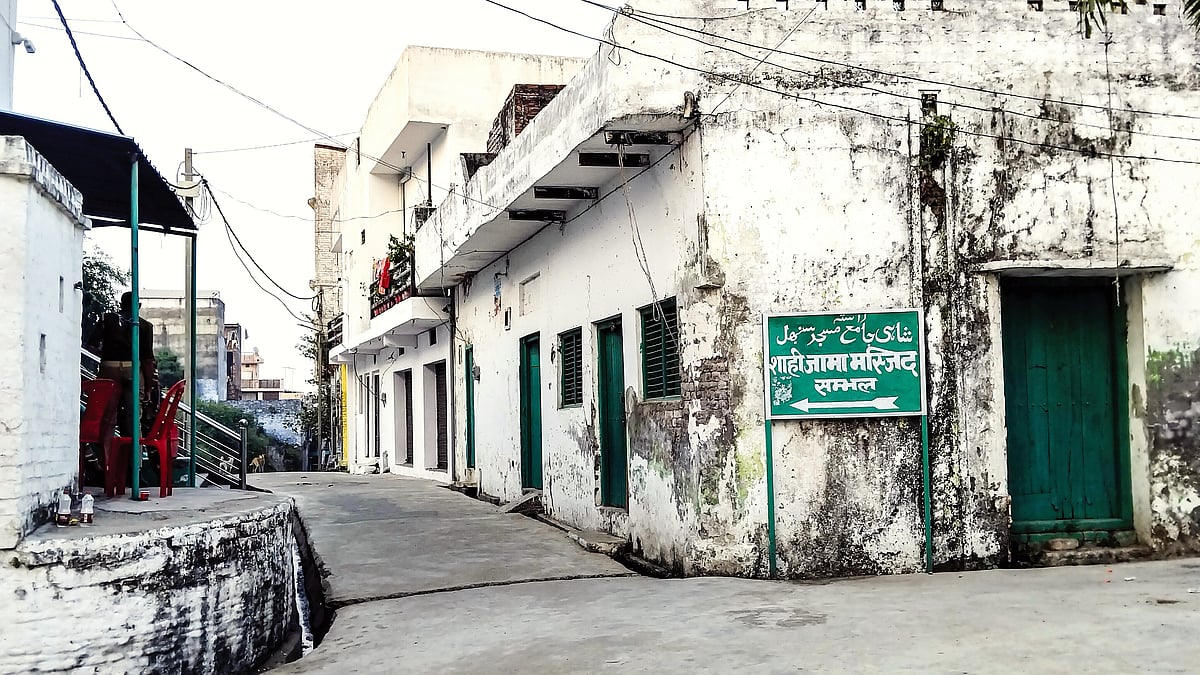
In Kot Garvi, near the Shahi Jama Masjid built in 1530, a Satyavrat police post has sprung up (some scholars believe Sambhal was known as Satyavrat in the Satya Yuga). Every path leading to the mosque is now blocked off with bamboo barricades.
The small room near the mosque steps now houses the Rapid Response Force (RRF). And they say only locals may enter this ASI-protected monument.
In the neighbouring village of Firozpur, the wide-open field known as the old fort now has an ASI boundary wall, and the lone surviving stone gate is being repaired. Children still play cricket on the ground, and as always, the new wall doubles as a place for neighbours to hang their washing.
The town — once spoken of in phrases like bavan sarai and chhattis purey — looks, in many ways, unchanged. The streets and bazaars swarm with disorderly crowds; neon signboards blink over newer shops; old eateries continue to thrive. At Babu Hotel, lovers of urad-chawal gather. Maroof, the haleem maestro, and Nazim Kababi pull in connoisseurs chasing another flavour.
Guru’s shop produces countless new sweets, but his pedas are still the biggest draw. The horn-comb artisans have learnt to work with fibre and now make all kinds of ornaments. And most of those who went to Delhi to learn the trade of dyeing and then set up workshops on the outskirts of town have been penalised for pollution and locked out of their small businesses.
Explaining Sambhal’s sacred geography — 68 tirthas, 19 sacred wells — the priest of the ancient Shri Kalki Vishnu temple, Mahendra Sharma, spoke with fervour: “Bhagwan Kalki will surely come. And our scriptures say he will be born here, in Sambhal.”
Yet he is pained: the town’s historic stature has never been honoured; no real attention has gone into developing its infrastructure. They never built educational institutions good enough to hold back the youth. The city constantly loses its own children to migration.
What has changed in his lifetime? “Only this,” he says, “that the path to the temple used to be a dirt track with camel carts; now it’s a tar road. Otherwise they made Sambhal a district, yes — but to submit an application to any officer, we still have to travel 25 kilometres to Behjoi.”
From the temple, we made our way to Kot Garvi. On the main road, from the signpost for Shaukat Ali Road, the high wall and upper dome of the Jama Masjid are visible. A steep, narrow lane climbs upward, guarded by RRF soldiers sitting at its mouth on chairs.
Walking up, two inscriptions flash into view — on the new building, the signboard ‘Satyavrat police post’, and below it, a stone marking Matloob Yar Street.
Right near the stone are bamboo barricades. Cross them, and to your left a board announces the Shahi Jama Masjid. Follow the arrow, and you first see RRF uniforms. The mosque steps enter your line of sight a little further ahead.
We were climbing the steps when a soldier stopped us. Were we locals or outsiders? Even after we said we’d come not to photograph but simply to see the mosque, he repeated: only locals may enter. Outsiders must stay out.
Soon the committee secretary, Masood Ali Farooqi, and member Zia arrived. The secretary said, “There’s a court order. You cannot go inside.” But Zia sahib quietly took us in anyway.
It was dusk. The greying sky lay utterly still. A couple of children darted around the ablution tank. Zia sahib let out a deep sigh: “It was built five hundred years ago. Why start a feud over it now?” We spoke awhile and then quietly began our descent.
The fastest train between Sambhal and Moradabad is the Sambhal Hatim Sarai–Moradabad Passenger. It comes in from Moradabad, once in the morn-ing and once in the evening, and then trundles back with its two-and-a-half coaches. Five tiny halts, 47 km and a journey of nearly three hours.
Its passengers are usually people with time on their hands — or people carrying too much luggage. The fare, thirty rupees, is its only real draw; otherwise the bus gets you to Moradabad in an hour-and-a-quarter. The UPSRTC ticket is eighty-four rupees. Buses run all day. The train takes a weekly holiday — Saturday.
I’d planned to reach the station before the evening train, but the day slipped away. Nadeem said a motor-rickshaw wouldn’t make it; the approach is too narrow. Best to take a motorcycle. So we cut through the narrow lanes, finally reaching the station. A brick path climbs from an empty ground to the platform. The train had long gone. The doors of rooms with nameplates had padlocks on them. The platform lay drenched in a deep, echoing silence — but it was well lit.
At the far end, outside the locked stationmaster’s office, someone lay on a charpai under a mosquito net. Our conversation must have disturbed him; gathering his jacket, he followed us. Munshi is a trackman. By day, he maintains the tracks; by night, he guards the station.
Yes, there’s an RPF post, he said; someone comes by during the day, but no one stays at night. The station master doubles as ticket-seller, so once the train leaves, his duty ends.
Of the many details that emerged in conversation, one stood out: nowadays the train has two trackmen on board, who hop off at every level crossing, close the gate, reopen it after the train has passed, and then hop on again. Earlier, the task fell upon the engine driver or the guard. This too explains the long, slow crawl of the journey.
I found myself thinking of priest Mahendra Sharma — nearly 70, yet like so many in the town, he has never taken this train. His lament about Sambhal’s sluggish development stayed with me. And then, the very next morning, I read in the paper that the chief minister, in a meeting with officials, had declared that Sambhal’s development is a government priority, and that efforts were underway to identify and restore the town’s tirthas and wells.
Sambhal now has 224 CCTV cameras across 60 locations. On 24 November, the RRF and PAC, along with 16 sector magistrates, the DM and the SSP, carried out precautionary patrols across the town. Drones hovered over areas around the Jama Masjid; the bazaars were mostly subdued.
It was on 24 November last year that violence broke out during a survey of the Jama Masjid, and five people were killed. Speaking to the media, DM Rajendra Pensia remarked, “Sambhal is not what it used to be.” Now, who wouldn’t wish this may forever be true?!
Join our official telegram channel (@nationalherald) and stay updated with the latest headlines