Nation
SIR can have serious consequences for those not included in voters' list: SC
Bench probes whether ECI can bypass statutory safeguards while revising voter rolls
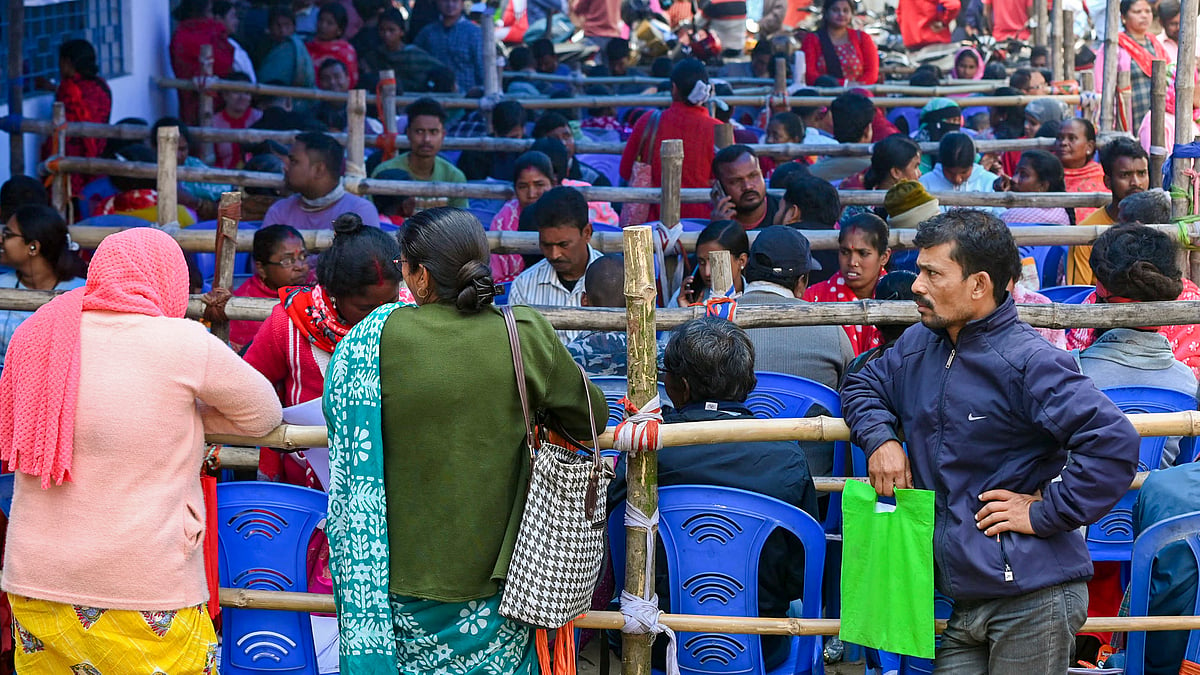
The Supreme Court on Wednesday cautioned that “no power can be untrammelled”, as it examined the fallout of the Election Commission of India’s (ECI) ongoing Special Intensive Revision (SIR) of electoral rolls. The court flagged that changes to the voters’ list carry significant civil consequences for those whose names are excluded.
A Bench comprising Chief Justice of India Surya Kant and Justice Joymalya Bagchi made the remarks during final hearings on a clutch of petitions challenging the ECI’s decision to conduct SIRs in multiple states, including Bihar.
Senior advocate Rakesh Dwivedi, appearing for the ECI, defended the exercise as the Bench probed whether the SIR could legitimately depart from the procedures laid down in the Representation of the People Act, 1950, and the rules framed under it.
The CJI underscored that dropping voters from the rolls is not a mere bureaucratic action, observing that non-inclusion in the rolls has genuine civil implications. He asked why a process that “affects the civil rights of people” should not strictly follow the procedures contemplated in sub-section (2) of Section 21 of the 1950 Act.
Section 21 empowers the EC to prepare and revise electoral rolls. Sub-section (2), which the Bench read out in court, mandates that rolls be revised in the “prescribed manner” by reference to the qualifying date before each general or by-election, unless the Commission records reasons to do otherwise. The provision further makes clear that a failure to carry out such revision does not invalidate the existing roll.
Justice Bagchi echoed the CJI’s concerns and questioned whether the ECI could act beyond the reach of judicial review. Pointing to the statutory framework, he noted that one of the rules envisages that an intensive revision involves preparing rolls afresh. He asked whether such safeguards could simply be bypassed, before remarking — “No power can be untrammelled.”
Dwivedi, responding for the Commission, relied on Section 21(3), which states that “notwithstanding anything contained in sub-section (2), the Election Commission may at any time, for reasons to be recorded, direct a special revision…” and that the existing roll remains in force until such special revision is completed.
He argued that Section 21(3) creates a separate, standalone power distinct from the routine revisions under sub-sections (1) and (2). “My submission is that sub-sections (2) and (3) of Section 21 do not operate in the same domain,” he said.
The Chief Justice pressed the Commission further, asking if the existence of Section 21(3) would mean the ECI could simply free itself from its own notified procedures when conducting an SIR under that provision. Justice Bagchi also focussed on the nature of the inquiry under Sections 21(2) and 21(3), particularly the documentary requirements. He noted that Form 6 requires seven documents, whereas the SIR demands 11, and asked whether the ECI could add to or discard the prescribed list — even excluding Form 6 documents altogether.
Dwivedi insisted the statute allowed such flexibility and that a power to deviate was implicit in Section 21(3). At the same time, he stressed that the ECI could not act arbitrarily and must demonstrate that its approach is just, fair and transparent, bearing in mind Article 326’s guarantee of adult suffrage.
The proceedings arise from petitions including one filed by the NGO Association for Democratic Reforms (ADR), which challenge the legality and constitutionality of the SIR scheme. The petitioners have warned of excessive discretion in the ECI’s hands, the prospect of citizenship inquiries through the back door, and the risk of disenfranchisement.
Wednesday’s hearing ended without a conclusion and will continue on Thursday.
Earlier, on 20 January, the EC had informed the Supreme Court that its SIR order was legislative in character, setting out guiding principles and documentary requirements and intended to apply nationwide, except in Assam.
With PTI inputs
Join our official telegram channel (@nationalherald) and stay updated with the latest headlines