


Dalal Street tumbles amid global jitters; Sensex down 1,300 pts, Nifty slides sharply
FII selling, profit booking and geopolitical tensions weigh on stock markets as volatility rises
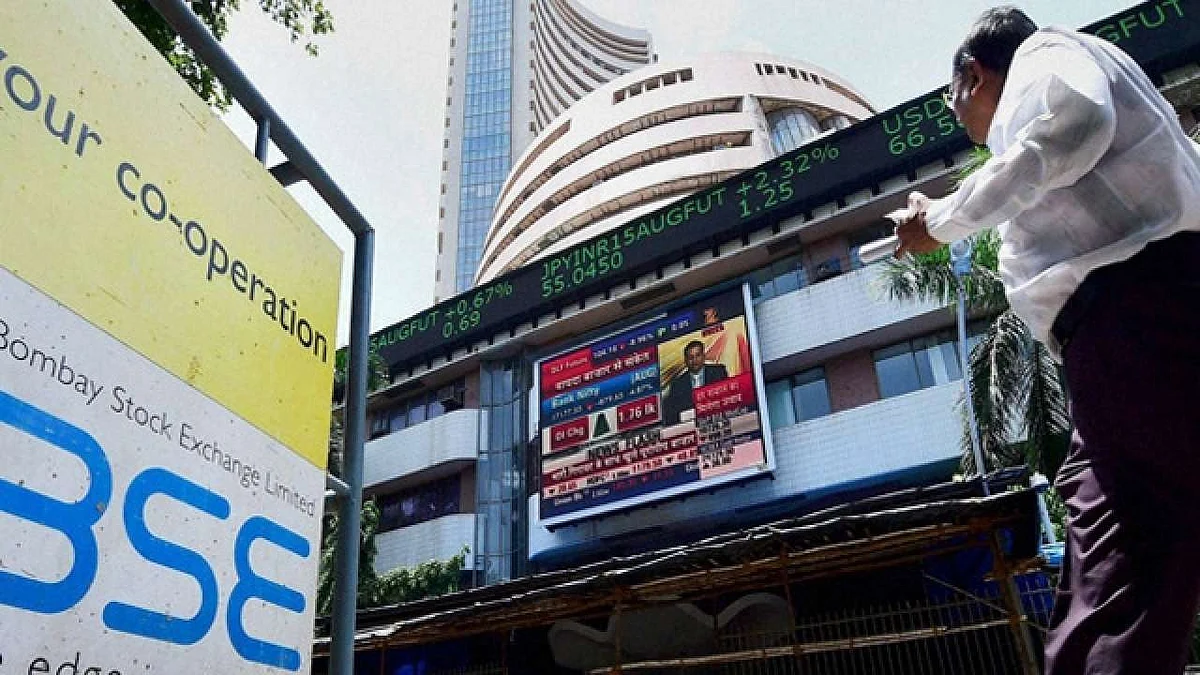


Indian equity markets ended sharply lower on Wednesday as investors turned cautious amid mixed signals surrounding the conflict involving the United States, Israel and Iran, which has raised concerns about its potential impact on inflation and global economic growth.
The benchmark BSE Sensex dropped 1,342.27 points, or 1.72 per cent, to close at 76,863.71, while the Nifty 50 declined 394.75 points, or 1.63 per cent, to end at 23,866.85 — slipping below the key psychological level of 23,900.
Market breadth remained weak, with around 1,807 shares advancing, 2,277 declining and 138 remaining unchanged on the exchanges.
Foreign investor selling continues
Persistent selling by foreign investors remained one of the key pressures on the market. On 10 March, foreign institutional investors (FIIs) sold equities worth Rs 4,673 crore, while domestic institutional investors (DIIs) provided some support by purchasing shares worth over Rs 6,333 crore.
According to market experts, this pattern of foreign selling being countered by domestic buying has largely defined market movements over the past year.
V K Vijayakumar, chief investment strategist at Geojit Investments Limited, said the trend of sustained FII selling balanced by steady domestic inflows into mutual funds could continue in the near term.
Profit booking after recent gains
Wednesday’s fall also followed profit booking after the previous session saw markets rebound from a short losing streak.
In the prior trading session, the Nifty had ended near 24,261 while the Sensex closed around 78,206, supported by broad-based buying across sectors such as automobiles, financial services and consumer stocks.
However, selling pressure returned on Wednesday, particularly in automobile and financial shares. Stocks such as Mahindra & Mahindra and Bajaj Finance fell between 3 and 4 per cent, while banking heavyweights HDFC Bank and ICICI Bank each declined about 1.4 per cent.
“Geopolitical uncertainty remains high and markets are reacting cautiously,” said Devarsh Vakil, head of prime research at HDFC Securities.
Eight of the 16 major sectoral indices ended in negative territory. Meanwhile, small-cap stocks rose about 0.5 per cent, while mid-cap indices remained largely flat.
Middle East tensions keep markets on edge
Investor sentiment has also been affected by developments in West Asia. The United States and Israel launched what were described as some of the heaviest strikes of the conflict against Iran, although Donald Trump recently suggested the fighting could end soon.
Oil prices briefly eased after a report by The Wall Street Journal indicated that the International Energy Agency was considering a record release of oil reserves to stabilise global crude prices.
Volatility gauge rises
Market volatility also increased, with the India VIX — often referred to as the market’s fear gauge — climbing more than 8 per cent to around 20.5, indicating expectations of heightened short-term fluctuations.
From a technical perspective, analysts say the Nifty remains within a consolidation range. Immediate support is seen near 24,100 and 24,000, while resistance lies in the 24,400–24,500 zone.
Aakash Shah, technical research analyst at Choice Broking, said a decisive move above resistance levels could open the path towards the 24,600–24,700 range, while a failure to hold support may trigger further volatility in the near term.
Join our official telegram channel (@nationalherald) and stay updated with the latest headlines