Nation
Suvendu orders FIR against Mamata as Cathedral Road rally triggers political storm
Police alleged violations of court conditions, while Mamata Banerjee claimed the gathering was obstructed despite her efforts to restore order
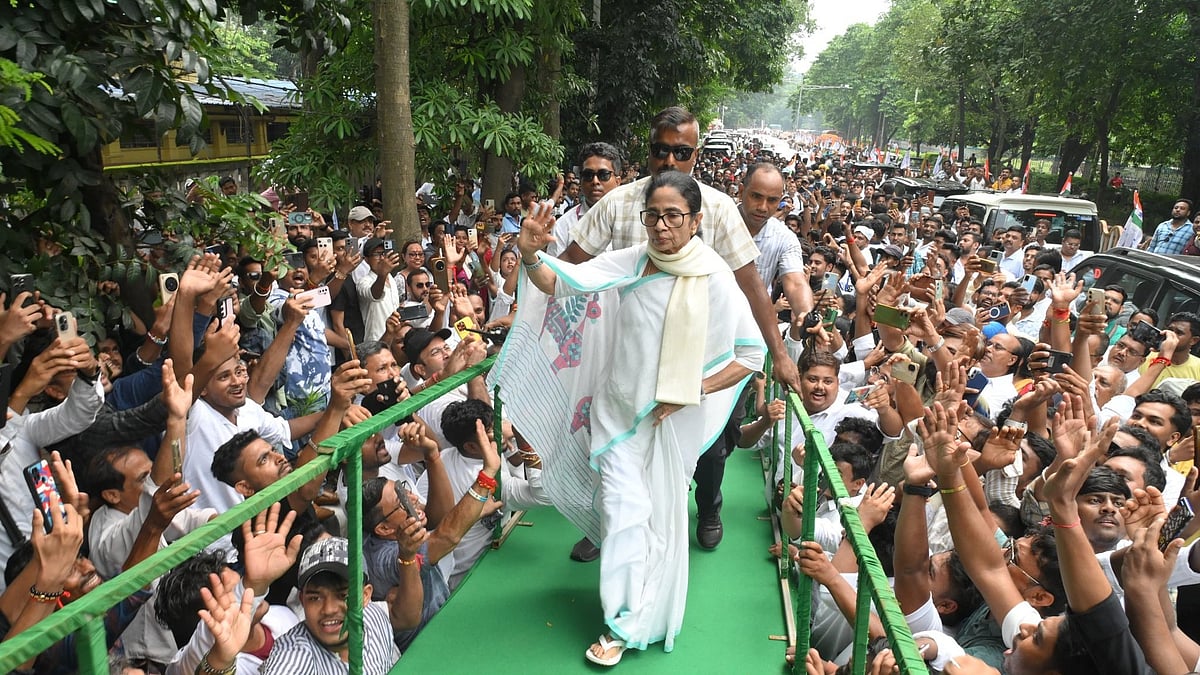
The political temperature in West Bengal rose sharply on Friday after Kolkata Police registered a suo motu FIR against Trinamool Congress Supremo and former Chief Minister Mamata Banerjee following the Trinamool Chhatra Parishad (TMCP) foundation day programme on Cathedral Road.
The case has triggered another political confrontation, with the police alleging violations of conditions imposed by the Calcutta High Court, while Banerjee and her supporters maintain that the gathering was being deliberately obstructed and that she herself tried to restore order.
The most striking aspect of the episode is that the decision to pursue a case against Banerjee came after BJP leader and Chief Minister Suvendu Adhikari publicly said that he had instructed the police to register an FIR.
Speaking to the media, Adhikari said, “How did the former Chief Minister violate the High Court's order today?” He alleged that the court had directed the organisers to keep one side of Cathedral Road open but claimed that the entire road was subsequently occupied.
He said, “The court had instructed that the meeting be held while keeping one side of the road clear. She summoned people standing right under the trees and blocked the road—what was that all about?” He added: “I have told the police to register an FIR and move the High Court against her. She will not be spared.”
Those remarks are particularly significant because the FIR was subsequently registered at Hastings Police Station. Police have invoked several provisions of the Bharatiya Nyaya Sanhita, including charges relating to criminal conspiracy, disobedience of an order, obstruction of a public servant and creating an obstruction or dangerous situation on a public road.
However, the events at the meeting present a more complicated picture than the charge of deliberate defiance might suggest.
The High Court had permitted the TMCP foundation day meeting subject to conditions, including keeping one flank of the road open and limiting the programme to the 12 pm to 3 pm period. A large crowd did gather around the venue, and police have alleged that both sides of Cathedral Road were eventually obstructed.
Yet Mamata Banerjee did not simply ignore the traffic situation. At one point, she expressed concern about vehicles entering the area where the meeting was taking place. She stopped the proceedings and asked that the vehicles be moved first.
“Our people will help you. Get these vehicles out. Ensure there is no inconvenience—whichever vehicles have entered,” she said from the stage, while also questioning why the police were not clearing the vehicles.
This is an important part of the incident because it complicates the allegation that Banerjee was simply seeking to prevent traffic movement. The available account instead shows her attempting to deal with vehicles that had entered the gathering area while trying to keep the programme going.
Banerjee’s broader political attack on Adhikari must also be understood in the context of the increasingly bitter battle within Bengal’s opposition politics. At the Cathedral Road programme, she alleged that permission for political events was being repeatedly denied, forcing her party to approach the courts to hold public meetings.
“Permission is not being granted for any political programmes; we have to go to court to secure permission. From now on, if the police do not grant permission, we will seek approval from the people and go ahead with our programmes,” she said.
Her criticism was therefore not limited to the immediate traffic dispute. It was also directed at what she portrayed as an attempt by the administration to make it increasingly difficult for her political organisation to hold public programmes.
The turnout at Friday’s meeting further underlined the political stakes. Despite Adhikari’s apparent support for the rebel TMC camp, the rival programme attracted considerably less attention and a smaller crowd than Banerjee’s gathering, according to the account provided. Her Cathedral Road meeting, by contrast, was visibly packed with supporters.
The contrast is politically significant. The competing rallies took place amid an open struggle between rival TMC factions following the party’s electoral setback. The Kalighat faction associated with Mamata Banerjee held its programme near the Birla Planetarium, while the rival faction organised its event on Rani Rashmoni Avenue.
The size of the crowds has consequently become another measure of the factions’ competing political influence. While the administration and Adhikari have focused on the alleged breach of court conditions, Banerjee’s supporters can point to the enthusiastic response to her programme as evidence that her political appeal remains substantial.
The police case nevertheless raises serious questions that must ultimately be settled through evidence rather than political declarations. If the court’s conditions were breached, responsibility must be established. But the circumstances also matter. A large political gathering can create unexpected traffic and crowd-control problems, and the fact that Banerjee publicly asked supporters to clear the vehicles is relevant when assessing her conduct.
The controversy therefore goes beyond the simple question of whether a road was blocked. It has become another battleground between Mamata Banerjee and Suvendu Adhikari, with the police FIR adding a legal dimension to their political confrontation.
Join our official telegram channel (@nationalherald) and stay updated with the latest headlines