


Viral skid videos put Kolkata’s rainbow roads under scanner
Experts question the science behind the paint job as the government celebrates its pre-Puja makeover
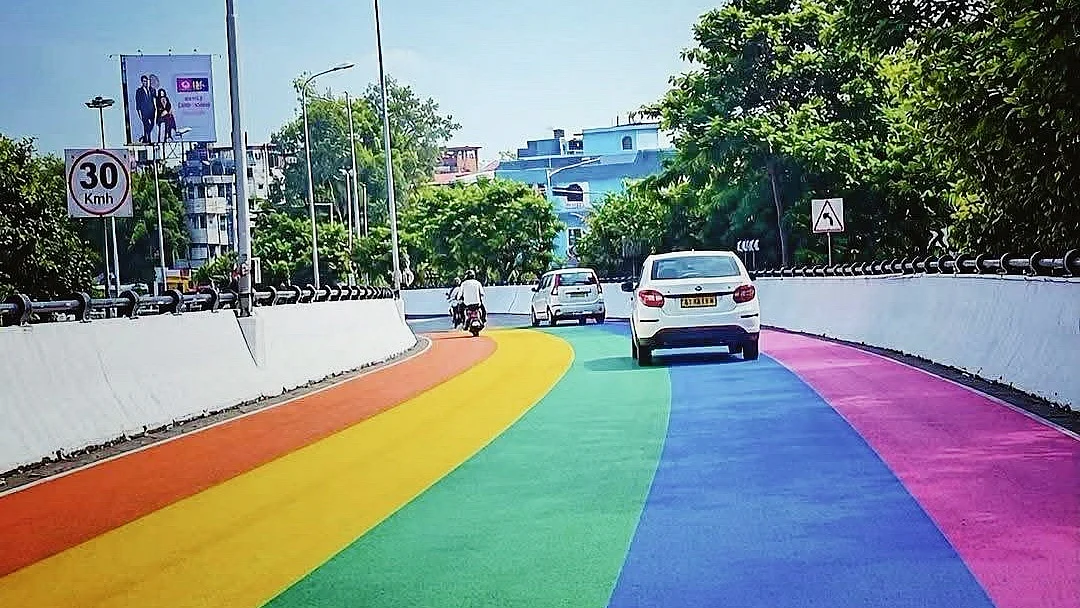


Viral videos purportedly showing two-wheelers skidding on Kolkata’s painted roads trigger safety concerns.
Experts question the choice of materials and urge the government to prioritise road repairs over decoration.
Minister Agnimitra Paul said CSR funds had paid for the makeover.
Viral videos purportedly showing two-wheelers skidding on Kolkata’s newly painted rainbow-coloured roads after a bout of rain have raised an uncomfortable question for the state government: can a road be made beautiful at the cost of making it unsafe?
The videos, circulating on social media, have triggered concerns over the safety of the brightly painted surfaces laid out as part of the city’s pre-Durga Puja beautification drive. National Herald has not independently verified the videos.
But the controversy has put the government’s priorities under scrutiny. While the administration has given parts of Kolkata’s roads and flyovers a colourful makeover, environmentalists, transport experts and political representatives are asking whether anyone adequately considered the consequences of turning surfaces meant for moving traffic into canvases for urban decoration.
After all, motorists need roads that offer grip, not just a good backdrop for photographs.
The Gariahat and Chingrighata flyovers, sections of Red Road leading towards Eden Gardens, and several other locations have been painted in vibrant colours. Traditional alpona designs have also appeared near Park Circus crossing and beneath the Gariahat flyover.
State municipal affairs and urban development minister Agnimitra Paul has defended the initiative, emphasising that the government did not spend any money on it. The work, she said, was funded through corporate social responsibility (CSR) initiatives. “The beautification work on Gariahat Bridge, Red Road and Chingrighata Bridge was carried out under CSR initiatives. No government funds were spent on this,” she said.
That may settle the question of which pocket paid for the paint. It does not, however, settle the more pressing question of whether the paint belongs on roads used by thousands of motorists.
The minister has also assured motorists that the paint will not last forever. “Motorists won't face any major issues. We’ve used a type of paint that will wear off within a few months,” she said.
The reassurance raises an obvious question: if the coating is unsuitable for a road surface, does the fact that it will eventually wear away make it any safer in the meantime?
Environmental technologist and road infrastructure expert Soumendranath Ghosh has warned against treating the road surface as an extension of the city’s festive decor. “A split second is all it takes for an accident to occur. Nothing should be done to distract drivers — let alone painting the road surface itself,” he said.
Ghosh also questioned whether CSR funding could have been put to more practical use, particularly given the condition of several roads in Kolkata. “It would have been better to ask for the repair of the city's dilapidated roads using CSR funds instead,” he said.
In other words, the city could perhaps have used a little less colour and a little more repair work.
Ghosh also stressed that road surfaces require materials suited to their function, rather than simply their appearance. “Any colour other than thermoplastic is not recommended for road colour. It resists the vehicles from skidding and it can be used,” he said.
His remarks highlight the central concern surrounding the project: road markings and surface treatments are not merely decorative choices. They have to account for friction, visibility and the behaviour of vehicles under different conditions.
The risks could become more pronounced during rainfall if the coating reduces grip between tyres and the road. Bright colours and reflected sunlight could also distract motorists or affect their perception of road conditions. Critics have further raised concerns that paint could obscure existing traffic markings or make potholes harder to spot.
Ophthalmologist Kingshuk Halder questioned the rationale behind the decision, pointing out that road markings and traffic signals follow established principles rather than individual aesthetic preferences. “Road markings are applied based on scientific principles. Traffic signals use red because it has a longer wavelength. What was the need to paint the roads in random colours like this?” he asked.
Environmental and social activist Naba Dutta also drew a distinction between decorating private spaces and altering public infrastructure. “Decorating a home or oneself is one thing, but decorating a road — where public safety is at stake — is entirely different,” the activist said.
Dutta added that it remained unclear “exactly who or what is being honoured by this kind of painting”.
The questions are not confined to environmentalists and road-safety experts. Ashutosh Chatterjee of the Congress has written to the minister and the Kolkata municipal commissioner, warning that the bright colours could dazzle motorists and affect friction between tyres and the road. Critics have also questioned whether the work complies with Indian Roads Congress guidelines governing road markings and traffic signals.
The beautification drive extends beyond Gariahat and Chingrighata to other bridges and structures, including Aurobindo Setu, Dhandhanye Setu and Chetla Bridge. Painting work has reportedly been carried out overnight, with traffic restrictions imposed to allow workers to operate.
Join our official telegram channel (@nationalherald) and stay updated with the latest headlines