Nation
The changing face of Banaras
For ordinary residents, the new wave of ‘development’ has alienated them from the city they still call home
It is said that Kashi exists outside of time. That it is enchanted, otherworldly, incomparable — a riddle, a mystery, a giver of salvation (or moksha in the Hindu tradition). In Kashi, death is considered auspicious. Kashi is soaked in Shiva, steeped in knowledge, a bestower of spiritual powers. The oldest city of this land, Kashi has been described in these very terms in the Puranas — from the Shiva Purana to the Skanda Purana to the Vishnu Purana.
That world is now behind us. This is a different age.
Kashi is keeping pace with the times, turning towards what is called ‘development’. In the process, it’s not just changing its appearance but its imminent character as well. Present day Kashi/ Banaras/ Varanasi seems to have escaped the pages of scripture into the brochures of the tourism industry. Kashi is no longer a repository of ritual or ancient knowledge. Today, the city brings to mind tourism, the hotel industry, food carnivals; it’s a hub of every imaginable kind of street food.
There was a time when Kashi meant broken, narrow lanes; single-track roads; filth at every corner; heaps of garbage; the sluggish crawl of cycle rickshaws; people loitering and spitting paan. Everyone was part of this — Hindu and Muslim alike. Traffic was a nightmare. There were no traffic cops at crossings, no signals. Jams would form anytime, anywhere. Getting from one place to another often felt impossible.
That meaning of Kashi has changed — or is changing. Today, its lanes are paved with neatly laid stone blocks. Walls once permanently stained with paan spit now carry painted narratives of Kashi’s legends. Many roads that were once single-lane have been widened into four-lane thoroughfares. In temple areas, streets and lanes are cleaned two or three times a day; there’s no garbage in sight. Partial cleaning of the ghats and the Ganga itself has changed the city’s appearance.
****
Kashi has always been divided into two parts — ‘Pakka Mahaal’ and ‘Kachcha Mahaal’. Pakka Mahaal — the old Banaras — was the neighbourhood of permanent houses, inhabited largely by orthodox Hindu families. Kachcha Mahaal once consisted of mud houses with handlooms installed inside them to weave the famed Banarasi saris. Since those weavers were mainly Muslim, this was a predominantly Muslim area.
But as power looms replaced handlooms, these houses too became permanent structures. Improvements in streets and infrastructure are now visible everywhere. There was a time when bypasses, flyovers or ring roads were unimaginable in Kashi; today, they are a reality.
Work is underway to widen several narrow lanes leading to the Kashi Vishwanath corridor and the Ganga ghats into four-lane roads. Hundreds of houses are being vacated after compensation. The most prominent among these is the Daalmandi area. Daalmandi is one of the city’s largest commercial hubs. Its lane is historic, with a daily turnover running into crores of rupees.
There is anger among sections of Banaras over the widening of
Daalmandi. They argue that demolition is happening because most residents here are Muslim. It’s true that most properties belong to one community, but more than half the business conducted in Daalmandi involves traders from the other community. From cosmetics to sundry bric-a-brac and every other imaginable commodity — both wholesale and retail markets across Banaras depend on Daalmandi. If the buildings disappear, where will this market go? Both communities are caught in this uncertainty.
A similar situation has unfolded in the Ardali Bazaar area near the district court. As the name suggests, this locality once belonged to court attendants (ardali). When their children took up hockey, the area came to be known as a nursery of Indian hockey. Nearly every household in this tiny stretch of 200-odd metres produced at least one player who competed at the national level. Nearly a dozen represented India at the junior or senior level.
It was in this area that a star named Mohammad Shahid was born — often called India’s second Dhyan Chand. Shahid represented India in three Olympic Games, captained the Indian hockey team and was honoured with the Arjuna Award and the Padma Shri. The road was named Mohammad Shahid Marg in his honour.
That area has now been demolished in the name of road widening. Around 47 houses — including Mohammad Shahid’s — have been razed. The signboard bearing Shahid’s name has been uprooted. Even the compensation given to residents here is far lower than what was paid in the Kashi Vishwanath Corridor project.
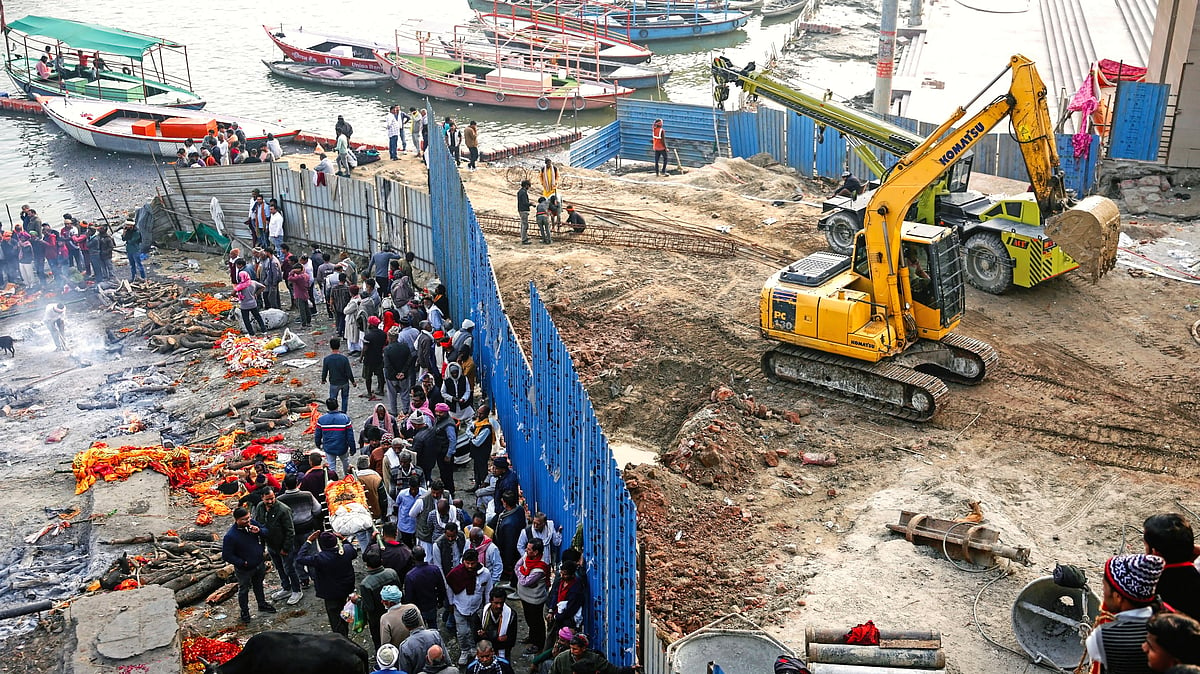
The winds of development have now reached Manikarnika Ghat. Thirty-eight new cremation platforms are being built, each fitted with tall chimneys. Old madhis, structures where priests once sat, are being demolished to expand the ghat. The wood trade here is also set to come under government control. Plans include community buildings, public toilets and other facilities. Officials claim all this is for the convenience of those who come to cremate their dead.
But the old-timers of Banaras are deeply disturbed. They argue that mourners have never sought these amenities, that people who come here to grieve their departed are not looking for conveniences. Negotiations over the price of firewood are understandable, they say, but they oppose the removal of traditional wood traders. As for toilets — defecating near the Ganga has always been considered a sin in Kashi. Who, then, wants toilets at Manikarnika?
It is widely rumoured that the redevelopment of Manikarnika is meant to favour the head priest of a nearby ashram. Close to the powers that be, he is allegedly pushing to shift the ancient mahashmashan (crematorium) itself.
Recently, a tourism official in Banaras announced that Manikarnika will soon be added to city tour packages, that Indian and foreign tourists will be taken on guided tours to the great cremation ground. For the ‘moksha tour’, the mahashmashan too is being equipped with various modern amenities. In other words, Manikarnika — as indeed the sacred city of Kashi itself — is being readied to woo and wow the tourist.
****
For now, Banaras is struggling with the return flow of pilgrims coming back from the Magh Mela in Prayagraj. This is an old problem, and traffic jams are worse at this time. So, a ropeway is being introduced. Running between Varanasi Junction and Dashashwamedha Ghat, it will operate 148 gondolas, each carrying 18 passengers. There will be five stations, all under construction. Each station is being designed like a small mall.
The hotel industry is expanding aggressively in anticipation of greater tourist traffic. Homestays and guesthouses have mushroomed in every lane. Since the cricket stadium began coming up on the city’s outskirts, luxury hotels have lined up. Taj, Ramada, Radisson were already present, now hospitality giants have bought ancient riverside buildings, dressed them up as heritage properties, and spread their footprint along the Ganga.
Seeing this boom, royal families across the country have begun converting their historic ghat-side properties into hotels. The Taj group has bought the sprawling Mehta Hospital at Ram Ghat and turned it into Taj Avantika. The Scindia family has initiated the conversion of its Ganga Mahal near Manikarnika into a hotel, set to open soon. The palace houses an ancient Lakshmi Narayan temple. Another Balaji temple owned by the Scindias at Panchganga Ghat is also slated for similar conversion.
Earlier, reaching ghat-side hotels was a challenge. Government intervention has changed that. Tourists are now brought by road from the airport to Namo Ghat, then transferred to their hotels on steamers or cruise vessels. Soon, helicopter services will begin from the airport to Namo Ghat; three helipads have already been built. Hundreds of steamers and boats operate daily, besides a dozen-odd cruise vessels, to give tourists a look-see of all the 84 ghats. A regular cruise service from Kashi to Gangasagar is also in the works.
Since the construction of the Kashi Vishwanath corridor, the city has transformed. Ayodhya has now been added to pilgrimage packages that include Kashi, Gaya and Prayag, swelling tourist numbers from India and abroad.
The Vindhyachal corridor has further increased the influx. Soon, work will begin on the Kaalbhairava corridor, stretching from Kaalbhairava to the Bindumadhava temple — known as Kashi’s Vaikunth Lok. This is the very site where Aurangzeb demolished the temple and built the Aalamgir mosque.
If construction begins this year, pilgrimage will take on an entirely new dimension.
The administrative machinery of Banaras is pleased with the tourism boom. But its people are not. For the commonfolk of Banaras, this wave of ‘development’ has alienated them from the city they still call home. The reels and memes flooding social media do not tell the truth of Banaras, they insist.
Translated from the Hindi original, simultaneously published in Sunday Navjivan, issue date: 1 February
Join our official telegram channel (@nationalherald) and stay updated with the latest headlines