Opinion
When, and how, did we move from 'merry' and 'happy' to 'safe Christmas'
Through wars, the Emergency, riots, assassinations, and pandemics—Christmas never felt unsafe. This time the atmosphere created by certain groups was unsettling
For the first time in my life, I received several messages wishing me a safe Christmas. Not happy. Not merry. Safe. For seven decades, Christmas greetings in my life have come wrapped in warmth, affection, and familiarity. Never before had safety figured in that vocabulary. Christmas was assumed to be benign, joyous, and universally acceptable—even by those who did not believe in its theology. This year, that assumption collapsed.
By the way, I have always preferred “Happy Christmas” to “Merry Christmas”. Merriment is fleeting, often noisy and indulgent; happiness is deeper, quieter, and rooted in contentment, compassion, and peace. Christmas calls for happiness, not merriment. Alas, many Christians see the two words as synonyms.
On the eve of Christmas, a Malayalam news channel interviewed me on Christmas celebrations in North India. I told the correspondent that such celebrations date back to Akbar the Great, who welcomed Jesuit priests at his court in Fatehpur Sikri in 1580, engaging them in theological dialogue and cultural exchange (Abul Fazl, Akbarnama).
I have been celebrating Christmas for the last seventy years or so. Through wars, the Emergency, riots, assassinations, and pandemics—Christmas never felt unsafe. This time, though I personally faced no threat, the atmosphere created by certain groups was deeply unsettling.
I live very close to a non-Christian senior secondary school. Until last year, the school celebrated Christmas with innocent enthusiasm. Children wore red-and-white caps, sang carols taught patiently by their teachers, and played Santa without knowing or caring about theology or politics.
On December 24, the campus would glow. Christmas stars twinkled, buntings fluttered, and publishing houses set up cheerful stalls. From the balcony of our flat, I watched it all unfold year after year, reassured by the ordinariness of coexistence.
This year, there was silence. No carols. No caps. And no decorations. On Christmas Day, the campus lay fog-covered—literally and metaphorically. Fear had done what no government order ever could.
My unease deepened when I read a statement by a Vishwa Hindu Parishad leader asking business establishments to stop decorating shops for Christmas because it was “not an indigenous celebration”. By that logic, neither trousers nor neckties should be worn, and no one should drink tea or coffee.
Fortunately for Christians, Atal Bihari Vajpayee was born on December 25. So the day had to be celebrated—albeit under a different label. Had he been born on December 26, perhaps Christmas itself would have been declared an imported virus. It is a different matter that government employees in several states were deprived of a holiday on Christmas, as at the Lok Bhavan in Thiruvananthapuram.
Reports poured in from Uttar Pradesh, Rajasthan, Madhya Pradesh, Chhattisgarh, and Odisha of Hindutva vigilantes storming churches, tearing down decorations, disrupting prayer services, and preventing poor vendors from selling Christmas caps and Santa Claus masks by the roadside.
These were not spontaneous acts of outrage. They were organised, confident, and brazen—performed by people certain that nothing would happen to them.
The most disturbing incident I saw came from Madhya Pradesh. A hefty woman, identified as the district BJP vice-president, was filmed physically attacking a visually challenged girl who was sitting quietly outside a church. She squeezed the girl’s face, interrogated her viciously, and humiliated her in public.
A police constable stood nearby. He did nothing. When the visually challenged girl found the courage to protest, the policeman tried to quieten her, not the aggressor. I do not know what happened to her. Ordinarily, she should have been arrested and sent to jail for attacking a blind girl. She, perhaps, knew that the girl would not be able to recognise her.
The BJP leader was unafraid. She knew she was protected. She was caught on camera, and the video is in the public domain. Yet, she acted as if accountability was an alien concept.
I can understand if someone does not want to celebrate Christmas. That is their right. But what right does anyone have to barge into a church and interrupt people while they are praying?
In one video, two dozen men were herded into a church to shout the Hanuman Chalisa loudly to disrupt the service. Imagine—just imagine—what would have happened if a group of non-Hindus had stormed a temple during puja and started shouting slogans. In another church, a “ferocious” man with a long tilak on his forehead was questioning the priest on immaculate conception, as if the priest could answer how a certain King had four famous sons.
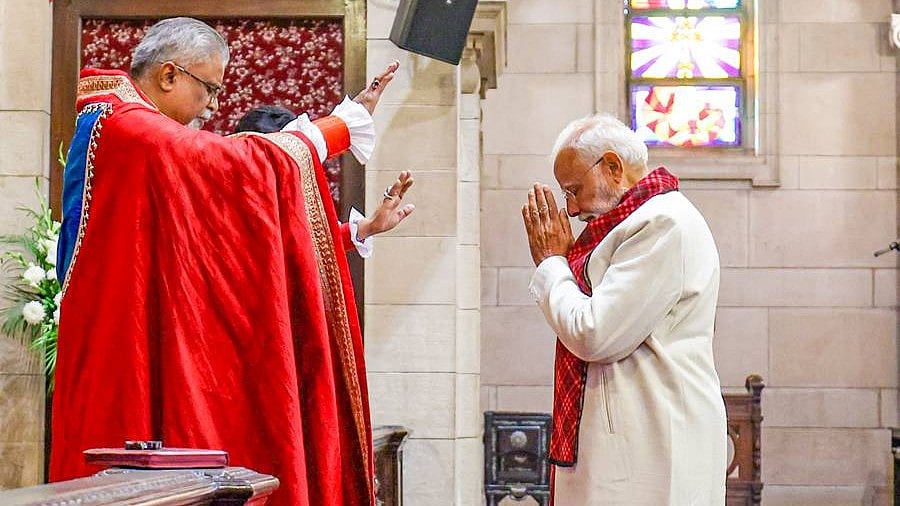
At the other extreme, Prime Minister Narendra Modi attended the Christmas service at the Cathedral Church of the Redemption near Rashtrapati Bhavan. Television cameras followed dutifully. The visuals were beamed into millions of homes in India and abroad on Christmas Day.
A non-Christian journalist friend asked me why the church authorities welcomed him when his ideological followers were making life miserable for Christians elsewhere. I told him that churches are open to everyone—irrespective of religion, caste, or ethnicity. They cannot be closed selectively. That is Christianity’s strength and vulnerability.
Modi would have noticed something else too: the absence of hierarchy. In a church, anyone can sit anywhere. Of course, he was offered a front seat, as any visiting dignitary would be. But the theology remains the same: all are equal before God.
This reminded me of an incident in Chennai. A journalist friend’s son was getting married. She invited Chief Minister Jayalalithaa. Two days before the wedding, the police called with instructions: the Chief Minister must be seated separately, away from the congregation but close to the pulpit.
My friend politely refused. No church could accept such segregation. The message was conveyed to Jayalalithaa. To everyone’s surprise, she arrived without fuss, without security theatrics, sat in the front row like everyone else, attended the wedding, blessed the couple, and left quietly. That is authority without insecurity.
I am sure the Church of North India, which manages the cathedral Modi visited, ensured his visit was dignified and smooth. Modi’s statement there was statesman-like. Nobody complained about what he said. But is that all that is expected of a Prime Minister?
A Prime Minister’s visit to a church is welcome—but not mandatory. What is mandatory is ensuring that Christians can celebrate Christmas without fear. That is Raj Dharma, about which Atal Bihari Vajpayee once lectured Modi in the aftermath of the Gujarat riots.
Christians did not expect a photo opportunity. They expected a stern warning to those taking the law into their own hands. They expected arrests. They expected consequences. From Jawaharlal Nehru to Lal Bahadur Shastri, Indira Gandhi, Rajiv Gandhi, V.P. Singh, I.K. Gujral, A.B. Vajpayee, and Manmohan Singh—not one felt compelled to visit a church on Christmas or Easter. Yet, Christians never felt neglected.
If Modi did not wish to speak directly, he could have asked his Sancho Panza to issue clear instructions and arrest those desecrating churches. He could have reminded chief ministers that governance is not about bombast but law and order. Instead, the world media beamed images of Modi in a church, concluding—wrongly—that everything was hunky-dory. It is not. Hundreds of pastors, evangelists, and ordinary believers languish in jails across North India.
This brings to mind Matthew 7:15: “Beware of false prophets, who come to you in sheep’s clothing but inwardly are ravenous wolves.” It warns against those who appear righteous but exploit faith to dominate, deceive, and destroy—using religion as camouflage for power.
Christians are routinely accused of “forcible conversions”. This is the silliest allegation imaginable. Take Rajasthan: Christians form less than 0.5 per cent of the population—one Christian among 700 people. Yet Rajasthan has the harshest anti-conversion law.
Christians are among India’s most law-abiding citizens. Crime statistics confirm this. When horrific violence was unleashed in Kandhamal, there was not a single instance of retaliatory violence. And yet, Christians are feared—by those who control state governments, the armed forces, and paramilitary institutions. That fear explains the latter-day aggression.
It was once said that Christians convert people using money power. Today, most Christian NGOs have lost their FCRA licences. Outside Kerala, Christians are largely poor. Money cannot buy faith. In fact, those who become Christians are expected to give, not receive. The practice of tithing requires believers to contribute a portion of their income—traditionally one-tenth—to support the church, its charity, and its mission.
In fact, the Bible repeatedly emphasises giving. “It is more blessed to give than to receive” (Acts 20:35). “Each of you should give what you have decided in your heart to give” (2 Corinthians 9:7). People are attracted to Christianity not because of inducements but because of its egalitarian ethos, its insistence on human dignity, and its refusal to sanctify hierarchy.
Christmas itself has always unsettled power. When Jesus was born, King Herod panicked. Fearing loss of control, he ordered the massacre of infants. Jesus’ parents fled to Egypt and returned only after Herod’s death. In other words, the infant Jesus frightened power.
Hindu scriptures tell a similar story. When Krishna was born, Kamsa was terrorised by prophecy. He imprisoned parents, slaughtered infants, and hunted a child who symbolised moral challenge to tyranny. Power always fears innocence armed with truth. It is the Herods and the Kamsas of our time who disrupt Christmas celebrations today.
The world is watching. It cannot be fooled by symbolic church visits while stormtroopers terrorise minorities. Amit Shah and others speak obsessively about Bangladeshis, creating the illusion of invasion. If infiltration exists, why can it not be stopped with all agencies under control? In Kerala, a Hindu man from Telangana was lynched on suspicion of being a Bangladeshi. Ironically, his name contained “Ram”. This is where lynching culture leads.
In Uttar Pradesh, the Yogi government even sought to withdraw murder charges against those who killed Mohammad Akhlaq—lynched for allegedly storing beef. Thankfully, the judge refused. He deserves full marks for courage and fidelity to law.
Christians in India are not asking for privileges. They are asking for protection under the law—nothing more, nothing less. They are asking that their churches not be vandalised, their prayers not be interrupted, their women not be assaulted, and their children not be terrorised in the name of culture.
They are asking the State to do what the Constitution mandates: prevent mobs from becoming magistrates and vigilantes from becoming judges.
A Prime Minister does not have to enter a church to prove his commitment to secularism. He proves it when the weakest citizen feels safe enough to pray without fear. He proves it when a disabled girl is protected from public humiliation, not abandoned to it. He proves it when those who desecrate places of worship are arrested, not emboldened.
Raj Dharma is not a televised visit or a carefully worded speech. It is the quiet, relentless enforcement of law. It is the certainty that no one—however well-connected—can squeeze a child’s face, storm a church, or shout slogans inside a place of prayer and walk away untouched. Atal Bihari Vajpayee understood this when he reminded a young chief minister that governance is not about ideological triumph but moral restraint. Power that cannot restrain itself inevitably turns predatory.
Christmas, at its core, celebrates the birth of a child who challenged power without raising a sword. That is why tyrants fear it. That is why the Herods and the Kamsas of every age react with rage. Not because Christmas is foreign, but because justice is.
If Christmas in India now needs to be celebrated “safely,” then something has gone terribly wrong—not with Christians, not with Christmas, but with the State. What India needs today is not drama; it needs Raj Dharma. As the year draws to a close, I wish my readers a happy, peaceful and courageous New Year.
This article first appeared in India Currents
Join our official telegram channel (@nationalherald) and stay updated with the latest headlines