Opinion
How deep does Indian secularism run?
Since dharma in our tradition has never meant religion in the narrow sense, dharma nirapekshata unnecessarily conveys indifference to a society’s moral values
The Republic of India was founded seventy-six years ago, but the foundations of its inner life/ nature (‘svadharma’) were laid nearly 3,000 years earlier. The Indian Republic of today is a confluence of the currents of Bharatvarsha, Hindustan and India. Traces of every stage of this civilisational journey live in our collective subconscious. That is why the svadharma of the Indian Republic is neither rigid nor eternal. It is shaped by movement—both internal and external. Our svadharma is fluid, constantly in motion.
For this reason, the search for India’s svadharma cannot be conducted in the so-called eternal values of ancient India. India’s svadharma is not to be found only in formal documents, written ideals, established ideologies or institutional religious texts. It reveals itself in the language of movements. First Buddhist and Jain philosophy, then the Sufi and Bhakti traditions and, in the modern era, the national movement—each challenged entrenched power, interrogated civilisational values, stirred the public conscience, and in the process redefined our svadharma. By understanding these religious, social and political movements, we can broadly identify four threads that define the svadharma of the Indian Republic. This essay and the three that follow will examine these four threads.
The first thread of svadharma begins with ‘maitri’ (friendship), passes through the idea of ‘sulah-e-kul’, and arrives at the modern concept of secularism, or ‘sarva dharma sambhava’. In contemporary debates on secularism, both sides often assume that secularism is a new idea—a new solution to a new problem. But seen from the perspective of Indian civilisation, neither the problem nor its solution are new. The coexistence of diverse views, sects, traditions and lineages has long been one of the defining features of Indian civilisation. That is why, from the very beginning, efforts were made—by both society and the State—to develop this coexistence not merely as a condition or compulsion, but as an ideal. The idea of maitri has always animated the svadharma of our civilisation.
Maitri is often associated with Emperor Ashoka or with Gautam Buddha—and rightly so. But Buddhist philosophy itself developed an earlier idea. In the Rigveda, the deity Mitra symbolises covenant, harmony and concord. In the Chandogya Upanishad, ‘Mitra’ becomes a marker of balance and mutuality. Building on this lineage, Gautam Buddha establishes maitri (in Pali, ‘metta’) as an ideal—one of the four brahmaviharas. Maitri is a mental disposition of non-hatred and equanimity. Ashoka’s inscriptions transformed maitri into a social and political ideal. He linked the principles of non-hatred, non-violence and compassion with communal harmony. Though a Buddhist himself, Ashoka’s edicts instruct respect for all shramana traditions (various Buddhist orders, Jains, Ajivikas and other mendicant sects) as well as brahmanas (followers of the Vedic tradition). By institutionalising sarva dharma sambhava as state policy and restraint as a social ideal, Ashoka laid the groundwork for what we today call secularism.
Akbar’s policy of sulah-e-kul expanded this principle of sarva dharma sambhava whose foundations Ashoka had laid. Whatever the personal religious inclinations of the emperor, the subjects would enjoy complete freedom of belief, worship and ritual. There would be no forced conversions. The state would not interfere in religious affairs, institutions or practices. Administrative laws and regulations would not belong to any one religion. No sect, denomination or faith would face discrimination. And the state would extend patronage and grants to all religious institutions and sites. Clearly, Akbar’s policy was not secular in the modern sense—nor could it have been. The point is that Akbar recognised India’s svadharma.
The secularism of our Constitution is merely an extension of the policies of Ashoka and Akbar. This is also how the term ‘secular’ is used in contemporary India. In common usage, ‘secularism’ or ‘dharma nirapekshata’ means viewing all religions and sects with equal regard and opposing the dominance of any one.
But if we examine the history of these words and their implications, neither dharma nirapekshata nor secularism in the European sense is quite adequate to explain this policy.
Since dharma in our tradition has never meant religion in the narrow sense, dharma nirapekshata unnecessarily conveys indifference to a society’s moral values.
In this regard, the term panth nirapekshata used in the official Hindi text of the Constitution is more appropriate. Similarly, ‘secularism’ drags into our discourse a European context that has little to do with either our problem or its solution. Our issue is not the relationship between Church and State. We face no threat of rule by a pope, a caliph or a clergy. We have no need for a European style secular order that is atheistic or wilfully blind to all religious matters.
Whatever the terminology, our challenge remains broadly the same as that faced by Ashoka and Akbar: to establish equanimity among followers of different beliefs and faiths, and to curb domination, hatred and violence. These are old challenges, but they have grown sharper in the modern context. New challenges have also emerged. Today, the state must regulate religious institutions, and it cannot shirk its responsibility to reform entrenched injustices within religious communities.
To meet this challenge, we must define sarva dharma sambhava by walking the path of maitri and sulah-e-kul. This is an indigenous worldview that respects religiosity. It is not indifferent to religion, because religion is a source of morality. Yet it remains impartial—indeed, non aligned—towards any particular sect or denomination. Born of the spirit of maitri, this worldview treats all religious communities with equal regard. Diversity in religious thought and practice is a civilisational inheritance.
The responsibility of state power, therefore, is not to suppress religious conduct but to prevent religious domination—to foster trust and mutual respect among different communities, and where necessary, to curb exploitation within religious communities themselves.
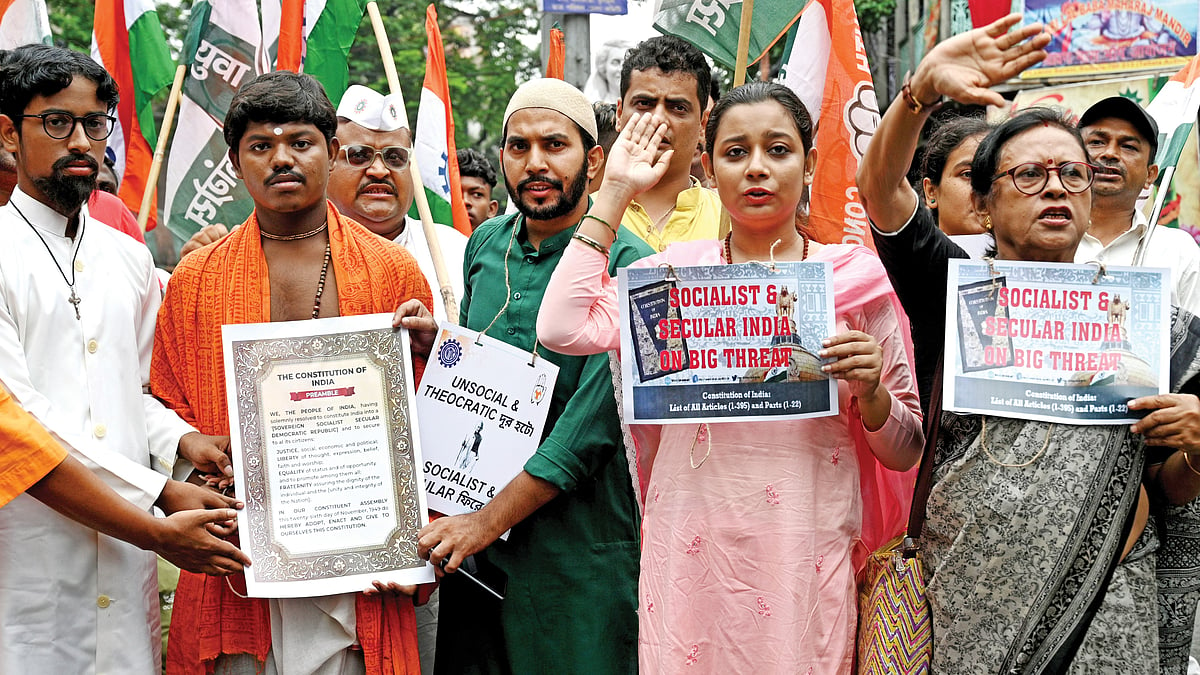
It is in keeping with this svadharma that the Indian Constitution was framed. The debate on when and why the word ‘secular’ was inserted into the Preamble is beside the point. The truth is that the basic structure of the original Constitution was already aligned with sarva dharma sambhava.
In this sense, sarva dharma sambhava is not merely a constitutional provision. It is not just a prudent policy choice. It is one of the foundational values of our civilisation.
It is an essential condition for the survival of India itself—either India remains on the path of sarva dharma sambhava, or India will not remain at all. This is the first core principle of the svadharma of the Indian Republic.
Translated and edited excerpts from the author’s forthcoming book Ganrajya ka Svadharma, Setu Prakashan
Join our official telegram channel (@nationalherald) and stay updated with the latest headlines