


Iran’s supreme leader warns US attack would trigger ‘regional war’
Khamenei issues sharp threat amid US military build-up, protests crackdown and nuclear tensions


Iran’s Supreme Leader Ayatollah Ali Khamenei on Sunday warned that any military action by the United States against the Islamic Republic would spark a “regional war”, escalating tensions as US President Donald Trump has threatened to strike Iran over its crackdown on nationwide protests and its nuclear programme.
Khamenei’s remarks, the most direct warning he has issued so far, came amid a heightened US military presence in the region, including the deployment of the aircraft carrier USS Abraham Lincoln and associated warships in the Arabian Sea.
“The Americans should know that if they start a war, this time it will be a regional war,” Iranian state media quoted Khamenei as saying. He added that Iran did not seek conflict but would respond forcefully to any attack or harassment.
“We are not the instigators and we do not seek to attack any country. But the Iranian nation will deliver a firm blow to anyone who attacks or harasses it,” he said.
Trump has repeatedly warned Tehran of possible military action following its violent suppression of protests that erupted late last year, while also stating that Iran wants to negotiate. He has increasingly linked the situation to concerns over Iran’s nuclear programme.
However, Trump has stopped short of confirming whether force would be used. Speaking to reporters on Saturday, he declined to say if a decision had been taken, saying opinions differed on whether Iran would be emboldened if the US refrained from military strikes.
The Iranian leader also hardened his stance on the protests, describing them as a “sedition” comparable to a coup. Tens of thousands of people have reportedly been detained since demonstrations began on 28 December, initially triggered by economic grievances and the collapse of Iran’s currency before evolving into direct challenges to the country’s leadership.
“Their goal was to destroy sensitive and effective centres involved in running the country,” Khamenei said, accusing protesters of attacking police, government buildings, Revolutionary Guard facilities, banks and mosques. Seditious charges in Iran can carry the death penalty, renewing concerns of mass executions — a red line Trump has cited for possible US action.
Amid the tensions, Iran planned live-fire military drills on Sunday and Monday in the strategically vital Strait of Hormuz, through which about a fifth of the world’s traded oil passes. The US military’s Central Command has warned against any threats to American vessels or disruption of commercial shipping during the exercises.
In a further escalation, Iran’s parliament speaker Mohammad Bagher Qalibaf said the Islamic Republic now considers all European Union militaries to be terrorist groups. The move follows the EU’s decision to designate Iran’s Islamic Revolutionary Guard Corps as a terrorist organisation over its crackdown on protests.
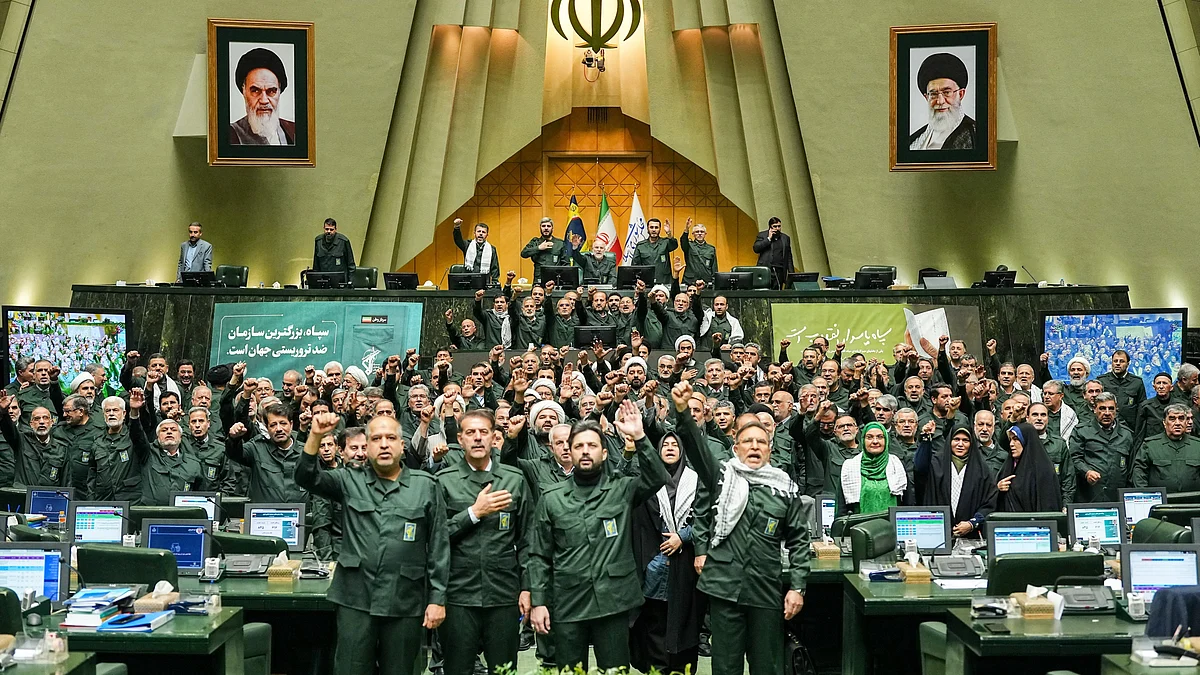
Qalibaf, a former Revolutionary Guard commander, announced the decision in parliament, where lawmakers donned Guard uniforms in a show of support. He said the EU had acted against its own interests and accused it of following Washington’s lead. Lawmakers later chanted anti-US and anti-Israel slogans.
Trump has outlined two red lines for military intervention: the killing of peaceful protesters or mass executions of those detained. He has also revived focus on Iran’s nuclear activities, which were the subject of prolonged negotiations before a brief conflict between Israel and Iran earlier this year.
The United States bombed three Iranian nuclear sites during that conflict, and satellite imagery suggests activity at some locations, raising concerns that Tehran may be attempting to conceal damage or salvage remaining facilities.
Despite statements from Iranian officials suggesting that “structural arrangements” for negotiations are progressing, there has been no public confirmation of direct talks with Washington. Khamenei has repeatedly ruled out negotiations with the United States.
As tensions rise, analysts warn that miscalculation by either side could rapidly destabilise the wider Middle East, drawing in multiple regional actors.
Join our official telegram channel (@nationalherald) and stay updated with the latest headlines