Opinion
Why Marco Rubio took a bypass to Ambani
Rubio reportedly urged Reliance to set up refining facilities in Venezuela. But what’s in it for India, asks Ashis Ray
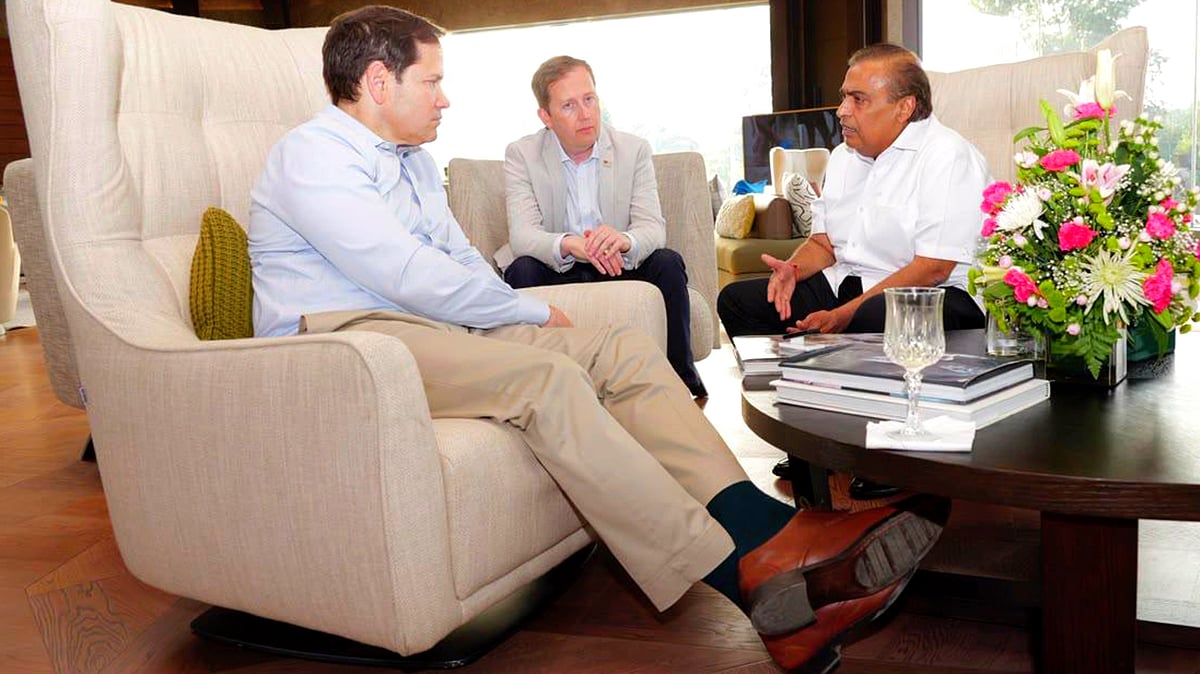
US secretary of state Marco Rubio was in India 20–22 October. Not in Delhi, though. Evidently, meeting his counterpart, Indian external affairs minister S. Jaishankar, or anyone in the Indian government was not his priority. His principal purpose was to visit Jamnagar to interact with Mukesh Ambani of Reliance Industries, whose oil refineries are headquartered there.
Contrary to protocol, Rubio’s visit was first announced by the US state department and only later confirmed, a bit sheepishly, by the Indian ministry of external affairs. In other words, the Trump administration bypassed the Modi government to set up this tête-à-tête with a private sector player to pursue its economic and strategic interest.
On arrival in Mumbai and standing on the steps of the iconic Taj Mahal Palace Hotel at Apollo Bunder, Rubio said: “So you have a company (Reliance) with a massive amount of refining capability… I think I should go talk to them, especially when it involves nation states, oil from another country…”
The US has rather controversially controlled Venezuela’s oil industry since kidnapping its president Nicolas Maduro and renditioning him to New York in January this year. Reliance Industries has the capability to refine heavy grades of crude and is therefore potentially able to meet the US requirement to process Venezuelan crude in sizeable volumes.
After Mukesh Ambani and son Anant had met with Rubio, Reliance issued a statement that said: ‘The visit included wide-ranging discussions on the global energy landscape and opportunities for commercial partnerships across conventional and new energy.’
As per a Reuters report, ‘The Ambanis also shared their perspective on opportunities for collaboration with US companies.’ With the gradual increase in Venezuelan output during the course of this year, Reliance has already become a significant importer of the nation’s crude.
In his meeting with Jaishankar, who hotfooted it to Mumbai for the purpose, Rubio unsurprisingly pressed India to up its energy purchases from the US. In his talks with Ambani, he reportedly urged Reliance to set up refining facilities in Venezuela to service the US market.
What’s in it for India? Buying Venezuelan crude means incurring exorbitant shipping costs because of the crisis in the Persian Gulf, unless India can negotiate concessions on account of refining support from Reliance.
Rubio also mentioned to media in Mumbai, according to NHK of Japan, that the next Quad summit will take place in Manila next month. Thanks to Trump, the Quad alliance of the US, Japan, India and Australia has been dormant for the past 22 months. A meeting of the four heads of government was to take place in India last year, but Trump was not interested. The whimsical convening in November is a lame attempt to gain some leverage over China before he visits that country but Beijing is unlikely to be fooled by these histrionics.
Rubio also met businessman Gautam Adani, though no details were available of the exchange between the two. Their meeting wouldn’t have pleased opposition Democrats back in the US who have sought an explanation from the US department of justice on how and why the corruption charges against Adani were dropped earlier this year. One of the reasons why Adani reportedly escaped prosecution in the US was his pledge to invest $10 billion in the US solar energy sector.
Asked by reporters to comment on the adverse remarks by OHCHR (Office of the UN High Commissioner for Human Rights) rapporteurs on the Indian government’s crackdown on the Jantar Mantar protesters, Rubio was dismissive of the ‘UN experts’ saying the phrase was an oxymoron.
A group of 25-odd rapporteurs of the OHCHR had stated, ‘Any restrictions on peaceful assembly must be legal, pursue a legitimate aim, and be necessary and proportionate’. Referring to the over 7,000 arrests of youth, journalists and human rights defenders, they said, ‘These actions violate India’s core international legal obligations, including the rights to freedom of peaceful assembly, freedom of expression, liberty, security of the person, and the right to defend human rights.’
The OHCHR experts described the crackdowns in various places, particularly Delhi, as revealing a ‘broader troubling pattern’ of Indian authorities using ‘undue restrictions on peaceful assembly, excessive use of force, arbitrary detentions, enforced disappearances and the targeting of student activists’. The rapporteurs have called for an ‘independent, impartial and thorough investigation’ into the activities of the law enforcement agencies concerned and associated forces ‘without delay’.
****
In September this year, the US Congress passed legislation empowering the US President to impose, at his discretion, 100 per cent tariffs on exports from countries buying Russian crude. The Trump administration has held this now-legal provision as a dagger to India’s throat, because of India’s high consumption of Russian crude in recent years, and will use it no doubt to extract a favourable trade deal from a petrified Modi. Trump has signalled a 60-day pause on invoking the new law to calm international prices ahead of midterm elections, but the threat lingers.
On his trip, Rubio patronisingly said: “India has repeatedly expressed a desire to diversify its energy portfolio (code for sourcing oil and gas from the US or US-blocked Venezuelan production) […] I think they’ve made substantial progress in this regard, and we’re happy to see that.” Under any circumstances, especially with a ballooning trade deficit and a collapsing rupee, it is certainly not in India’s national interest to opt for more expensive crude compared to the currently competitive offer from Moscow.
Whereas the New York Times presented Rubio’s visit as an attempt to ‘strengthen economic ties amid strained relations, at a reception to celebrate 250 years of American independence from Britain, the US secretary of state apparently forgot to address Jaishankar in his speech or even acknowledge his presence or make any reference to the bilateral relationship.
Jaishankar, on the other hand, remarked that his discussions with Rubio earlier the same day held ‘great value’ and reaffirmed India’s “continued commitment to advance the India-US strategic partnership”.
A US state department readout of the Rubio-Jaishankar meeting said: ‘The secretary reiterated that increased energy trade with the United States can play a transformative role in diversifying India’s supply chains while meeting its sizeable consumer demand […] and advocated for the increased purchase of US technologies and systems’.
That sounded like Washington playing hardball in negotiations to enforce a one-sided trade agreement. India will do well to not buckle under pressure, as other more courageous countries have done.
Ashis Ray was editor-at-large of CNN, and is the author of The Trial that Shook Britain. More of his writing here
Join our official telegram channel (@nationalherald) and stay updated with the latest headlines