Opinion
The Gandhian way and the challenge of our fascist times
To turn Gandhi into a saint is as misguided as dismissing him as irrelevant, writes Shailendra Chauhan
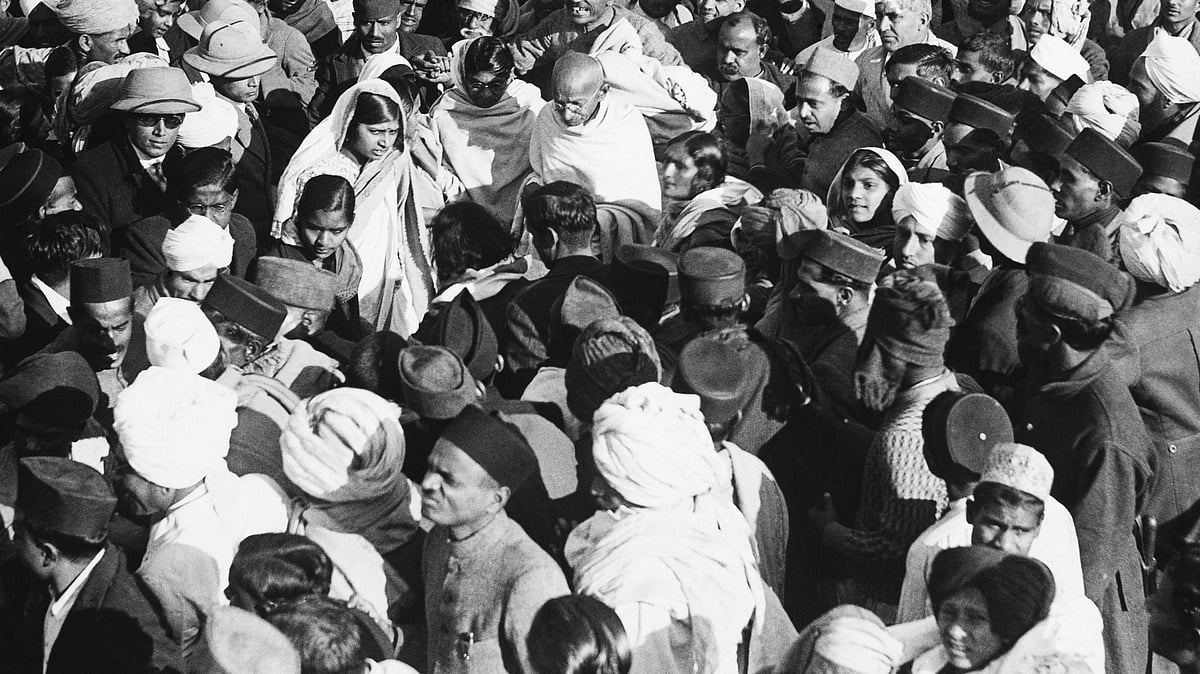
Every year, as 2 October approaches, Gandhi returns to our midst. He appears in official ceremonies, school functions, speeches and the seemingly obligatory advertisements. In that annual ritual, Gandhi is briefly part of public memory, but the Gandhi we remember raises no inconvenient questions.
Today, when democratic societies are grappling with serious concerns over the centralisation of power, intolerance of dissent, political polarisation, the spread of fear and the growing power of propaganda, it is no longer enough to remember Gandhi as an icon of non-violence.
When power demands nothing but obedience from the citizen, when dissent is regarded with suspicion, when institutions have lost their independence, when one section of society has begun to see another as the enemy, what is the Gandhian way? And, in these times, can Gandhi’s way still be a force of political resistance?
Gandhi did not see power simply as the strength of the ruler. He tried to understand what allows power to endure. Those who govern may have at their disposal the police, the army, the law and the administration, but they cannot govern indefinitely without some degree of cooperation from society. When citizens refuse to cooperate with an unjust system, when they voice dissent publicly despite fear, power starts losing legitimacy.
That was the great political discovery at the heart of Gandhi’s satyagraha.
Satyagraha was not merely fasting, sitting in protest or holding peaceful demonstrations. It went beyond an insistence on the truth: it was a method of withdrawing cooperation from unjust power. Non-cooperation, civil disobedience, the boycott of foreign goods and the refusal to pay taxes were all part of this wider political vision. Gandhi understood that an empire does not run on the strength of the ruler alone; it requires the cooperation of the ruled.
So, for him, resistance stemmed from the citizen’s conscience. That insight remains just as relevant today.
The strength of a government is not determined by how many police personnel it has, what laws it can invoke or how tight its stranglehold on the media. Its real power lies in how frightened society is, how divided it is, and how readily it accepts what it is told.
These conditions are ideal for fascist politics. A frightened citizenry does not ask questions. A divided society starts policing itself. A society shaped by propaganda forgets that truth may exist outside what power claims as the truth.
Gandhi’s resistance was directed at this state of mind.
****
Gandhi’s notion of non-violence is misunderstood. It’s not a magic wand. To assume that every repressive regime will ultimately yield before a non-violent movement is to flatten the complexity of history.
The colonial British empire against which Gandhi fought was unquestionably violent. Jallianwala Bagh is a horrific testament to that violence. The repression was brutal. Yet that regime operated within some constraints. Britain had a Parliament, a press and a tradition of political opposition. The empire also had to maintain a claim to moral legitimacy. Echoes of India’s freedom movement carried beyond India’s borders. British rule was repeatedly forced to confront the contradiction between the democratic and civilised political tradition it claimed to represent and the colonial violence it practised.
A fascist regime can be far more ruthless. It may not regard its opponents merely as political adversaries; it may present them as enemies of the nation, society or civilisation itself. The morality of non-violent persuasion will have limited effect on such a regime. It may interpret the pain of the satyagrahi as their weakness and non-violence as cowardice.
So, it’s dangerous to see Gandhi’s ahimsa outside its political context.
This is not to say that Gandhi’s method is rendered irrelevant in fascist times. But it needs to be decoded carefully.
Non-violence in Gandhi’s world view is not simply the refusal to commit violence. It is first a refusal to reduce a person to an instrument. Even while resisting power, it urges us to recognise the adversary as human — that was Gandhi’s exacting moral framework. To resist the violent language of power even while pressing one’s demands.
This is where Gandhi’s ideas collide with our own times.
The language of political disagreement has grown harsher. Your political opponent is now an enemy rather than a fellow citizen who happens to disagree. Social media has intensified this tendency. Political debate is less a battle of ideas and more a war of words, lung power — and identities.
Fascist politics thrives in this ecosystem. It reduces citizens to their narrow identities. It needs borders within society, on either side of which fear and hatred can keep growing. Resistance to fascism, then, is not simply a struggle against power, but also a struggle against the fear and hatred being manufactured within society.
This is where Gandhi’s way becomes important.
Satyagraha means telling the truth despite fear; non-cooperation (or ‘asahayog’) means refusing to obey an unjust command; civil disobedience means recognising that law and justice are not always the same thing. And non-violence means refusing, even while resisting, to lose the humanity that resistance seeks to protect.
There is yet another dimension to the Gandhian method — organisation.
Gandhi’s movement was not simply a collection of courageous individuals. It needed mass participation — farmers, labourers, students, women, traders, professionals… were all involved in one form or another. Gandhi’s political strength certainly drew on his personal charisma and moral authority, but it didn’t stem from that alone. It became political power because it drew mass participation.
This may be the most important lesson for our own times.
An individual citizen can question power, but organised civil society can challenge the structure of power itself. Independent journalism, universities, trade unions, farmers’ organisations, civil liberties groups, writers, artists, scientists, lawyers and social workers — these are all living institutions of democracy. Their independence is not a conspiracy against a government; it is an essential condition of democracy.
If these institutions fall silent out of fear, democracy will wither even if it retains some of its trappings.
So instead of searching for Gandhi at Rajghat, we need to look for him wherever an individual, even while standing alone, refuses to obey an unjust order; wherever a journalist continues to ask questions despite pressure; wherever a teacher teaches students not just the syllabus but how to question; wherever a writer chooses an inconvenient truth over comfortable conformity; wherever a citizen defends the rights of someone whose views are different from his own.
****
Gandhi’s way is not above criticism. Gandhi himself was not free of the limitations of his time. His social ideas, his views on caste, his economic thinking and his political experiments have all been debated, and indeed they should be. To turn Gandhi into a saint is as misguided as dismissing him as irrelevant.
A good way to remember Gandhi is to remember his willingness to experiment, to think again.
He made experiments and reflected on them, he tested the relationship between means and ends. At a time when political success is equated with the truth, Gandhi’s insistence that the means matter as much as the ends remains important.
If, in the name of saving democracy, we abandon democratic conduct, what exactly have we saved?
If, while opposing fascism, we ourselves embrace hatred, falsehood and violence, we may change those who wield power without changing the nature of politics.
Gandhi offers no assurance that the person who speaks the truth will necessarily prevail. The value of satyagraha also lies in its capacity to keep us whole even in the face of injustice. And Gandhi’s way is certainly not an old political formula; it confronts us as a test.
Adapted from the Hindi original published in Sunday Navjivan