Opinion
Waking up in West Bengal under the BJP
For minorities in Bengal, identity has historically been layered but relatively unthreatened in everyday life. On 4 May this baseline was altered
As a child, mornings always carried more than the promise of a new day. They meant newspapers, discussions on politics, strains of Rabindra Sangeet over Akash Vani. For the first time in all these years, on the morning of 5 May 2026, all those things seemed so distant, as if from another life.
For the first time in independent Bengal, a far-right party is in power. Ironically, my state was the party’s ideological womb. As the baby journeyed through its life—metamorphosing from the Hindu Mahasabha to the Jan Sangh to achieve adulthood as the Bharatiya Janata Party—its dream to rule over Bengal took one hundred years to come true.
All this is very close to me. I am the daughter of a first-generation refugee. My father did not inherit stability. He built it, after losing his home, his rose garden, his trophies. He wasn’t alone, just one of millions who crossed borders during moments of rupture in the subcontinent’s history. Arriving in West Bengal as survivors looking for ground beneath their feet, a roof over their heads. Bengal was not just a place—it was a possibility. Through language, culture and community, Bengal offered a fragile but real sense of continuity after the traumas of displacement.
Growing up, I did not experience that displacement directly. But I lived with its memory. Today, as the BJP comes to power, the language of politics has shifted in ways that feel familiar—not because I have lived them before, but because I have inherited the memory of where they can lead. That sheer, all-too familiar dread of ‘not belonging’. Those words, that tone. Identity, citizenship, security, belonging—these are no longer neutral words. They carry implications that extend beyond governance, into the realm of lived experience. For someone whose family history is rooted in displacement, these are not distant debates. These are personal.
This shift—that many are calling a ‘recalibration’—is so much more than that. To me, it is the recolonisation of Bengal. Colonisation is not only about capturing territory; it is about capturing people to transform and monetise them into cheap labour. The process of the SIR, initiated just before the election, created an atmosphere of repression. It brought back memories of displacement, of the constant nagging fear that one must be prepared to leave, any time, without warning.
The SIR unleashed a calculated and selective exclusion. I witnessed the desperation of people, especially women, during my trips to the suburbs of Kolkata and the Sundarbans. During one such trip, I saw a little girl holding on to her grandmother’s sari, both standing at the door of a local train compartment. I found out that the woman had survived an attempt to take her own life after the SIR struck her name off the electoral roll. Perhaps the little girl was holding on to her to keep her tied to things that still mattered—family, love, community. On the morning of 5 May, this image came back to me in vivid high-definition.
It was difficult to fathom my emotions. Sometimes frustration, sometimes rage, but mostly, as the day rolled on, despair. Time and again, I questioned the importance of elections, I bewailed the futility of elections. I hoped that this day, too, would pass, like all the others. I wondered, after the dust settled, if I, too, would quietly accept this as ‘fate’.
For minorities in Bengal, identity has historically been layered but relatively unthreatened in everyday life. On 4 May, I saw this baseline altered—not necessarily by removing their rights but by introducing a sense that their right to belong was being reassessed. Already the threat of dispossession was at work. To that was added the threat of displacement.
For Bengal’s minorities—Muslims, Christians and smaller linguistic or ethnic groups—the political shift carries deeper implications. These communities have long been integral to the state’s social fabric. Their presence is not marginal but foundational. But here was the BJP reframing the very concept of belonging!
It emerged through cumulative signals: rhetoric that cast suspicion, administrative practices that felt uneven, and a broader narrative that positioned certain identities as contingent. The result was a subtle but pervasive shift—from easy, assumed belonging to belonging with strings attached.
That growing fear of dispossession and displacement—not always articulated through policy, but felt through the atmosphere of uncertainty. While the current moment may appear chaotic, unbearable, experience from other parts of India suggest that such conditions can, over time, be normalised.
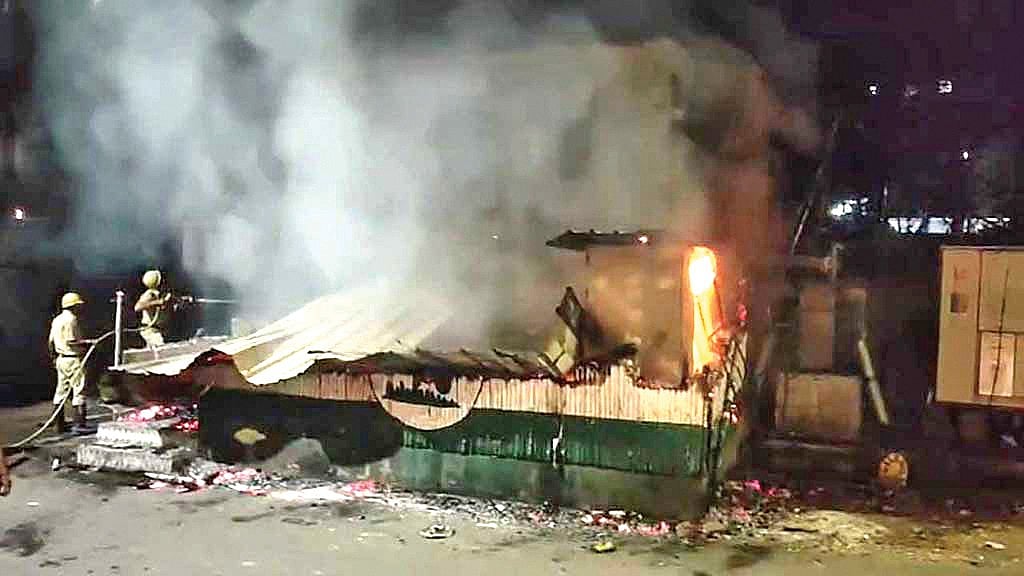
It gave me an eerie feeling, as if a storm was coming. A storm that would destroy everything I held precious. As the day gave way to evening and what felt like a never-ending night, I watched with horror the destruction that was unleashed. Overnight, social and mainstream media turned into a putrid cesspool of hatred and whataboutery.
For me, what was most dreadful was the heckling of women candidates. This was unprecedented. Many women who have been vocal about the wrongs of the BJP were forced to lock their profiles. The threats were so vile it did not matter that they were virtual. Reels showed men and young boys dressed up as Mamata Banerjee being beaten and disrobed. This is the fantasy of the BJP cadres—violence with impunity. Instead of protesting and saving the victims, many were found recording such incidents and sharing them.
Public spaces have long been a canvas of political expression in West Bengal. But today these spaces are overrun by the BJP’s lumpen cadre, brought in by the party for a hostile takeover of Bengal.
This is no ‘recalibration’. It’s the third colonisation of Bengal. The state is at risk of losing control over its resources, its intangible wealth of thought and expression. It faces a violent and terrifying transformation of its intellectual culture that has historically thrived on debate and dissent.
For me, a thread broke on the morning of 5 May. I’m trying to hold on, like that little girl, holding on to her grandmother’s sari
Jagati Baagchi is a political and gender rights activist, with a background in law and forensic anthropology. She divides her time between Kolkata and Kampala
Join our official telegram channel (@nationalherald) and stay updated with the latest headlines