POLITICS
‘Didi’ still a crowd puller; rebels irrelevant?
Mamata Banerjee retains her support base as she searches for new allies
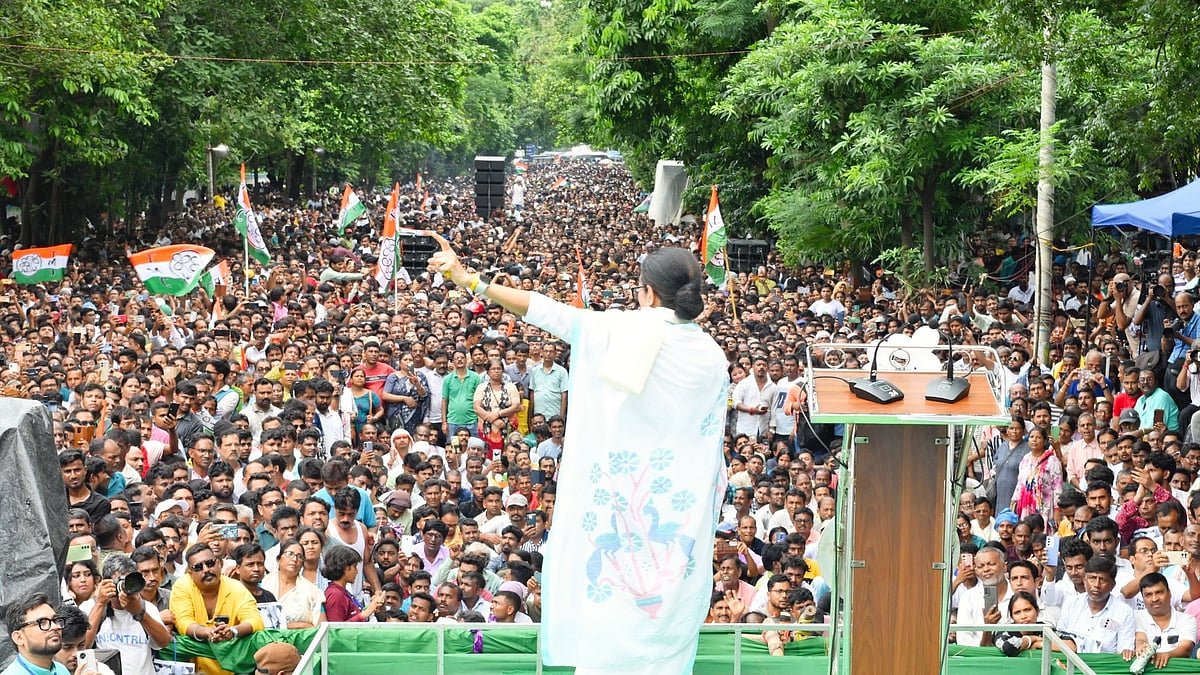
Over time, Kolkata had got used to a massive political gathering every year on 21 July. The Shahid Divas rally, organised in the memory of 13 Youth Congress activists shot dead by Kolkata Police during a 1993 protest march led by Mamata Banerjee, has long served as the annual barometer of the Trinamool Congress’ (TMC) organisational muscle, political direction and electoral readiness.
Incidentally, Banerjee at her 1993 rally was pushing for the introduction of photo-identity cards for voters which the Election Commission of India (ECI) later adopted. Thirty-three monsoons later, the same ECI has played havoc with West Bengal’s voters’ list by disenfranchising 27 lakh people, with Banerjee herself thrown out of power.
But there are more reasons why 21 July this year underlined a fundamentally different juncture in West Bengal's politics. For the first time in over three decades, the legacy of 21 July was contested, challenging the Banerjee-led TMC’s ownership over the event and the surrounding narrative. There were three concurrent rallies — within a three-kilometre radius in central Kolkata — each one commemorating the same event, with each group claiming genuine parentage.
Banerjee’s TMC held its rally on Cathedral Road opposite Birla Planetarium, after being dislodged by the new BJP government from its customary venue in front of Victoria House. TMC’s breakaway group, led by Ritabrata Banerjee, Firhad Hakim, Chandrima Bhattacharya and Madan Mitra, gathered at Mayo Road. Not to be undone, the West Bengal Pradesh Congress Committee (WBPCC), asserting its historical claim over the 1993 legacy and trying to regain its foothold in state politics, gathered at the Shahid Minar grounds.
All eyes were on which rally would receive the highest traction. In other words, all eyes were on whether a beleaguered Banerjee could still draw the crowds.
If the numbers were any indication, it became clear that despite her resounding electoral defeat, a meltdown of her party organisation and relentless persecution and stonewalling by the BJP government, Banerjee remains the go-to for a vast majority of TMC workers.
While her rally site overflowed with workers from all over West Bengal, empty chairs greeted visitors at the venue where the breakaway TMC had gathered. While Banerjee’s rally had more party workers and a handful of leaders, it was leaders galore at the TMC rebels’ event, but hardly any worker to listen to the speeches. The crowd at the Congress rally was somewhere in the middle, indicating that the party has a long way to go before re-emerging as a credible player in West Bengal.
****
Unlike in the recent past, the gathering at Cathedral Road was not a victory lap by an entrenched ruling party, but a desperate counter-offensive by a newly-ousted-from-power opposition leader trying to remain politically relevant. It was also about re-engineering her party’s survival strategy. Banerjee’s address revealed a significant realignment of the TMC’s tactical line. While she offered an olive branch to traditional rivals like the CPI(M), there was a clear purge of internal defectors.
In a major departure, Banerjee called on all anti-BJP political forces in Bengal, directly naming the Left Front (CPI-M) and Congress. "I appeal to every political force in Bengal that is opposed to the BJP. Come together, unite and prepare for the democratic struggle ahead. I have no objection if everyone stands together for this cause," she announced, underlining the need for synergy in INDIA bloc.
This was a significant departure from her decade-long insistence on regional dominance. Up against a unified state machinery backed by the Union government, Banerjee recognises that any split in anti-BJP votes — which earlier worked in her favour — now strengthens BJP's consolidation. By attempting to restate the local state dynamics around a broader national platform, Banerjee appears to be hinting at a unified opposition front to engage the BJP on a one-to-one contest.
While Banerjee’s message is not lost on its intended audience, the response has been on expected lines, indicating the need for further deliberation, both in the Congress and CPI(M).
Veteran Congress leader Adhir Choudhury dismissed the TMC factions' parallel programmes as "circus", emphasising that the Congress on its own was the only force capable of taking on the BJP in West Bengal. State Congress president Subhankar Sarkar, however, took a more nuanced approach. “We welcome anyone who aligns with Congress’ all-India framework to fight the BJP,” Sarkar told National Herald.
But the CPI(M) remains adamant in its refusal to accept TMC’s olive branch. “Mamata Banerjee is not only weakened, she has lost all credibility. Moreover, TMC has no presence outside West Bengal. She never felt the need to fight the BJP when it was needed most,” former Lok Sabha MP and senior CPI(M) leader Sujan Chakraborty told National Herald. Younger party leaders, however, do not seem to be as averse to greater accommodation. “It will be good to move beyond conventional ‘untouchabilities’," was a refrain heard among a section of young CPI(M) leaders.
Other than reaching out to her political rivals, the second part of Banerjee’s address was directed at her own party — no amnesty for defectors who aligned with the BJP or established splinter factions, and a clear line of succession for Abhishek Banerjee — who went on an overdrive at the rally — and senior stalwarts like Kalyan Banerjee, Dola Sen and Sovandeb Chattopadhyay, signalling internal continuity despite external pressure.
The real test for Banerjee will come when she hits the ground by visiting each district as she promised to do. How she and her rump TMC figure in local body polls and panchayat elections will decide her political future and survival.
****
In the process, the TMC rebels, who tied their horses to the BJP bandwagon, appear to have been left high and dry, gaping at empty chairs at their rally. While Banerjee has shut the door on them, “the BJP has no utility for these leaders, except to notch up numbers in the Assembly, Lok Sabha and Rajya Sabha to pass various Bills”, a senior RSS leader told National Herald. “Most will be back in TMC if Abhishek Banerjee no longer calls the shots,” he explained.
That signal, however, did not emanate from the TMC’s 21 July podium as Abhishek — under Mamata Banerjee’s indulgent gaze — upped his game and tore down his rivals, both in the party and beyond. “Those who left the party and are now abusing or blaming me today, I challenge them to return to Didi. If they do, I will resign from my party post within one hour," he thundered.
After 15 years at the helm of the administration, the TMC’s electoral defeat has transformed Banerjee from a chief minister back to an anti-establishment street fighter, taking the good fight to the districts. The 21 July rally has once again demonstrated that though she no longer controls the state administration, she retains her ability to mobilise and lead from the streets — as well as 41 per cent of the popular vote.
Sourabh Sen is a Kolkata-based independent writer and commentator on politics, human rights and foreign affairs. More of his writing here
Join our official telegram channel (@nationalherald) and stay updated with the latest headlines