POLITICS
Why Stalin stands tall even in defeat
Stalin embodies a different possibility in Opposition politics. The way he handed over the baton to Vijay is proof
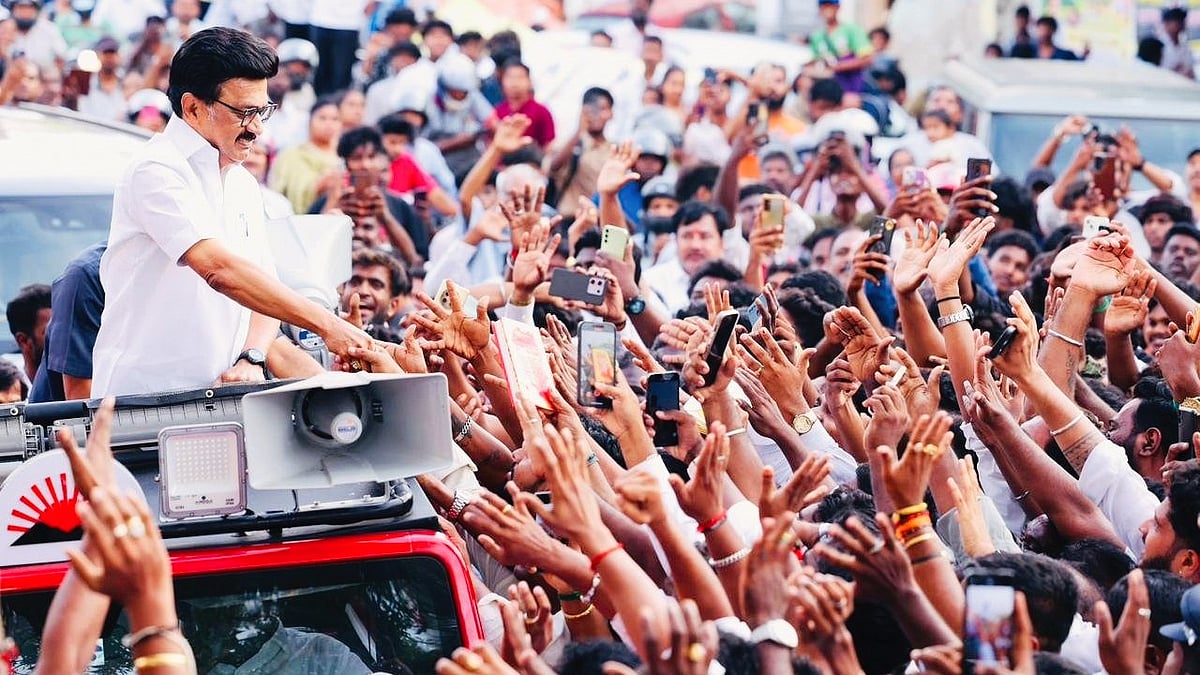
The afternoon M.K. Stalin lost Kolathur, the constituency he had nurtured for years, people imagined he’d show some signs of disappointment, if not anger or a brooding silence. Instead, the outgoing chief minister stepped out to greet tearful party cadres and sympathisers, looking utterly composed, a smile on his face, hands folded before the very voters who’d defeated him.
Travelling in an open vehicle, he thanked the people of Kolathur for standing with him for decades. Electoral verdicts are temporary, but public service must continue, he said, with no bitterness, no allegations of betrayal, no emotional drama. Even his critics admitted that he met defeat with a dignity rare in contemporary Indian politics.
Another image rippled across Tamil Nadu with extraordinary emotional resonance. C. Joseph Vijay, the actor who had just led his new party to power, arrived at Stalin’s residence. Tamil Nadu has an ugly history of chief ministers ordering the arrest of opposition leaders, of ruling party MLAs coming to blows with their rivals inside the Assembly.
But Stalin and his son Udhayanidhi, now leader of the opposition, received Vijay warmly, almost affectionately. No sign of insecurity, no attempt to diminish the young victor, no passive aggression — again, not a very likely scene in contemporary Indian politics.
“We’re still wondering how he lost despite relatively good governance. His clear opposition to aggressive Hindutva kept the BJP at bay. Stalin is far from a spent force,” says Chennai-based writer and social commentator Kavin Malar. Stalin’s political strategies, she argues, will still keep Tamil Nadu difficult for the BJP, which managed to win only a single seat this time. His refusal to allow a DMK-AIADMK pact effectively aborted any possible attempt by the BJP leadership to manipulate the verdict. He even allowed DMK alliance partners to support Vijay.
“Defeat has not diminished him,” says Prof. Sumathi Padmanabhan of Coimbatore’s Kongunadu Arts and Science College. “Somewhere during his stint in power, Stalin ceased to be just a chief minister, he turned into a statesman. For millions in Tamil Nadu, he came to represent ideological clarity, decency and moderation at a time when Indian politics was becoming increasingly shrill and polarised.”
****
Outside Tamil Nadu, many still don’t get Stalin. For years, sections of the national media saw him as the reluctant inheritor of a political dynasty, as someone who lacked the charisma of his father, Karunanidhi. He was mocked for the way he spoke, for his caution and his mannerisms. He didn’t have the star appeal of an MGR or the invincible aura of Jayalalithaa.
“Stalin evolved into a patient politician. He didn’t rule through fear. He didn’t try to project infallibility. He preferred systems over spectacle,” observes veteran Chennai-based journalist and political observer P.K. Sreenivasan.
For many people this writer spoke to, Stalin’s transformation into this leader was first visible during the Covid years. When many Indian states looked clueless or overwhelmed, Stalin strengthened public health outreach, expanded welfare delivery and invested heavily in district-level monitoring. Bureaucrats remarked that Stalin was unusually meticulous in review meetings and more focused on implementation than announcements.
“I’ve worked under different chief ministers,” says a senior IAS officer from Bihar, who also worked with Stalin. “What astonished me was his grasp of environmental concerns, of climate change. Under him, wetlands were protected from encroachment and degradation. Forest cover improved. Biodiversity zones became safer. He represented a model of governance that was rooted in sustainability.”
Across Tamil Nadu, the Chief Minister’s Breakfast Scheme, launched in 2022, became one of the most powerful symbols of Stalin’s politics. In thousands of government schools, children from poor families started receiving breakfast, in addition to the state’s celebrated Nutritious Noon Meal Programme.
Critics were dismissive of ‘just another welfare scheme’, but teachers across the state reported visible change — in attendance and the alertness of their wards. Parents, especially working mothers, expressed great relief.
Similarly, free bus travel for women became transformative in ways that statistics alone cannot capture. The daily commute became easier for domestic workers, nurses, fish vendors, textile labourers and students. Families saved money. Women gained mobility and independence.
Under Stalin, welfare was designed as economic breathing space for ordinary people. Unlike older welfare politics focused entirely on subsidies, he attempted to combine social justice with aspiration. The Naan Mudhalvan programme focused on skill development, language training and employability among students. Tamil Nadu’s lower middle classes increasingly saw the government as a facilitator of upward mobility.
Stalin’s politics also represented a modernisation of the Dravidian ideology, seen outside Tamil Nadu mainly through the lens of anti-Hindi agitations and regional assertion. Stalin expanded Tamil identity politics within the constitutional language of federalism, social justice and pluralism.
He consistently argued that states must retain autonomy within the Union. He opposed Hindi imposition without slipping into separatist rhetoric. He challenged centralisation while remaining firmly committed to constitutional politics. That balance made him nationally important.
“One of the defining moments of his tenure was the appointment of trained temple priests from non-Brahmin communities,” says Nagercoil-based women’s rights activist Jessica Richard. “The move was hugely symbolic. Stalin pitched it as opposition to caste hierarchy rather than anti-religion, continuing the Dravidian movement’s struggle against social exclusion.”
Richard also highlights his government’s early decision “to withdraw thousands of cases filed against protesters, activists and ordinary citizens during the previous regime. Those cases involved the anti-Sterlite protests, anti-CAA demonstrations and various environmental movements. The message was clear: a democratic state should not criminalise dissent.”
Stalin’s arguments on delimitation and his clear articulation of the risks of making this exercise population-centric resonated far beyond Tamil Nadu. His vocal resistance was a big reason why all the southern states made common cause, and why a regional anxiety became a national debate.
His personal journey also struck a chord. Not an overnight sensation manufactured by television studios, Stalin spent decades in organisational politics. As a young man, he went to jail during the Emergency. He spent years in the shadows, and his rise to the top was seen as a culmination of a tenacious political journey.
“Indian politics today is so aggressive. Opposition leaders are often treated as enemies rather than competitors,” says Satheesh Kumar, a Coimbatore-based farmer leader. “Against this backdrop, Stalin’s dignified restraint appeared almost extraordinary.”
Even in defeat, Stalin embodies a different possibility for opposition politics in India. The way he has handed over the baton to Vijay is proof.
K.A. Shaji is a South India–based journalist who has chronicled rural distress, caste and tribal realities, environmental struggles and development fault lines. More of his writing here
Join our official telegram channel (@nationalherald) and stay updated with the latest headlines