


Vijay pries open the politics of Tamil Nadu
For over 50 years, the state’s politics was defined by a stable, deeply institutionalised bipolarity. TVK has upset that equation
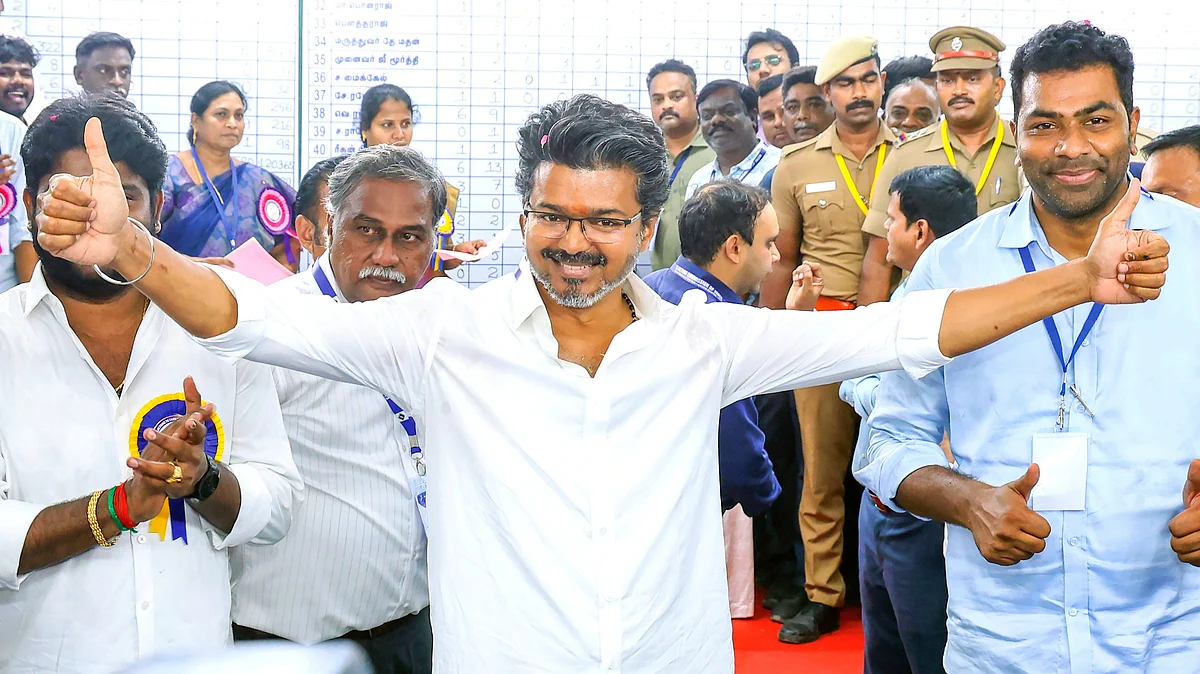


Tamil Nadu has delivered a verdict that resists easy interpretation. At the centre of the churn is Joseph Vijay Chandrasekhar, whose emergence has not merely added another player to the field but altered the grammar of politics in the southern state. In challenging the state’s entrenched duopoly of the DMK and AIADMK and successfully resisting a determined campaign by the resource-rich BJP, Vijay has positioned himself as the principal disruptor of a system that seemed immutable for decades.
For over five decades, Tamil Nadu’s political landscape was defined by a stable, deeply institutionalised bipolarity. The DMK and the AIADMK were not just parties competing for office but a political ecosystem of two players that had shaped welfare delivery, governance practices and the state’s distinctive political identity.
In Assembly elections through the 1990s and 2000s, their combined vote share frequently crossed 70 per cent. Even in closer contests, it rarely went below 60 per cent. The reins of government alternated between the two, but the system held. That system has now been shaken loose.
The numbers underline the scale of change. Across urban constituencies, the combined vote share of the DMK and AIADMK has declined by an estimated 8–12 percentage points compared with the previous election cycle. In Chennai, where bipolar contests once produced margins exceeding 15 per cent, several constituencies have recorded victory margins below five per cent.
Multi-cornered contests have replaced predictable outcomes. North Tamil Nadu, including Vellore, Tiruvallur and Kanchipuram, has seen a fragmentation of traditional vote banks. Here, Vijay’s TVK (Tamilaga Vettri Kazhagam) has drawn disproportionately from first-time voters and lower middle-class urban clusters that were once split between the DMK and AIADMK.
Anecdotal evidence suggests that in the industrial belt of Sriperumbudur and Hosur, younger workers and service sector employees have shifted allegiance to the TVK, drawn to its aspirational messaging that still retains cultural familiarity.
In western Tamil Nadu, historically a stronghold of the AIADMK, the shift has been more nuanced. The party retains pockets of strength among intermediate caste groups and agrarian communities, but its margins have thinned. TVK has not completely displaced the AIADMK but cut into its vote share to alter outcomes.
Triangular contests have replaced the earlier bipolar pattern in districts like Coimbatore, Erode and Salem. The Cauvery delta, for long a DMK bastion, continues to favour the party but with reduced margins. Welfare schemes and historical loyalty still hold, but even here, there is visible erosion among younger voters.
Southern Tamil Nadu, including Madurai, Ramanathapuram and Tirunelveli, presents a more complex picture, with caste alignments, local leadership and micro-level issues shaping outcomes alongside broader political churn.
Nearly 20 per cent of the electorate is now in the 18–29 age group. They are less bound to ideological inheritance and more responsive to leadership narratives, governance expectations and digital communication. “This is not a marginal shift in voting behaviour,” says C. Lakshmanan, former faculty at the Madras Institute of Development Studies. “Traditional loyalties are weakening, especially among younger voters.”
Cinema meets politics
Tamil Nadu has known the political power of cinema. M.G. Ramachandran transformed his screen persona into a welfare-driven political force. J. Jayalalithaa consolidated that legacy with a strong leadership model and expansive welfare programmes. M. Karunanidhi, on the other hand, anchored the DMK in ideological depth and organisational continuity. Each phase produced a stable axis of power.
The present moment is different, though, in that it is dissolving the old binary. Vijay’s rise is not sudden; it’s the culmination of a process. The Vijay Makkal Iyakkam, initially a fan network, evolved over two decades into a welfare-oriented organisation. Blood donation drives, disaster relief operations and educational assistance programmes created a grassroots presence that extended beyond fandom.
By the time TVK was launched, the network already had booth-level structures and district-level organisers. Local body election victories provided early evidence of electoral viability.
“This is not just star power,” says political observer Pradeep Damodaran. “It is years of organisational work.”
Cinema provided the emotional connect with his support base. His films Mersal, Sarkar, Master and Leo weren’t pure entertainers; they had a political sub-text. Mersal questioned taxation and public healthcare disparities. Sarkar invoked citizen rights and tangled with electoral malpractices. Master and Leo reinforced the image of an individual confronting entrenched power.
These narratives created a political persona ahead of Vijay’s plunge into active politics. “Cinema prepared audiences to accept him as a political figure,” says Lakshmanan.
A new era of coalition
Vijay’s political arrival, the end of Tamil Nadu’s old duopoly and a hung Assembly have forced the state into a reckoning with coalition politics, a departure from its history of stable single-party dominance.
At the time of writing, the Congress had offered conditional support to the TVK; the Left parties were still dragging their feet; Stalin had announced that the DMK would “not obstruct” the TVK government (if it comes into being) for the first six months and observe its functioning without interference.
The TVK, which has 108 seats, was 10 short of the 118 needed to get a ruling majority. According to some reports, the AIADMK had indicated its willingness to extend support from the outside, while others speculated that a breakaway faction may help it form the government.
Even in the midst of this churn, Tamil Nadu has resisted the national behemoth. With all the resources at its disposal, and even after running a determined campaign, with Prime Minister Modi trying to spin a narrative of civilisational continuity, the BJP has not been able to make significant inroads here, managing to win a solitary seat and 2.97 per cent of the vote.
Vijay’s ambivalence on identity issues, central to the DMK’s politics, and his avoidance of a direct confrontation with the BJP didn’t cost him in this election. In his acknowledgement of Modi’s congratulatory message the day after his victory, Vijay emphasised a commitment to governance that transcends political boundaries. The ambivalence of his public posture may be strategic, but it also makes observers wonder about his ideological moorings.
On the surface, Vijay situates himself within the symbolic universe of Dravidian politics. His gesture of garlanding Periyar and his invocation of Ambedkar and Kamaraj indicate that he draws on secular, Dravidian traditions. His interventions on issues like demonetisation, the Citizenship Amendment Act and the Sterlite protests have provided glimpses of his political credo. Yet these were still mainly gestures, that do not constitute a coherent ideological framework.
Some commentators have seen the Tamil Nadu election as the sun setting on Dravidian politics. But regional assertion and the principles of social justice and welfare remain deeply embedded in voter expectations. What has been challenged is the monopoly over these ideas. “The emotional contract between voters and parties has changed,” says Chennai-based political observer P. Sundar Rajan. “Welfare schemes are still valued, but they are not enough.”
Urbanisation has also played a hand. Tamil Nadu is nearly half-urban (>48 per cent), and exposure to diverse political narratives and the expansion of digital media have weakened the traditional networks of patronage.
If not by design, then simply via the availability of a third credible option, the electorate has forced every party to reassess its relevance. Power is now contingent. For Vijay, the next challenge is to articulate governance priorities and to forge out of his movement an organisation capable of governance.
“There is a difference between building a movement and running a government,” says Sundar Rajan. “The real test lies ahead.”
K.A. Shaji is a South India–based journalist who has chronicled rural distress, caste and tribal realities, environmental struggles and development fault lines. More of his writing here
Join our official telegram channel (@nationalherald) and stay updated with the latest headlines