


The price AIADMK must pay to sail with the BJP
Seat-sharing tensions aside, the Dravidian party is hard put to take a stand on divisive issues
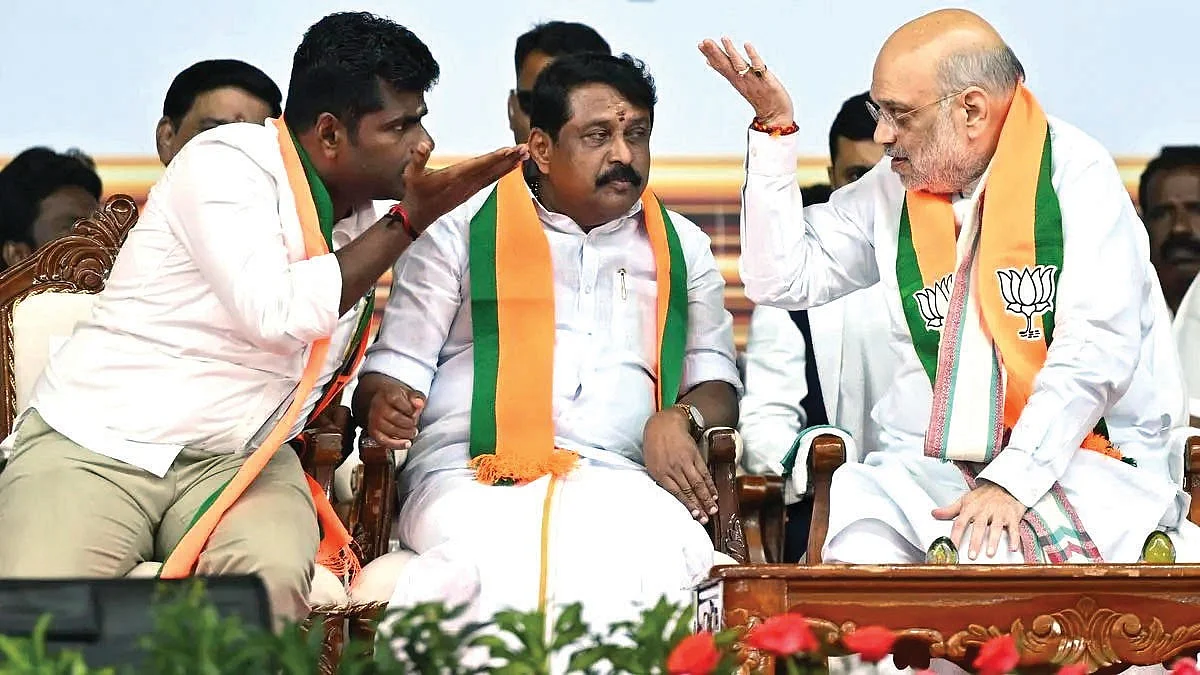


In Thiruparankundram, a politically sensitive Assembly constituency on the outskirts of the temple city of Madurai, the tensions within the AIADMK-BJP alliance are unfolding in full public view.
The seat, traditionally held by the AIADMK, became a point of friction when the party refused to concede it to the BJP during seat-sharing negotiations. Recent local controversies around time-honoured traditions — involving animal sacrifice and the relocation of a sacred flame — were communalised by the BJP to rally Hindu sentiment. Yet, when the final list was drawn, the AIADMK retained the seat and fielded its own candidate, V.V. Rajan Chellappa, a senior leader with deep roots in the region.
Muslims, who once formed part of the AIADMK’s broader social coalition, now view the alliance with unease. While the BJP seeks to benefit from the AIADMK’s legacy vote even as it tries to build an independent political base, AIADMK cadres in Thiruparankundram admit, often off the record, that the BJP is not pulling its weight. Booth-level coordination remains inconsistent, and mobilisation lacks the urgency expected in a high-stakes contest.
Across Tamil Nadu, the relationship is marked by growing asymmetry. The AIADMK remains the senior partner in terms of seats, but the BJP is steadily expanding its footprint. This imbalance is especially visible in western Tamil Nadu, long considered an AIADMK fortress.
Districts such as Coimbatore, Erode, Salem and Namakkal are witnessing growing BJP assertion. One of the party’s most visible faces, former IPS officer and Tamil Nadu BJP president K. Annamalai, has maintained public discipline, but insiders acknowledge unease. While leaders speak openly about their growing base among intermediate castes and urban voters, they privately express dissatisfaction over seat-sharing arrangements.
Also Read: It’s advantage Stalin in Tamil Nadu
Political analysts see a familiar pattern. “The BJP does not enter alliances to remain junior partners indefinitely,” says M. Thiruvenkadam, Chennai-based political observer and office bearer with the Social Science Collective. “It uses alliances as an entry point, builds its organisation and then gradually expands its influence. What we are seeing in Tamil Nadu is an early stage of that process.”
There are also deeper ideological differences. Tamil Nadu’s political landscape, rooted in the Dravidian movement, has historically resisted the ideology of the BJP.
For the AIADMK, this presents a great dilemma. Its decision to realign with the BJP ahead of the Assembly election was driven by electoral necessity after a poor showing in the 2024 Lok Sabha polls. However, the alliance has complicated the party’s ability to articulate a clear ideological position, particularly on secularism and social justice, once central to Dravidian politics.
In constituencies like Thiruparankundram, this tension manifests as cautious messaging that neither fully embraces the BJP’s ideological framing nor decisively counters it. The consequences are visible. Minority voters are drifting away, while sections of the traditional base appear uncertain about the party’s direction.
The contrast with Jayalalithaa’s leadership is frequently invoked. During her tenure, alliances with the BJP were tactical and tightly controlled. She negotiated from a position of strength and ensured that ideological boundaries remained intact. “Jayalalithaa engaged with the BJP, but she never ceded space,” says S. Sundarrajan, Chennai-based political analyst and commentator on Dravidian politics. “What we see today is not engagement but accommodation.”
The consolidation achieved under Edappadi K. Palaniswami after years of internal conflict has not translated into political confidence for the AIADMK. The expulsion of former coordinator O. Panneerselvam and the continuing shadow of V.K. Sasikala and T.T.V. Dhinakaran has meant centralisation without unification.
The BJP, in contrast, is playing a longer game. Its approach in Tamil Nadu is to enter through alliances, build cadre strength, target specific caste groups and change the narrative. Even in constituencies it does not contest, its ideological imprint is becoming visible. Thiruparankundram is a case in point, where the BJP has influenced the political conversation without securing the seat itself.
The movement of leaders underscores this shift. Current Tamil Nadu BJP president K. Nainar Nagendran, a former AIADMK minister who crossed over to the BJP, represents a broader trend in which leaders and cadres, facing uncertainty within the AIADMK, are switching horses.
“The real story may begin after the election,” says C. Lakshmanan, Chennai-based political analyst and retired faculty member of the Madras Institute of Development Studies. “If the AIADMK fails to mount a strong challenge, the BJP will emerge as the more assertive opposition force. That is when we could see a realignment of political loyalties.”
The DMK’s sharpest line of attack has been to frame Palaniswami as the ‘Nitish Kumar of Tamil Nadu’. To understand its resonance, one must look at how Nitish Kumar’s politics in Bihar created conditions for the BJP’s steady expansion without an immediate erosion of his own authority.
Nitish Kumar first came to power in 2005 through an alliance with the BJP, combining his support among backward castes with the BJP’s base among upper castes and urban voters. Over time, he expanded this coalition by incorporating Extremely Backward Classes and marginalised groups through targeted welfare and governance measures.
This broader base, however, also became accessible to the BJP within the alliance framework. His subsequent political shifts, breaking with the BJP in 2013, returning in 2017, exiting again in 2022 and rejoining in 2024, repeatedly altered Bihar’s political equations.
Yet one outcome remained consistent. The BJP steadily enlarged its independent organisational strength and ideological presence, eventually emerging as the dominant force within the alliance.
This is the essence of the Nitish model. A regional leader retains office and visibility, but the long-term beneficiary is the national party.
Tamil Nadu may be witnessing the early stages of a similar process. While Palaniswami may not replicate Nitish’s frequent shifts, he may inadvertently play a comparable role. The comparison with Nitish Kumar has its limits, though. Nitish’s strength lay in his ability to build a durable cross-caste coalition that the BJP could not easily displace. For a long period, he was the anchor of the alliance, not its dependant.
Palaniswami’s rise within the AIADMK was shaped by organisational manoeuvring after Jayalalithaa’s death. His strengths are his administrative record and his role in stabilising the party. But he lacks the statewide emotional connect that defined both M.G. Ramachandran and Jayalalithaa, and his authority does not command the same depth of loyalty across cadres.
Sumanth Raman, a Chennai-based commentator known for his work on electoral politics and public policy, points to this difference. “Nitish Kumar built a political base that the BJP needed. In Tamil Nadu, the equation is still evolving. The AIADMK has a legacy base, but it is fragmented. That makes the alliance structurally unequal from the beginning.”
The DMK’s framing of Palaniswami as a potential Nitish Kumar highlights the risks of accommodation. The challenge is to avoid the Nitish Kumar trajectory, where a regional party, in seeking short-term stability, creates conditions for a long-term shift in political power. That balance is difficult. In the unfolding politics of Tamil Nadu, it may well determine not just the future of the AIADMK, but the very shape of opposition politics.
Join our official telegram channel (@nationalherald) and stay updated with the latest headlines