POLITICS
Why Netaji has become Bengal's new political flashpoint
Mamata Banerjee turns controversy into larger battle over Bengali identity, while BJP faces questions over repeated remarks on the icon
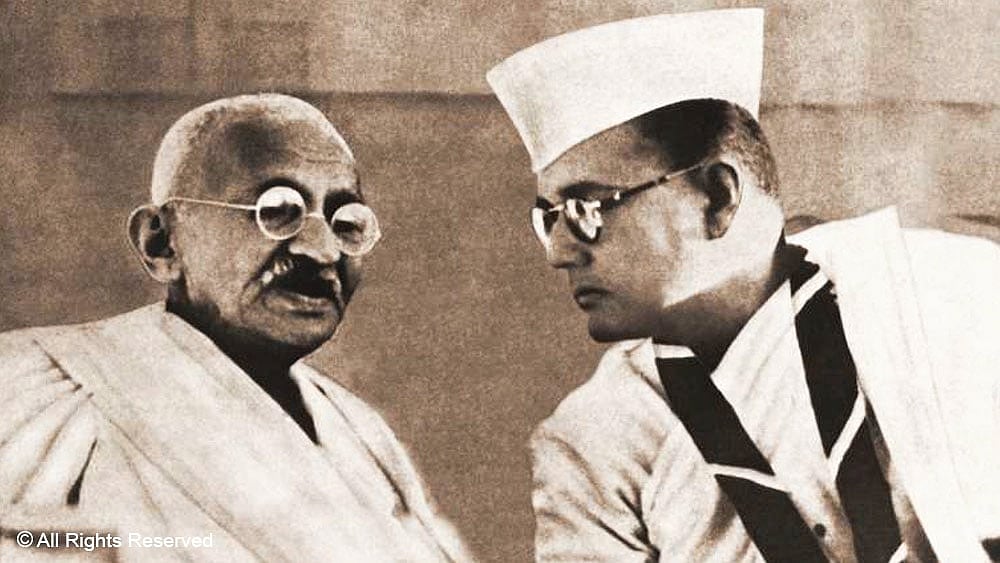
The controversy over remarks targeting Netaji Subhas Chandra Bose is rapidly evolving into a wider political contest in West Bengal, with former chief minister Mamata Banerjee seeking to frame the issue as one of Bengali identity, historical memory and the BJP's relationship with some of the state's most revered icons.
Her intervention comes at a time when the BJP is already battling criticism over comments made by its Rajya Sabha MP Ananta Maharaj alias Nagen Roy, who described Netaji as a "British stooge", questioned why he did not return to India after Independence, and claimed that the Maharaja of Cooch Behar had "defeated Hitler and the Azad Hind Fauj". The fact that Roy represents the politically crucial Rajbanshi community has not escaped attention.
The row has also revived scrutiny of earlier remarks by West Bengal BJP president Samik Bhattacharya, who had claimed that when Syama Prasad Mukherjee urged Subhas and his elder brother Sarat Chandra Bose to speak against the persecution of Hindus in East Bengal between 1937 and 1939, they did not respond. The All India Forward Bloc — the erstwhile Left Front partner founded by Netaji — dismissed the statement as a distortion of history and demanded a public apology after Bhattacharya also referred to sections of the party as "goons".
The remarks — and the BJP leadership's silence thus far — have sparked outrage across political parties, historians and civil society, while also prompting legal complaints over allegedly offensive social media posts targeting the freedom fighter.
Rather than treating the controversy as an isolated instance of political provocation, Mamata Banerjee has sought to portray it as part of a broader pattern of disrespect towards Bengal's historical figures.
Addressing party workers through a live social media broadcast, the former chief minister said she was deeply disturbed by the remarks. "I am pained and deeply saddened. Certain individuals within the BJP — who know nothing of politics, culture, harmony, the country, or Bengal — are today insulting the national icon Subhash Chandra Bose," she said.
She widened her attack by arguing that the BJP had systematically sidelined Bengal's tallest icons. "Yet, one must remember that he was the very person who established so many organisations for the nation. Today, however, that national icon — along with Rabindranath Tagore — has been sidelined. Some are even labelling Netaji Subhash Chandra Bose a traitor," she said.
Banerjee also revived a long-standing political issue that has periodically resurfaced in Bengal — the mystery surrounding Netaji's alleged disappearance following the air crash in which he was killed, as per the official version. Questioning why the BJP-led Centre had not fulfilled its promise of making all related files public, she said the issue remained unresolved despite repeated assurances.
"The BJP made many promises before coming to power — including opening the files — so why are the files regarding the mystery of Netaji's disappearance still not being made public?" she asked.
By linking the latest controversy to the unresolved mystery surrounding Netaji's disappearance, Banerjee has attempted to shift the debate from one centred on an individual MP's remarks to a larger question of whether the BJP has failed to accord the freedom fighter the respect he deserves.
The issue has also moved beyond electoral politics. A Hindu organisation has announced a protest march in Kolkata on Sunday, beginning from Sealdah railway station, describing the alleged insults to Netaji as an attack on the nation itself. Calling upon people across political affiliations to participate, organisers have portrayed the march as a non-partisan effort to defend the legacy of one of India's most revered freedom fighters.
At the same time, the controversy has acquired a legal dimension after social activist Munmun Chakraborty Das filed complaints against two Facebook users accused of circulating morphed images and derogatory content relating to Netaji. In her representation to the authorities in Cooch Behar, she argued that the posts had hurt public sentiment and carried the potential to disturb law and order.
Taken together, the succession of controversies has enabled Banerjee's Trinamool Congress (TMC) to argue that these are not isolated remarks but part of a recurring pattern involving prominent BJP leaders.
The issue has also provided an opening for Bangla Pokkho founder Dr Garga Chatterjee to re-emerge in Bengal's political discourse. Once among the state's most prominent advocates of Bengali linguistic and cultural identity, Chatterjee has used the controversy to revive his long-standing argument that Bengal's icons are not defended with the same political urgency as regional heroes elsewhere in the country.
"If the way Subhas Chandra Bose is being insulted daily in Bengal by two MPs and their followers were done to Shivaji in Maharashtra, the chief minister of Maharashtra himself would have lodged a police complaint before the Marathi people could even react, and the offenders would have been arrested within an hour," he said.
For the BJP, the immediate challenge is containing the fallout from controversial remarks made by its own leaders. For TMC, with Banerjee leading the political offensive, the controversy offers another opportunity to reinforce its long-standing positioning as the defender of Bengal's history, language and cultural identity.
Join our official telegram channel (@nationalherald) and stay updated with the latest headlines