POLITICS
Will Modi govt walk out of ‘one-sided’ US-India trade deal, asks Congress
Randeep Surjewala sharpens his attack on Centre after US Supreme Court strikes down Trump’s emergency tariff powers
Senior Congress leader Randeep Surjewala on Friday sharpened his attack on the Centre after the Supreme Court of the United States struck down President Donald Trump’s use of emergency powers to impose sweeping global tariffs.
The court, in a 6–3 ruling authored by chief justice John Roberts, held that Trump had exceeded his authority under the International Emergency Economic Powers Act (IEEPA), declaring the far-reaching levies illegal — a significant blow to what had been a centrepiece of his second-term economic agenda.
In response, Trump announced a fresh move: a 150-day “temporary import surcharge” of 10 per cent ad valorem under Section 122 of the Trade Act of 1974, effectively lowering the tariff rate from 18 per cent to 10 per cent.
Against this shifting legal and political backdrop, Surjewala took to X to raise a volley of pointed questions. “Are these tariffs sustainable vis-à-vis India? Can these provisions be justifiably applied to India?” he asked, demanding clarity on whether the revised tariff regime would still underpin the US-India Trade Deal (Framework Agreement).
"Will the Modi government now show the courage to walk out of a one-sided US - India Trade Deal, asked Surjewala.
The Congress leader said the agreement is already facing opposition from farmers, small and medium enterprises, energy experts, data specialists and economists. “Will these new tariffs still hold the US-India Trade Deal?” he asked, before pressing further: “Will the Modi government now show the courage to walk out of a one-sided deal?”
Surjewala also questioned whether the government would now act in what he termed the “national interest” by resuming purchases of cheaper Russian and Iranian crude to safeguard India’s energy security. He asked if New Delhi would reconsider commitments to withdraw so-called non-tariff barriers — including agricultural subsidies — or permit the import of genetically modified crops, which he argued could threaten India’s seed integrity, purity and biodiversity.
He further sought assurances that the government would not remain bound to import USD 500 billion worth of American goods over the next five years at zero tariff, a figure he said amounts to Rs 45 lakh crore. “Will the Modi government promise to protect India’s data and digital security?” he asked.
Earlier this month, as Washington and New Delhi announced a framework for an interim trade agreement, Trump signed an executive order removing 25 per cent punitive tariffs imposed on India over its purchases of Russian oil. The US president cited India’s commitment to curb direct or indirect energy imports from Moscow and to expand purchases of American energy products. Under the deal, the reciprocal tariff on Indian goods was reduced from 25 per cent to 18 per cent.
Following the Supreme Court’s verdict, Trump insisted there was “no change” in the India trade arrangement. Speaking at a White House news conference, he said, “Nothing changes. They’ll be paying tariffs, and we will not be paying tariffs.”
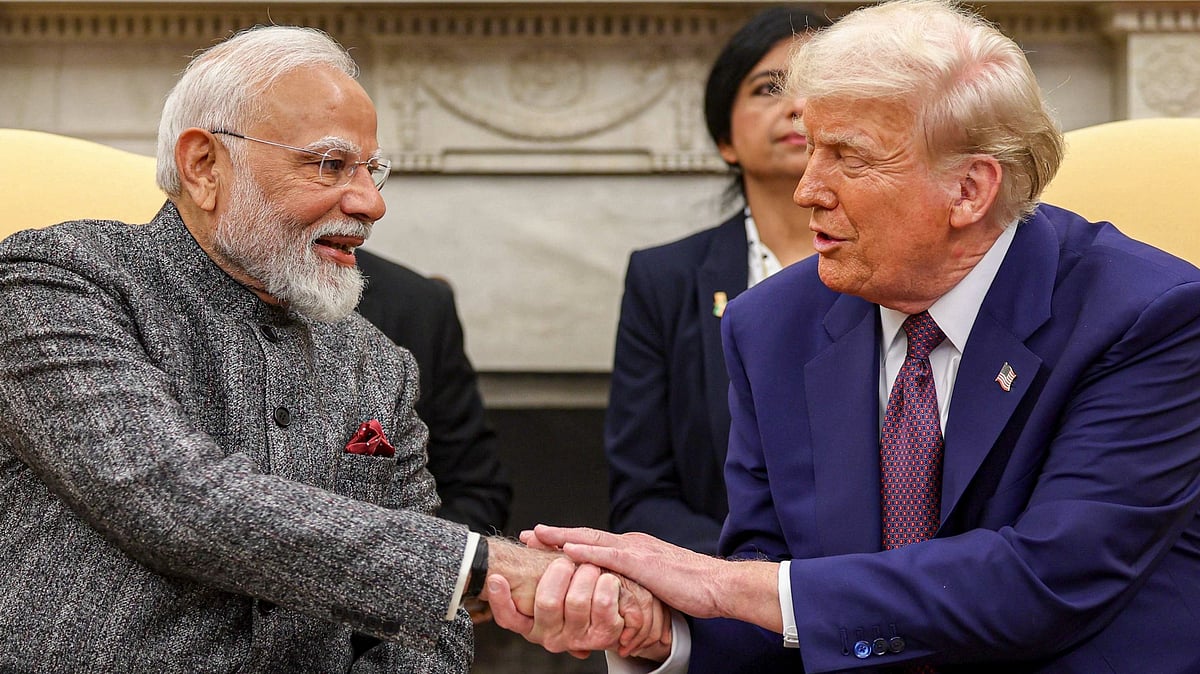
Praising his ties with Prime Minister Narendra Modi, Trump described the relationship as “fantastic” and reiterated his claim that India had scaled back Russian oil imports at his request. He also repeated his assertion that he had helped defuse tensions between India and Pakistan through the leverage of tariffs.
Calling the revised pact “a fair deal”, Trump said, “India — and I think Prime Minister Modi is a great gentleman, a great man — was much smarter than the people he was dealing with in the United States. He was ripping us off. So we made a deal with India. It’s a fair deal now.”
As legal battles reshape Washington’s tariff policy, the political contest over the US-India trade framework appears far from settled, with questions of sovereignty, energy security and economic leverage now thrust sharply into the spotlight.
With PTI inputs
Join our official telegram channel (@nationalherald) and stay updated with the latest headlines