Sports
Asiad: How Salman and Satnam beat the odds to land India’s rowing medal
“The world will remember that a Khan and a Singh won India’s first medal in this event”
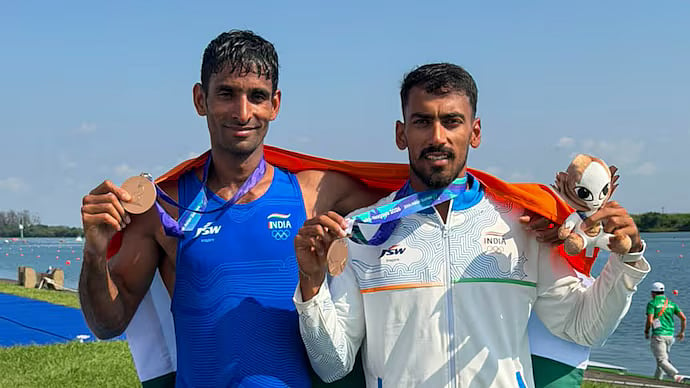
The solitary bronze medal Indian rowers won in the double sculls at the Aichi-Nagoya Asian Games on Thursday was possibly worth its weight in gold. The odd couple of Satnam Singh and Salman Khan, holding modest posts in the Indian Navy and Army respectively, defied tremendous odds and last-minute changes to their team combination to rise to the occasion, but were still bitter despite their podium finish.
“The world will remember that a Khan and a Singh won India’s first medal in this event,” the lithe Satnam told RevSportz in an interview soon after their event, but revealed that they had competed almost under duress.
“If we hadn’t participated, we’d be considered anti-national,” Satnam said, as the rowers expressed strong reservations over an eleventh-hour shuffle of team combinations by the Rowing Federation of India (RFI).
The rowing programme, originally planned across four days, was compressed by the organisers to two due to predictions of weather disruptions caused by Typhoon Dujuan. This forced the Indian camp to rethink its crew combinations, and the changes played havoc with their planning for most events. Arvind Singh, originally entered in the single sculls, was moved to the quadruple sculls, while Balraj Panwar was shifted from the quad to the single sculls.
Saurav Kumar and Vipul Satish, who were initially part of the men’s pair, were set to be replaced by Nitin Kumar and Jaswinder Singh. Navdeep Singh and Kulwinder Singh, meanwhile, were moved from the double sculls to the quadruple sculls. The changes left several athletes frustrated, but RFI president Balaji Maradapa clarified that the revised crew combinations were decided by the coaches “in the interest of the team” — bringing Singh and Khan together in the double sculls for the first time.
This is what made the medal — a rarity for India in this discipline — so special. The Khan-Singh duo are both giants of men, with 28-year-old Salman standing six-foot-three and weighing nearly 100 kilos of rippling muscle. The 26-year-old Satnam is a couple of inches shorter, with sinews like wound nautical rope.
“In men’s double sculls, our confidence was zero. We were sitting together in this boat for the first time. We didn’t sit in this boat at the national camp. We didn’t even train together in the past, since he’s from the Army and I am from the Navy,” Satnam said. With next to no preparation, they took to the course on Thursday morning, armed with little more than willpower, and gave it their all.
Under a blistering mid-morning sun, their massive frames squeezed into their narrow boat, the two hauled themselves — and their 27kg craft — over two kilometres along the glassy waters of the Nagara River as it flowed towards Nagoya. They completed the race in 6 minutes 13 seconds, finishing just under three seconds behind second-placed Uzbekistan.
Media present at the men’s double sculls event reported that, at the end of the race, Salman had his burly hand held up by a volunteer as he navigated the short, 10-foot ramp out of the water on trembling legs. Satnam, meanwhile, doubled over in anguish and screamed: Gold chala gaya (we lost the gold).
Join our official telegram channel (@nationalherald) and stay updated with the latest headlines