


Book extract: ‘Artificial’ intelligence and ‘natural’ greed
Artificial intelligence (AI) and robotics are no longer merely the stuff of science fiction


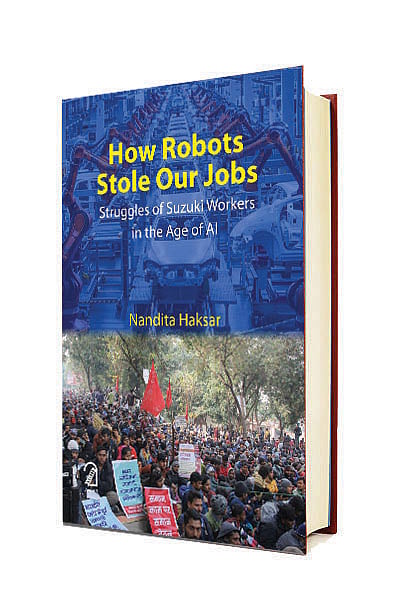
Title: How Robots Stole Our Jobs: Struggles of Suzuki Workers in the Age of AI
Author: Nandita Haksar
Pages: 252
Price: Rs 475
Publisher: Aakar Books
Artificial intelligence (AI) and robotics are no longer the stuff of science fiction; they have become a part of our everyday lives. India now ranks among the fastest-growing AI economies in the world [it just hosted the AI Impact Summit, 16-20 February, attended by several heads of state]. With the growing threat of displacement and disruption by AI and new technologies, however, should we, Indian citizens, be proud or should we be alarmed?
Our government, like all governments around the world, paints a rosy picture of our AI-powered future. Take, for example, NITI Aayog’s report, ‘AI for Inclusive Societal Development’ (October 2025), which promises that AI will empower India’s 490 million informal workers by expanding access to healthcare, education, skilling and financial inclusion.
The report highlights how AI-driven tools can boost productivity and resilience for millions who form the backbone of India’s economy. The report also stresses that technology can bridge deep social and economic divides, ensuring that the benefits of AI reach every citizen. The Union Cabinet approved the India AI Mission in March 2024, with a budget outlay of Rs 10,371.92 crore over five years. A NITI Aayog report estimates that AI could add between US$ 500 and 600 billion to India’s GDP by 2035.
[…]
Geoffrey Hinton, the 2024 Nobel Prize–winning computer scientist known as the ‘godfather of Artificial Intelligence’, has warned that AI may wipe out millions of jobs, while emphasising that the real danger does not lie with the technology, but with how society wants to deploy it. Hinton warns that AI systems might be able to control humans just as easily as an adult can bribe a three-year-old child with candy.
[…]
Hinton says, “What’s actually going to happen is rich people are going to use AI to replace workers. It’s going to create massive unemployment and a huge rise in profits. It will make a few people much richer and most people poorer. That’s not AI’s fault, that is the capitalist system.”
[…]
It is said that AI technologies are more environment-friendly, but in fact, they consume unfathomable amounts of data, labour and natural resources. For example, a single AI query can consume up to ten times more power than a basic online search and training a large language model can use over 1,000 megawatt-hours of electricity, roughly equal to the consumption by several hundred Indian households.
These technologies can lead to water scarcity. Cooling systems in large data centres rely on water-based technology, yet over 80 per cent of the facilities today are located in water scarce states such as Maharashtra, Telangana, and Tamil Nadu. In Bengaluru, data centres already consume nearly eight million litres of water each day, even as the city faces extreme water shortages. And then there are the robots.
[…]
A media report in April 2025 carried the heading that maids were beginning to be replaced by robots in Bengaluru. The report was about Manisha Roy from Hebbal, who replaced her cook with a kitchen robot capable of chopping, sautéing, and steaming. “Now I do other household chores while the food is getting ready, because I know my food won’t be charred,” she shared.
Also Read: Are we being overrun by ‘AI slop’?
[…]
The report stated that this shift is driven by the desire for consistent, hassle-free assistance. Robots offer reliability, and their one-time cost proves economical over a period of time. There is not even a passing mention of the impact of this shift on the maids, the tens of thousands of women who work as domestic help across the country to support their families.
One of the reasons is, as Karen Hao points out, AI generative technologies spawn “heightened volumes of misinformation”. News reports and video clips celebrate how humanoids can paint, dance, play sports, and some have even learnt embroidery. There are news items which announced that robots in warehouses are loading and unloading materials, and there are some factories run entirely by robots called dark factories. Amidst all this reporting, full of joy and wonder, there is very little mention of the impact of these new technologies on the lives of the millions of workers who are being displaced by automation and AI-driven robots.
[…]
India is one of the youngest nations in the world, with more than 62 per cent of its population in the working age group (15-59 years), and more than 54 per cent of its total population below 25 years of age. The government recognises that India faces a dual challenge of paucity of a highly trained workforce, as well as non-employability of large sections of the conventionally educated youth, who possess little or no job skills.
[…]
The Skill India programme was introduced by the central government in 2015 to upgrade the skills of workers to prepare them for the transition to new technologies.
However, this scheme has not achieved its purported goal, according to the latest report of the Comptroller and Auditor General (CAG) of India. In its performance audit of the Pradhan Mantri Kausal Vikas Yojana (PMKVY), the CAG report has highlighted serious gaps in the implementation of India’s flagship skill development scheme.
[…]
Trade union movements in India have come out strongly against the new labour codes [and the draft Shram Shakti Niti 2025].
[…]
However, they have so far not engaged with the question of new technologies and the disruption caused by them in working class lives.
This disruption has been felt by the middle class as well when major Indian IT companies, including TCS, Infosys, Tech Mahindra and Wipro, quietly began restructuring their workforce, taking more than 50,000 people off their rolls. There have been mass layoffs in the manufacturing sector as well, especially in the automotive sector.
[…]
According to a pamphlet brought out in May 2025 by the Maruti Suzuki Asthayi Mazdoor Sangh, ‘Suzuki presently employs 34,918 workers out of whom only 18 per cent are permanent, 40.72 per cent are contractual workers, 21.6 per cent are temporary workers (TW), 21 per cent are trainees (MST and SST) and apprentices. The vast non-permanent workforce together accounts for more than 80 per cent of the total workforce’.
These figures match the figures given in a report on the ‘Future of Work in India’s Automotive Sector’, which observed ‘a significant ratio of non-standard employment to permanent workers across OEMs (Original Equipment Manufac-turers) and tier 1 vendors, with bulk of the work on the shop floor being performed by workers in non-standard employment’.
[…]
Some experts optimistically argue that during the past three industrial revolutions, driven by steam, electricity and digital technologies, people were displaced and there was disruption, but ultimately more jobs were created.
The same will happen this time too. However, the fundamental difference between the other technological revolutions and the fourth industrial revolution is that human beings are being replaced with robots, which will, in turn, lead to industries without workers and growth without employment.
Nandita Haksar is a lawyer and human rights activist
Join our official telegram channel (@nationalherald) and stay updated with the latest headlines