


UPI payments above Rs 2,000 are not automatically chargeable: What the new rules mean
Small transactions remain protected, P2P transfers stay free, and MDR would apply only to select merchant payments



The government’s decision to protect Unified Payments Interface transactions of up to Rs 2,000 from charges has prompted concerns that people may now have to pay for larger transfers. However, the notification does not introduce an automatic fee on every UPI payment exceeding that amount.
Under the Finance Ministry’s gazette notification dated 14th September, banks and payment-system providers cannot directly or indirectly charge a person making or receiving a UPI payment of up to Rs 2,000. Payments made using RuPay debit cards are also covered by the protected category.
The change creates room for a Merchant Discount Rate, or MDR, to be introduced on certain higher-value merchant transactions. The rate, eligible merchant categories and revenue-sharing mechanism have yet to be finalised.
For an ordinary UPI user, the immediate position is straightforward: payments of Rs 500, Rs 1,500 or Rs 2,000 remain free. A payment of Rs 2,500, Rs 5,000 or Rs 20,000 does not automatically attract a customer fee merely because it exceeds the Rs 2,000 threshold.
What does the Rs 2,000 threshold mean?
The threshold identifies UPI payments that are expressly protected from any direct or indirect charge. It is neither a new transaction limit nor a point beyond which users must automatically pay a fee.
Until now, the law effectively prohibited MDR on UPI and RuPay debit-card transactions, Reuters reported. Parliament’s Taxation and Other Laws (Amendment) Act, 2026, changed the legal framework by removing the blanket zero-MDR requirement and allowing the government to specify which payment categories must remain free.
The 14th September notification exercises that power by protecting UPI transactions of up to Rs 2,000 and RuPay debit-card payments. It leaves open the possibility of charges on UPI payments above the threshold, but does not itself determine the final MDR, the merchants to whom it would apply or the date of its introduction.
Will customers be charged for paying more than Rs 2,000?
Not under any policy announced so far.
The government has maintained that UPI will remain free for citizens and that any MDR, when introduced, would be nominal and confined to a limited category of merchant transactions above a prescribed threshold.
All person-to-person, or P2P, transfers are expected to remain free. These include sending money to a friend, relative or another individual through a UPI ID, mobile number or QR code.
The policy discussion relates primarily to person-to-merchant, or P2M, payments. These are transactions made to shops, restaurants, e-commerce platforms and other businesses.
Therefore, a person transferring Rs 10,000 to a relative would not be treated in the same way as someone paying Rs 10,000 to a large commercial establishment, according to the Indian Express.
What is MDR?
MDR is the fee charged to a merchant for processing a digital payment. It is generally calculated as a small percentage of the transaction value.
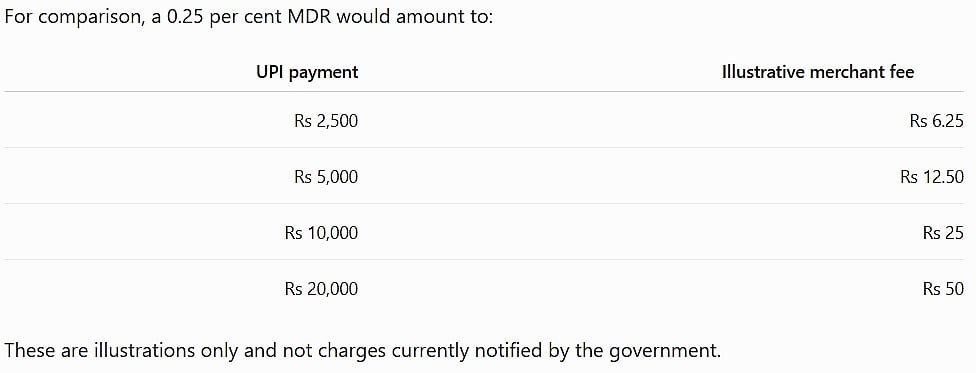
For example, if a 0.25 per cent MDR were applied to a Rs 10,000 merchant payment, the processing charge would be Rs 25. That fee would ordinarily be paid by the merchant and distributed among the organisations that processed the transaction.
These can include:
The issuer bank, where the customer holds the account
The customer’s UPI application
The payment service provider bank
The merchant’s acquiring bank or payment aggregator
NPCI, which operates the UPI network
MDR is already part of the card-payment system. Debit-card MDR is generally around 0.8 to 0.9 per cent, while credit-card charges can be substantially higher. UPI merchant payments, by contrast, have operated under a zero-MDR regime since January 2020.
Could merchants pass the fee to customers?
An MDR is technically imposed on the merchant or payment ecosystem, not deducted automatically from the customer’s bank account.
However, there are concerns that merchants could eventually try to recover the cost by increasing prices, introducing a convenience fee or encouraging customers to use another payment method. Whether and how such practices would be regulated will depend on the final framework.
The notification’s prohibition on direct or indirect charges provides explicit protection for UPI payments up to Rs 2,000. For larger payments, the government and NPCI will need to clarify the safeguards accompanying any future MDR.
Who will decide the MDR structure?
The UPI and Services Steering Committee of the National Payments Corporation of India is expected to consider the proposed charges and their distribution among participating organisations.
The committee represents the various parts of the UPI ecosystem, including public and private sector banks, small finance banks, UPI applications and industry organisations such as the Indian Banks’ Association and the Payments Council of India.
Its discussions are expected to cover:
The MDR percentage
The minimum transaction value at which it would apply
Whether it should be restricted to large merchants
The definition of a large merchant
Exemptions for smaller businesses
The division of MDR revenue among banks, apps and payment aggregators
Recent consultations have focused on merchant payments and the allocation of fee revenue among banks, UPI applications and aggregators. No final rate or distribution formula has been announced.
What MDR rate is being considered?
Industry estimates have placed a possible MDR at between 25 and 40 basis points, equivalent to 0.25–0.4 per cent of the transaction value. Other proposals have suggested a range of 0.3–0.5 per cent for higher-value payments made to large merchants.
These figures remain proposals and have not been notified as final rates.
Moneycontrol reported that an MDR of 25–30 basis points could be considered for transactions above Rs 2,000 involving large merchants. Preliminary estimates suggest that a 0.25 per cent charge on eligible payments could create an annual revenue pool of around Rs 13,000 crore.
Will every merchant face MDR?
That has not been decided.
One proposal is to apply MDR only when both conditions are met: the transaction exceeds Rs 2,000 and the recipient is classified as a large merchant. Another possible approach is to determine eligibility primarily through a merchant’s annual turnover.
The government has previously indicated that small everyday payments, particularly those made to neighbourhood retailers, would remain outside the charging framework. But the 14th September notification itself does not state that MDR will apply exclusively to large merchants.
The final decision will therefore need to define whether the fee covers all merchants receiving higher-value payments or only businesses above a turnover threshold.
Why is MDR being reconsidered?
UPI has expanded from a relatively small payment network into the backbone of India’s retail digital-payment system.
The number of banks connected to UPI increased from 44 in 2016–17 to 741 by July 2026. The network processed a record 2,366 crore transactions worth nearly Rs 29.88 lakh crore in July alone, according to a PIB release.
Banks, payment applications and other service providers incur expenses to operate this infrastructure, including costs related to servers, software, cybersecurity, fraud prevention, customer support and dispute resolution.
Under the zero-MDR model, these companies cannot recover those expenses directly from merchant transactions. The government has instead supported parts of the ecosystem through incentive schemes, including incentives for low-value UPI payments made to small merchants.
The proposed MDR is intended to create a more sustainable source of revenue for the organisations maintaining and expanding the system.
Why are payments above Rs 2,000 important?
Higher-value merchant payments account for a small share of the number of UPI transactions but a substantial portion of the money transferred.
In 2025–26, payments above Rs 2,000 represented only about 4 per cent of person-to-merchant UPI transactions. However, as per an Indian Express report, they accounted for roughly two-thirds of their total value.
This makes them an attractive category for monetisation: the industry could collect meaningful revenue from a relatively small proportion of transactions while keeping most routine UPI payments outside the MDR framework.
How do RuPay debit-card payments fit in?
The notification separately lists debit cards operated through RuPay as a protected electronic payment mode. Its wording does not attach the Rs 2,000 limit to RuPay debit-card payments; that threshold specifically qualifies the UPI category.
RuPay credit cards linked to UPI are different from RuPay debit cards. Merchant charges can already apply to eligible RuPay credit-card payments made through UPI, subject to the relevant NPCI framework and exemptions.
What about offline UPI?
Alongside the discussion over MDR, the payments industry is exploring greater use of facilities such as UPI Tap and Pay, which can make transactions simpler in areas where mobile connectivity is unreliable.
Shams Tabrej, chief executive and founder of Ezeepay, said such services could be particularly useful in Tier-II and Tier-III cities and rural areas, where unstable networks can interrupt digital payments.
“If a person can pay by tapping a phone and not wait for a working data connection, life is simpler. It also helps people feel more at ease with digital payments,” he said.
Tabrej said the next phase of UPI’s development would depend not only on increasing transaction volumes but also on making payments reliable and accessible across different connectivity conditions.
What should users remember?
The notification does not mean that free UPI is restricted to Rs 2,000. It means payments up to that amount have been expressly placed in a category on which banks and system providers cannot impose direct or indirect charges.
At present:
UPI payments up to Rs 2,000 are protected from charges.
P2P transfers remain free.
A customer is not automatically charged for paying more than Rs 2,000.
MDR relates to merchant payments, not ordinary transfers between individuals.
No final MDR rate, merchant category or implementation date has been announced.
The proposed charge is expected to be borne by eligible merchants and shared among payment-system participants.
Further rules are required before an MDR can take effect.
For users, therefore, nothing changes immediately at the payment screen. The real change is legal and regulatory: the government has protected smaller transactions while creating room for the UPI ecosystem to earn revenue from selected higher-value merchant payments in the future.
With agency inputs
Join our official telegram channel (@nationalherald) and stay updated with the latest headlines