


Byrnihat's toxic truth, and a very narrow response from the government
A viral investigation, an official inspection and a question: why is Byrnihat still among the world's most polluted places?
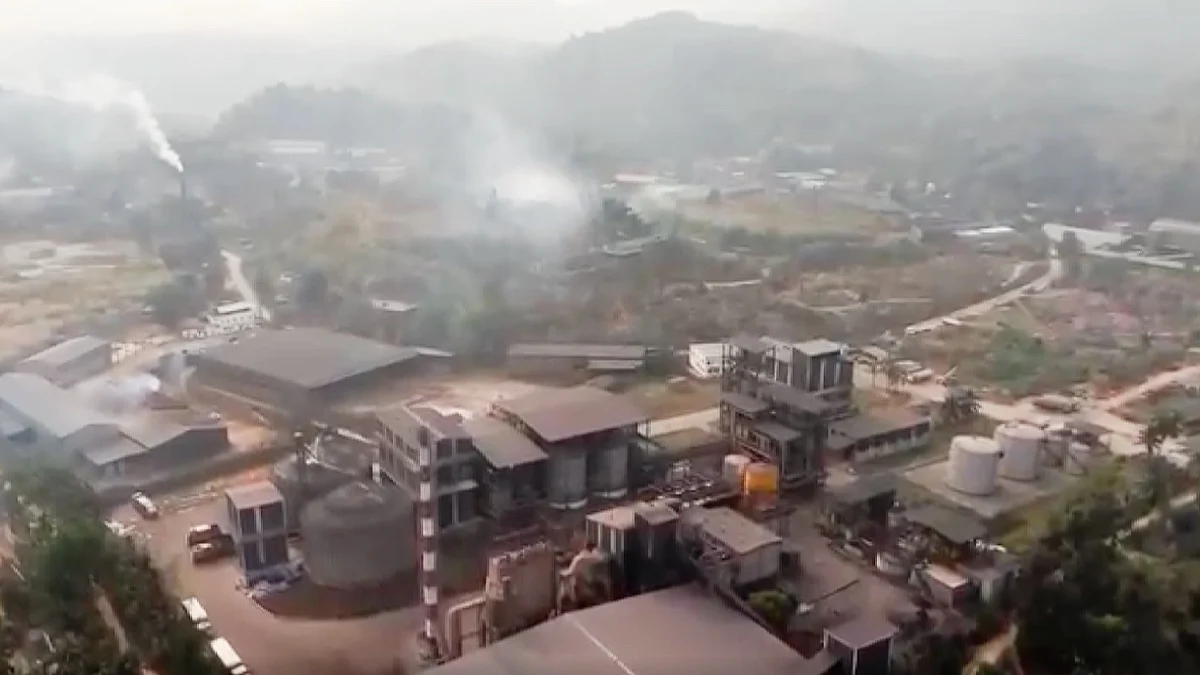


In Byrnihat, the industrial town on the Assam-Meghalaya border that has repeatedly figured among the world's most polluted places, the Meghalaya government's response to a viral investigation has been remarkably narrow.
After an inspection on 29 June, the Meghalaya State Pollution Control Board (MSPCB) said the white plume seen in journalist Sarthak Goswami's widely shared video emanating from Umiam Distillation Pvt Ltd (UDPL), a grain-based ethanol plant in Byrnihat's Export Promotion Industrial Park (EPIP), was merely water vapour and not smoke. The board also said the plant was operating within prescribed pollution norms.
UDPL has echoed that position. It says the viral video unfairly singled out one factory in an industrial cluster comprising dozens of units, that it operates pollution-control equipment including electrostatic precipitators (ESP) and a zero liquid discharge (ZLD) system, and has itself called for an independent source-apportionment study covering the entire Byrnihat industrial estate.
Perhaps all of that is true. But even if every one of those claims is accepted, they answer only one question while leaving the central one untouched.
If the visible plume is steam, if UDPL is compliant and if several polluting units have already been shut over the years, why does Byrnihat continue to rank among the most polluted places in the world?
That is the question the official response does not answer.
Goswami's reporting deserves serious attention not because it conclusively proves that one ethanol plant is responsible for Byrnihat's pollution, but because it forced regulators and the company to publicly respond to questions that residents have raised for years.
His investigation goes far beyond dramatic images of factory chimneys. It documents residents complaining of persistent respiratory ailments, foul-smelling air and pollution they say has become part of daily life. Most strikingly, it shows vegetation coated with a thick grey residue. Leaves that should be green appear covered with an ash-like film — an image difficult to reconcile with assurances that pollution is under control.
The footage also raises uncomfortable questions about transparency. As Goswami continued documenting conditions around the plant, security guards prevented him from filming and asked how he would feel if someone began filming outside his own home, all of which is part of the video.
Industrial emissions, however, are not a private matter. Factories operating under environmental regulation discharge into public air and public waterways. Documenting those emissions — whether by journalists, researchers or citizens — is a matter of legitimate public interest. If anything, attempts to obstruct such reporting only strengthen the case for greater transparency.
Whether the residue seen on leaves originated from one industrial unit or several is precisely what a scientific investigation should determine. The video raises the question. It does not pretend to answer it.
The MSPCB's inspection focused on a specific allegation: whether emissions visible from one stack at UDPL were smoke or water vapour.
The board concluded they were steam. But Byrnihat's environmental crisis was never about one chimney. It is about ambient air quality. It is about PM2.5 concentrations that have repeatedly placed the town at or near the top of global pollution rankings. It is about an industrial ecosystem spanning two states, with cement plants, ferro-alloy units, distilleries, coke ovens, heavy truck traffic, road dust and other potential pollution sources.
The government's statement leaves several important questions unanswered.
Was the inspection based on continuous emissions monitoring data or simply a snapshot?
Will the MSPCB publish the complete inspection report, emissions data and methodology?
Has any independent source-apportionment study been conducted to identify the contribution of each industrial unit, vehicular emissions, road dust and other pollution sources?
How much of Byrnihat's pollution comes from the ethanol plant, and how much from the dozens of other industrial units operating across the Assam-Meghalaya border?
If major industries are compliant and enforcement has improved, why do Byrnihat's pollution levels remain among the highest recorded anywhere in the world?
Byrnihat's pollution has long been attributed to multiple industrial sources, heavy vehicular traffic, road dust and the geography of the region, which can trap pollutants. If UDPL has been found compliant after inspection, that should not end the conversation. It should intensify efforts to identify the actual sources responsible for the town's toxic air.
The irony is that the government's response and the company's defence have converged on the same point: neither claims that the ethanol plant alone explains Byrnihat's pollution. Yet neither offers a comprehensive explanation for why the town continues to record some of the worst air quality in the world.
Join our official telegram channel (@nationalherald) and stay updated with the latest headlines