


Can Kaziranga survive?
Cutting down the buffer zone around the national park and tiger reserve is bad news, and not just for animals, writes Rashme Sehgal
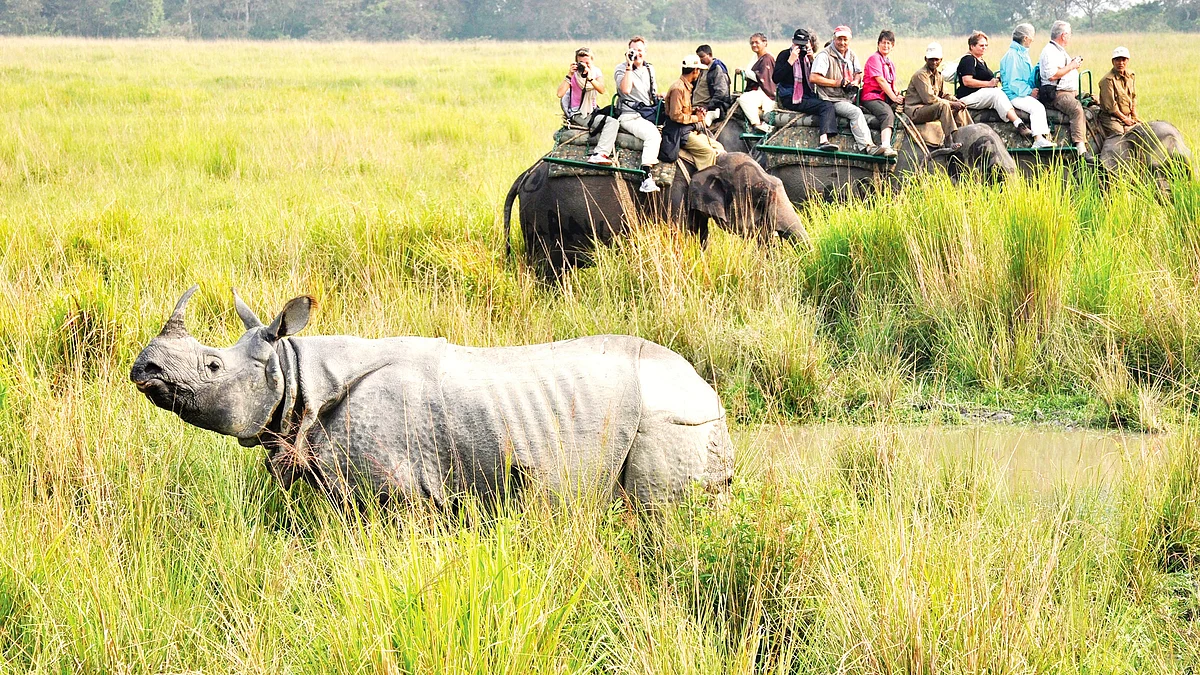


Our politicians have the most cannibalistic instincts when it comes to the acquisition of forest land. Why else would the Assam state government want to cut down the Eco-Sensitive Zone (ESZ) around the Kaziranga National Park & Tiger Reserve from ten kilometres to one kilometre?
Assam chief minister Himanta Biswa Sarma set the cat among the pigeons by announcing that they were just waiting for the final notification from the ministry of environment and forests (MoEF) before going ahead. Shrinking the buffer zone would lift restrictions on local infrastructure and civic projects, including a modern stadium in Bokakhat, a commercial tourism complex and other civic amenities.
Other plans are afoot: three five-star hotels, a convention centre and an elevated corridor. Land at Ingle Pathar in Kaziranga has already been given on a 99-year lease for a proposed luxury resort tied to Juniper Hotel, allegedly a subsidiary of the Hyatt group. The group is planning a 106-room luxury hotel on a 10 acre plot, to be operational by 2030.
Environmentalists warn that Ingle Pathar is home to nearly 300 elephants. Construction and increased human presence will precipitate animal-human conflict and destroy one of the last inviolate homes for wild elephants in the country.
Over the last three decades, the 1,000 sq. km. park has held out as one of the few remaining citadels of wildlife, where a dedicated team of foresters helped revive endangered species, especially the one-horned rhino. (Kaziranga is home to two-thirds of the world’s one-horned rhino population.) Between 1 April 2025 and 28 May 2026, it attracted a record 5.5 lakh tourists. Declared a UNESCO World Heritage Site in 1985, it became a tiger reserve in 2006, with 148 tigers to begin with.
While the state government maintains that no formal request has yet been made to the ministry, the Supreme Court had already muddied the waters. In its 2023 ruling, it stated that mandatory ESZs should be site-specific, determined by topography, local conditions and wildlife behaviour. This meant even one kilometre of protection was no longer a given.
As a result, several states reduced or dispensed with buffer zones. A preliminary analysis of 109 national parks and sanctuaries by the Vidhi Centre for Legal Policy found that 60 national parks had done away with ESZs completely. Animals are increasingly bottled inside demarcated spaces in parks and sanctuaries. Kaziranga seems to be headed in the same direction.
State governments have justified shrinking or eliminating ESZs on the grounds that it helps improve basic infrastructure and day-to-day activities for villagers living in peripheral areas. For the people on the periphery of Kaziranga, it’s another story.
Forty-five Adivasi families at Ingle Pathar claim their agricultural and grazing land has been forcibly acquired. Other evictees say they were paying land tax until revenue officials stopped collections in 2022. Some claim they were offered compensation of Rs 3 lakh per family, which they have so far refused.
Public opinion is divided. Some believe tourists will benefit the area financially. Many, particularly women who are beneficiaries of state welfare schemes, are favourably inclined towards the BJP government. Others are deeply apprehensive, despite possessing permanent ‘myadi patta' documents issued when their forefathers were brought in as indentured labourers by the British. Their livelihoods remain tied to the environment and they do not want it destroyed.
“Assam was once known as the ‘Country of Golden Gardens’,” a leading environmentalist told this reporter. (Garden being a euphemism not only for its tea gardens but also its subtropical forests and extraordinary wildlife.) “This push for development has placed an enormous strain on its natural resources and wildlife habitats. Earlier, vast tracts of the Dehing Patkai Elephant Reserve were broken up because of illegal coal mining and forest felling. The mining mafia has now moved to the hills of Karbi Anglong, which form a boundary to Kaziranga.”
Several locals believe mining is taking place surreptitiously along the nine vital elephant and tiger corridors leading out of the park. Recent media reports have pointed to the disappearance of the Parbari corridor, a critical wildlife passage connecting the park to the Karbi Anglong hills.
Mubina Akhtar, who heads the Kaziranga Wildlife Society, cannot make sense of the government’s plans. The Kaziranga Elevated Corridor Project, inaugurated by Prime Minister Modi on 18 January, involves the diversion of 20.4 hectares of forest land from the core zone of the tiger reserve and nearly 365 hectares from the existing ESZ. It also entails widening the highway that cuts through the park and constructing 21 km of greenfield bypasses around Jakhalabandha and Bokakhat.
“It beats me why the state government did not allot land for hotels in Bokakhat and Jakhalabandha, just 20-30 km from Kaziranga. The park is richly biodiverse. Increasing tourism while reducing its size is obviously going to affect animal life,” said Akhtar.
The ESZ is particularly important during the rainy season. During floods, when the Brahmaputra flows south of the park, animals move northwards into the buffer zone. The Dhalamara area of Karbi Anglong becomes their refuge. “This needs to be protected,” Akhtar added.
Kaziranga DFO Arun Vignesh defended the elevated corridor, arguing that it would reduce animal deaths from vehicle collisions. A Gauhati University study found that 6,036 animals were killed in just two years (2016-17).
“The number of animals killed by speeding vehicles has come down. Poaching, especially of rhinos, has also gone down with the setting up of 170 camps with armed forest guards in the park’s core areas,” said Vignesh.
A senior retired forester offers a sharply different assessment.
“Nothing is being done properly. Kaziranga is mainly a grassland. To maintain the grass, it has to be burnt every year. This is not being done properly and the grassland is shrinking. The entire focus is on building ‘infrastructure’ from which politicians can make money.”
The menace of illegal mining also continues. Conservationist and legal-rights activist Rohit Choudhury filed a petition in 2012 highlighting unregulated quarrying and mining in and around Kaziranga, listing 60 illegal stone quarries. In 2019, the Supreme Court banned mining along Kaziranga’s southern boundary and ordered that ‘no new construction shall be permitted on private lands which form part of the nine identified animal corridors in the park’.
In 2026, Choudhury petitioned the Supreme Court-appointed central empowered committee, claiming illegal construction was taking place in two wildlife corridors in violation of the 2019 order. Park authorities say the complaint is ‘under examination’.
“Mining has resumed on a large scale,” Choudhury told this reporter. “Media reports confirm wetlands are drying up and our forests, especially bamboo forests, are fast disappearing. Once the natural habitat of the animals is destroyed, what chance does Kaziranga have?”
Activists speaking out against the sell-out are being harassed and jailed. The arrest of outspoken activist Pranab Doley under the National Security Act created shock waves. More than 60 rights groups, trade unions and civil-society organisations called the move “vindictive and arbitrary” and demanded his release. Several international human-rights and indigenous-rights organisations have written an open letter (dated 18 August), demanding that no hotel project be pursued without the prior consent of indigenous communities living in the region.
The national park has survived poaching, floods, encroachment and mining. Can it now survive this latest threat of unregulated commercial urbanisation that risks destroying the very habitat that makes Kaziranga a shining jewel in India’s crown?