


The river we’re fighting over is no longer the same
The Cauvery basin is losing its ability to store water when it is available and endure scarcity when it is not
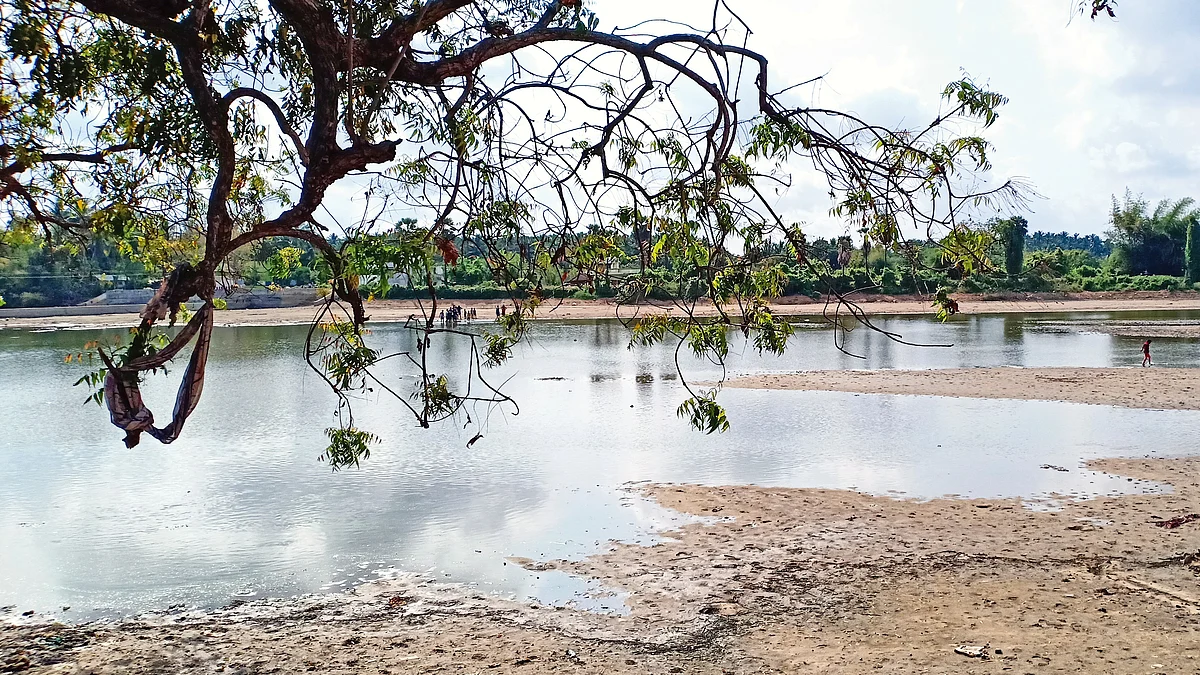


"The tragedy is not that we are fighting over the Cauvery. It is that the river we are fighting over is slowly disappearing."
In Ayappa’s acclaimed short film The Story of Kaveri, the river speaks as a living presence, reflecting on how those who depend on it have turned against one another. That imagined yet deeply resonant voice captures the paradox of one of India’s most contested rivers.
For decades, the Cauvery has been the site of court battles, tribunal awards, protests and political negotiations. Beneath these visible struggles lies a quieter crisis. The river itself is changing.
Nearly 800 kilometres long, the Cauvery supports more than 80 million people across Karnataka, Tamil Nadu, Kerala and Puducherry, draining a basin of over 81,000 sq km. For centuries, it enabled a highly organised irrigation system, particularly in the delta, where paddy cultivation flourished. That long history of stability is now under strain.
At first glance, the river does not appear broken. Each monsoon, reservoirs fill, canals reopen and water flows into fields. What this seasonal recovery conceals is the Cauvery’s increasing inability to convert rainfall into reliable flows.
Rainfall is not necessarily declining. Climate projections suggest that parts of peninsular India may receive stable or even slightly higher precipitation. Yet the river itself is expected to carry less water.
A basin-scale climate study by IIT Gandhinagar (published this year in Earth’s Future) used CMIP6 climate models to show that effective water availability in the Cauvery basin will continue to decline until at least 2050, beyond which recovery remains uncertain. The study estimates a further reduction of around 3.5 per cent in flows between 2026 and 2050. This may appear modest, but it follows a much larger historical decline: streamflow in the Cauvery dropped by nearly 28 per cent between 1951 and 2012.
Also Read: The irreversible course of damage
‘The Cauvery basin stands out as an exception,’ the study notes. ‘While several Indian rivers may see increased discharge, this basin shows a persistent decline due to rising evapotranspiration and altered rainfall patterns.’
Unlike Himalayan rivers, the Cauvery has no glacial buffer. It depends almost entirely on monsoon rainfall. That dependence is now becoming a vulnerability.
What is changing is not just how much rain falls, but how it behaves. Increasingly, rainfall arrives in short, intense bursts followed by prolonged dry spells. A study on precipitation trends by Tamil Nadu Agricultural University notes that ‘short-duration extreme rainfall events are increasing in frequency and intensity, leading to higher runoff and reduced infiltration.’
Rapid runoff reduces groundwater recharge, weakening the base flows that sustain rivers during dry periods. At the same time, rising temperatures increase evapotranspiration, meaning more water is lost to the atmosphere.
The result is hydrological decoupling. Rainfall no longer translates into river flow in a predictable manner. Reservoirs fill quickly during intense rainfall events but struggle to retain levels through extended dry periods. Farmers who once relied on predictable irrigation cycles now face uncertainty within a single season.
Human intervention has heightened this instability. The Cauvery is one of India’s most regulated rivers, with major dams such as Krishnaraja Sagar in Karnataka and Mettur in Tamil Nadu. Built to stabilise irrigation, these dams also altered the river’s natural rhythms.
Flood pulses that once replenished floodplains are curtailed. Sediment that sustained the delta is trapped upstream. Lean-season flows now depend on administrative decisions rather than ecological continuity. ‘The regulation of flows has reduced the river’s resilience,’ note basin-level assessments.
The consequences are most visible in the Cauvery delta. Spread across nearly 14.7 lakh hectares and contributing about 45 per cent of Tamil Nadu’s rice production, the delta has been the backbone of the state’s agrarian economy.
Also Read: The many meanings of rice
Today, reduced freshwater inflows, erratic rainfall and rising sea levels are reshaping the region. Salinity is pushing inland. Groundwater is turning brackish. Coastal erosion is increasing. Studies indicate that seawater intrusion has intensified as freshwater discharge weakens.
In parts of Thanjavur and Nagapattinam, cropping intensity has declined. Traditional kuruvai and samba cultivation cycles are becoming harder to sustain. Some farmers are shifting to pulses or aquaculture. Others are leaving the land fallow.
“We cannot plan anymore,” says K. Veerapandi, a farmer from Thiruvaiyaru. “Water may come, or it may not. Even if it comes, we don’t know when.”
Leaders of farmer organisations echo this uncertainty. P.R. Pandian of the Cauvery Delta Farmers Protection Association notes that unpredictable releases make cultivation increasingly risky. Activist Ayyakannu has pointed to rising distress, including debt and migration.
When the region was declared a Protected Special Agriculture Zone in 2020, farmer leader S. Ranganathan said, “This will help the delta survive for more than a thousand years.” Others weren’t so hopeful. “The Bill does not have the power to stop ongoing hydrocarbon projects,” says P. Maniarasan.
Even as the state seeks to protect agriculture, large-scale extractive projects continue to be planned. Proposals by ONGC and Vedanta include drilling hundreds of hydrocarbon wells across the delta. Farmers have resisted these projects, highlighting contamination and land degradation in places like Neduvasal and Kathiramangalam.
Environmental groups warn that petrochemical and refinery projects could further strain an already fragile ecosystem. Scientific studies have found heavy metals and chemical pollutants in parts of the Cauvery, including in sediments and fish.
‘The presence of heavy metals in fish indicates bioaccumulation in the food chain,’ notes a 2024 study by N.G. Nikita Gupta and S. Arunachalam, published in Frontiers in Public Health.
Contamination comes from industrial discharge, agricultural runoff and untreated sewage. Over time, pollutants accumulate, creating long-term reservoirs of toxicity. This introduces a second dimension of scarcity. Water may be available, but not usable.
Groundwater, once a fallback, is also under severe strain. Across the basin, extraction has exceeded recharge. Borewells are going deeper. In coastal areas, falling water tables are enabling seawater intrusion.
Assessments by the Central Ground Water Board, which classify several Cauvery basin blocks as over-exploited, along with IIT Gandhinagar projections that show declining runoff, suggest the basin is approaching a point where both surface and groundwater systems will be stressed simultaneously.
Urban demand has added to the pressure. Cities like Bengaluru depend heavily on Cauvery water, intensifying competition between urban and agricultural uses.
Meanwhile, political conflicts continue. The Cauvery dispute between Karnataka and Tamil Nadu has long centred on allocation. As availability declines, the focus is shifting from sharing to scarcity.
Frameworks designed for a more stable river are struggling to adapt to a new hydrological reality. Traditional water systems that once buffered variability are weakening. Tanks, canals and local storage structures have deteriorated. Urbanisation has reduced infiltration and increased runoff. The basin is losing its ability to store water when it is available and endure scarcity when it is not.
The Cauvery can no longer be considered a perennial river that guarantees stability. It is becoming a seasonal, heavily managed, increasingly unreliable system. For millions across the basin, this transition is already felt in the unpredictability of irrigation, the deepening of wells, the risks of cultivation and the shrinking margins of survival.
While we are still fighting over the same river, the river we are fighting over is no longer the same.
K.A. Shaji is a South India–based journalist who has chronicled rural distress, caste and tribal realities, environmental struggles and development fault lines. More of his writing here
Join our official telegram channel (@nationalherald) and stay updated with the latest headlines