


Staying alive with dark humour and ‘AQI Porn’
AQI has now begun to function like a new dopamine hit. We obsess over toxic air as if listing the symptoms will keep them at bay
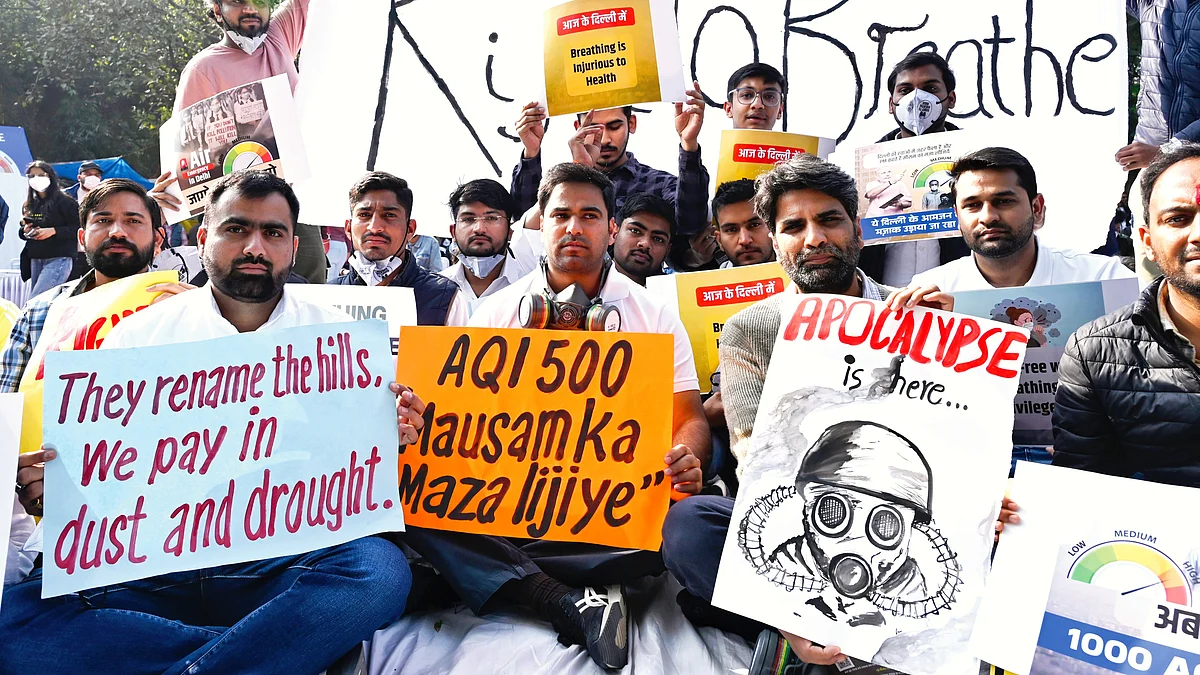


It’s become an annual ritual. The moment winter sets in, Delhi plunges into AQI panic. Newsrooms, TV panels and social media timelines spew warnings about the city’s toxic air. A fresh batch of ‘new’ solutions are aired — some long past their expiry date, others so fantastical they seem like they’re from another planet.
Everyone knows the truth: none of this will fix the air that Delhiites are condemned to breathe. In fact, can it be called air at all? ‘We’re not breathing air anymore,’ a netizen posted on X, ‘We’re inhaling death every day.’
To grasp how grave the crisis has become, it helps to listen to Dr Randeep Guleria, former director of AIIMS and head of pulmonology, before that. He draws a chilling parallel: Delhi’s pollution is now killing more people than Covid-19. Even the Supreme Court harked back to the pandemic era, asking why Delhi saw blue skies then, despite stubble-burning.
One answer was the lockdown. While the Covid lockdown was excessive, experts are suggesting the current pollution crisis might just require such an extreme measure. The analogy reveals an uncomfortable truth: the problem is too immense for half-measures.
Very few people believe that governments — state or central — have what it takes to clean up the air. Today, we clutch at straws, hoping that relief from Delhi’s pollution will come from the Supreme Court. It was way back in 1987 that environmental lawyer M.C. Mehta first approached the court over Delhi’s deteriorating air quality. Since then, countless petitions have been heard and numerous orders issued. Yet, pollution levels have only climbed — from ‘worrying’ to ‘deadly’.
For nearly 38 years, different aspects of Delhi’s pollution crisis have repeatedly come before the Supreme Court — with the same outcome: zilch. The one intervention that did make a noticeable difference dates back to 1998, when the Supreme Court ordered the complete conversion of Delhi’s diesel-run public transport to CNG.
At the time, the idea of shifting the entire fleet of buses, taxis and auto-rickshaws to CNG seemed wildly unrealistic. No major city in the world had attempted such a transition. Predictably, the decision triggered protests, strikes and fierce resistance. But the court held firm. Once completed, the task paid off: the improvement in Delhi’s air quality was unmistakable.
Former East Delhi MP Sandeep Dixit argues that only such bold decisions can deliver real results. But they demand strong political will — something he believes is missing today, with the BJP (mis)governing both the Centre and all of Delhi’s neighbouring states.
Truth is, the scale of intervention required today is far greater than anything attempted in the past. Most of the government’s current measures — like the Graded Response Action Plan (GRAP) — feel more like tired bureaucratic routines than real solutions and their impact has never been convincingly demonstrated.
The Kejriwal government’s odd-even scheme, introduced with much fanfare, failed to make any real difference. The idea of cloud seeding to trigger artificial rain and wash away our pollution woes was another ill-conceived band-aid on a festering sore of a problem. Rekha Gupta’s government floated the same proposal.
An RTI by activist Ajoy Bose revealed that the Delhi government paid Rs 38 lakh to IIT, Kanpur, to produce artificial rain via cloud seeding. Forget pollution-clearing showers — Delhi did not receive even a drizzle.
The list of such failed experiments is long — anti-smog towers, anti-smog guns, water sprinklers, bio-decomposers — each the equivalent of using a newspaper to dodge a bullet. What the government has been surprisingly efficient at, though, is tweaking, hiding and downplaying AQI data. (Social media was awash with one such ‘innovative solution’ — videos of water trucks spraying AQI monitoring stations to lower AQI readings!)
Targets have regularly been missed. In 2019, the National Clean Air Programme set an ambitious goal of reducing Delhi’s PM2.5 levels by 20–30 per cent by 2024. One year past that deadline, PM2.5 levels have instead surged dramatically to ‘severe’.
While governments have failed quite spectacularly to deliver clean air to the National Capital Region — society has not done much better. Carpooling, a practice adopted in many global cities, has never appealed to Delhi’s car-owning elite. Even small contributions to reducing traffic and emissions like the share-a-cab options offered by Uber and Ola have now been discontinued altogether.
India has become a society where private fixes are expected to compensate for public failures. When government hospitals falter, people turn to private healthcare. When the state school system disappoints, parents opt for private education. When clean drinking water is unreliable, households instal RO systems. So naturally, when the air turns toxic, people buy air purifiers — that is, those who can afford them.
Clean air is now a luxury, a consumer product available only to those with the means to buy it. For everyone else, the conversation about the basic human ‘right to clean air’ has all but vanished.
Air purifiers have become a middle-class staple — installed in living rooms, bedrooms, offices, even cars. Words like ‘HEPA filter’ have entered our everyday vocabulary.
When records from Delhi’s Public Works Department (PWD) showed that the government had quietly ordered 15 ‘smart air purifiers’ for its own offices in October — at a cost of Rs 5.5 lakh — the public was not amused. Media images of Prime Minister Narendra Modi and Delhi chief minister Rekha Gupta meeting visitors in their air-purified offices were decried.
Yet even the privileged cannot fully escape. No matter how many purifiers one instals, stepping outdoors means confronting the same hazardous AQI that lesser mortals must. One can limit outdoor time, but there’s no way to escape the air that surrounds us all.
AQI has now begun to function like a strange new dopamine hit. We obsess over it, reciting the dangers of toxic air as if listing symptoms could somehow keep them at bay. Memes and jokes circulate on WhatsApp, as though laughter might cleanse our lungs.
It’s the first thing we check when we get up. Every evening, we compare AQI charts the way people once compared cricket scores. This poisonous air has not just created an entire genre of ‘AQI porn’, it has transformed our fantasies. We no longer fantasise about distant beaches — we yearn for just about any place where the air is breathable.
We cannot stop the toxic particles from entering our bodies with every breath, so we try to steal tiny moments of relief from the very crisis that consumes us. Since we cannot escape it, we seek comfort in complaining about it.
Join our official telegram channel (@nationalherald) and stay updated with the latest headlines